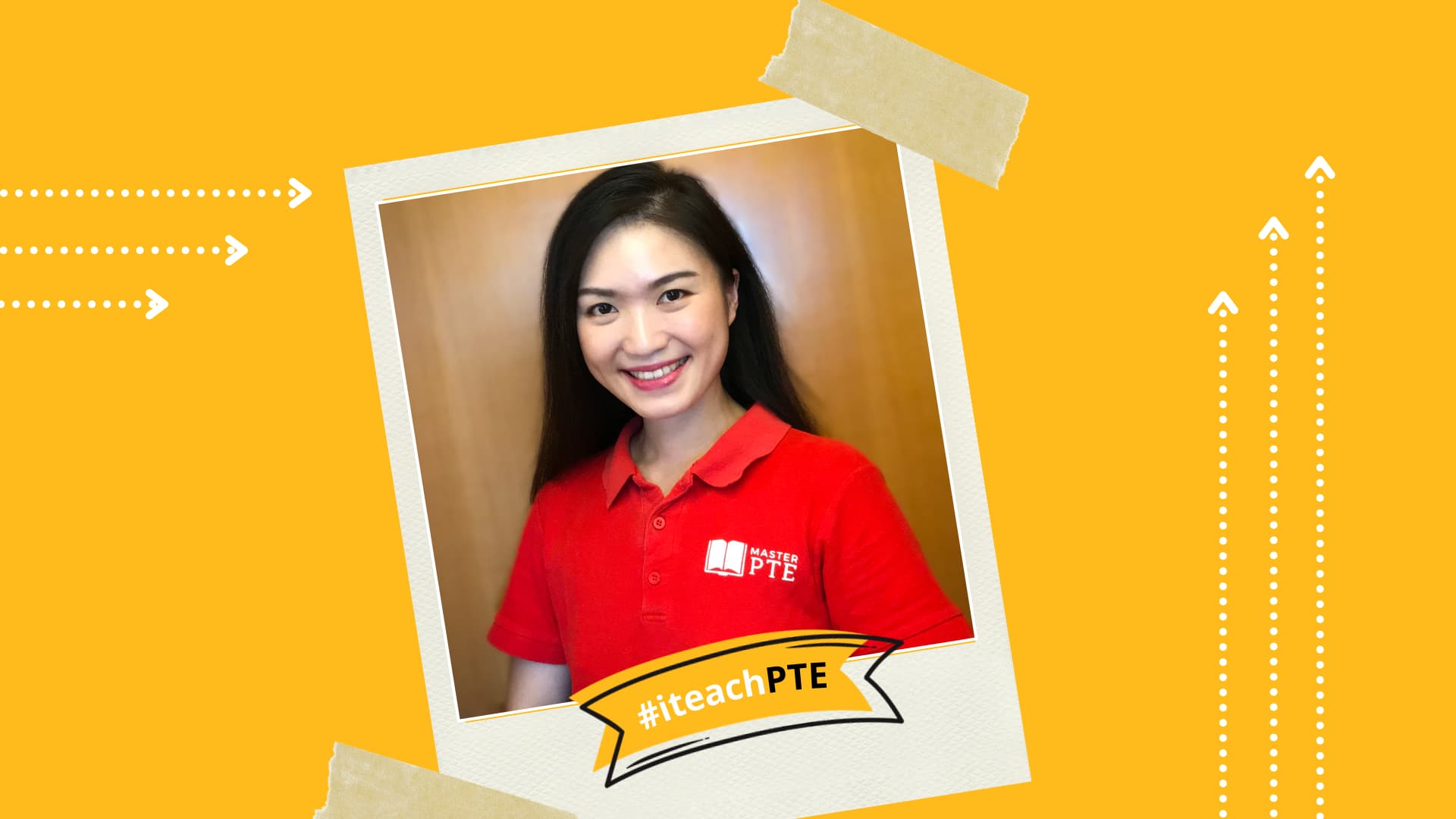
Teacher profile: Sharing the learning journey with PTE teacher Kelly Hoo

PTE Author
PTE Author
Image - Kelly Hoo #iteachPTE
Reading time: 6 minutes

Kelly Hoo is an English teacher based in Malaysia. She works with people from all over the world, helping them to prepare for PTE. But when Kelly first began learning English, she found it really difficult. She certainly never dreamed that one day she would be teaching English and running her own company!  

From student to teacher  

So how did Kelly go from learning English, to teaching other people how to get the score they need in PTE?  

Kelly’s first language was Mandarin, and she struggled a lot when first learning English. “I started my journey with IELTS,” she explains, “and then I discovered PTE.”  

Kelly was learning English in order to attend the University of Melbourne, where she studied for a Bachelor of Commerce. “I always thought I’d be an accountant,” she laughs. “But it wasn’t meant to be!”  

After graduating, Kelly went to work for Unilever, a big multinational corporation. But she found herself giving advice to people learning English, and being able to help people on their language-learning journey was really rewarding.  

“It started with sharing tips with other people who were learning English,” she says. “I’d been through the journey, so when I saw people struggling, I would always give them recommendations and advice.”  

Starting her own company 

From those small beginnings, Kelly went on to become a full-time teacher. The next step was starting her own English teaching company, Master PTE, where she is able to combine her passion for teaching with the expertise she gained in her business degree.   

But Kelly credits her success to the people around her. “It’s not just my own hard work,” she says. “Our team at Master PTE is amazing. My colleagues work so hard and do such a good job. Without them, I wouldn't be here, sharing my experience.”  

The company is now four years old, and in that time Kelly and her colleagues have helped lots of students build their English skills, prepare to sit PTE, and get the score they need.  

Helping students set manageable goals  

The team at Master PTE teaches students of all ages and levels, from all over the world, in a mix of online and in-person classes.  

“Thanks to Covid, we’re now doing hybrid classes,” explains Kelly, “a mix of online and face to face. Our clients are mainly working adults or students, so they’re very busy, and they need that flexibility.”  

At Master PTE, Kelly and her colleagues help students to break the big goal of getting the PTE score they need into smaller, more manageable goals.  

“We don’t ask them to do ten exam tasks in a day, because it’s impossible,” says Kelly. “We focus on what’s doable - a little bit of preparation each day, to make it easier for our students and give them a feeling of achievement, and the satisfaction that comes from that.”  

The skill that Kelly’s students struggle with the most is speaking. It’s a cultural problem, Kelly says, as in Malaysia, people are worried about making mistakes. “We want to boost their confidence and tell them to express themselves. I always tell students, Don’t be afraid to make a mistake. Just say what’s on your mind - it’s ok, we don’t judge people at Master PTE!”  

Speaking to a computer can also be a challenge for some students, but for others, a computer-based exam like PTE helps with their confidence. They prefer to speak to a computer rather than a human examiner.  

Kelly’s students are her inspiration  

One of the things Kelly loves about her job is meeting people from all over the world. “We have students from Japan, from Botswana, from India. It's amazing to connect with people and learn about their culture, their stories. The learning is definitely a two-way street in our classes!” she laughs.  

One of Kelly’s most inspirational students was from India. He was planning to sit PTE in order to move to Australia with his wife and young children. “When I first spoke to him, his English was at a really low level,” she explains. “I thought he would need a lot of preparation.”  

He started studying with Kelly, preparing for the test, and working hard every evening. “He was really burning the midnight oil,” she says, “as he was working full time too. He put in so much hard work, but he was doing it for his family, for his kids’ future, to give them a better life. I really admired his spirit - and I was so happy in the end when he got the score he needed after just two months of studying!”  

The importance of perspective 

Kelly has one piece of advice for other PTE teachers: always try to think from the students perspective.  

“Teaching English is easy for us,” she says. “We use English everyday. That’s why it’s so important to put yourself in your student’s shoes. Make sure they can absorb and retain the information you are teaching them.”  

From time to time, Kelly studies a new language like German, or Japanese, just to remind herself what it’s like to learn a new language.  

“I understand where the students are coming from,” she says. “I’ve been a learner too, and learning English as a second language isn’t easy.”  

That’s why Kelly is so focused on understanding each student’s situation, and making things a little easier for them by supporting them and creating a community that they are part of.  

“I always tell them, Don’t give up!” she says. “Learning can be fun and interesting.”  

Learn more 

For more insights into PTE preparation, have a look at the PTE blog, where you’ll find inspiration, advice, and lots of useful resources such as free lesson plans and preparation tools. And if you’d like to be featured on our PTE teacher profile series, just fill out this form!

Related Content

  • Mastering the ‘summarize group discussion’ task for PTE Academic success
    By PTE Author

    The Summarize Group Discussion task is one of the most comprehensive speaking challenges in PTE Academic. It tests your ability to listen actively, take effective notes, and deliver a coherent summary that captures multiple perspectives.

    Understanding how to approach this task strategically can significantly boost your speaking score.

  • Mastering PTE Academic: A guide to the "Respond to a Situation" task
    By PTE Author

    The "Respond to a Situation" task in the Speaking section of PTE Academic tests your ability to handle real-world university scenarios using appropriate language. This task simulates everyday campus interactions, requiring you to respond naturally and effectively to common situations you might encounter as a student.

  • [asset] Understanding your English proficiency - woman studying on laptop
    Understanding your English proficiency
    By PTE Author
    Reading time: 5 minutes

    Knowing your English level helps you pick the right course, get visas, and make strong applications for work or school. In short: proficiency levels are standard descriptions of what you can do in reading, listening, speaking, and writing.

    You can check your level with trusted online tests or official exams like PTE Academic or PTE Core, which give scores based on global standards. Below, we explain how levels are defined, how they’re tested, how to estimate your current ability, and what different goals usually need, so you can plan your next step with confidence.

    What are English proficiency levels?

    Language proficiency levels show how well you can read, listen, speak, and write. These levels follow shared standards so schools, employers, and governments around the world can easily understand your skills.

    The most common system is the Common European Framework of Reference for Languages (CEFR), which rates language ability from beginner (A1) to highly advanced (C2). A recent overview explains CEFR’s role as a standard for designing tests and interpreting scores across countries and programs and notes ongoing efforts to keep it up to date for modern assessments.

    Pearson’s Global Scale of English (GSE) provides a more granular 10–90 scale that also aligns to CEFR tiers. This makes it easier to see fine-grained progress and map scores to CEFR bands.

    Typical CEFR levels at a glance:

    • A1: Understand and use everyday expressions; introduce yourself; ask and answer simple questions

    • A2: Handle routine tasks; describe immediate needs and simple aspects of daily life

    • B1: Understand main points of clear standard input; produce simple connected text; manage travel or work situations

    • B2: Interact with fluency on familiar topics; write clear, detailed text; follow lectures with some support

    • C1: Use English flexibly and effectively in academic and professional contexts; understand demanding texts

    • C2: Understand virtually everything heard or read; summarize information coherently; express nuanced ideas precisely

    Common uses:

    • A1-A2: Mainly used for basic immigration visas, family reunification, entry-level work or training programs, and integration courses where simple everyday communication is sufficient.

    • B1–B2: Many vocational programs, initial professional roles, and some visa pathways

    • B2–C1: Most undergraduate admissions and professional certifications

    • C1–C2: Postgraduate study, specialized professions, and roles requiring complex communication

    How English proficiency levels are measured

    Proficiency is measured across four core skills:

    • Reading:Understanding texts, identifying main ideas and details, and interpreting vocabulary in context

    • Listening : Following speech at natural speed, recognizing key information, and inferring meaning

    • Speaking: Producing clear, organized speech; using accurate grammar, vocabulary, and pronunciation

    • Writing: Composing well-structured texts suited to purpose and audience; demonstrating control of grammar and cohesion

    The scoring for most English language tests is measured against the CEFR. For The scores for PTE Academic (for studying and work) and PTE Core (for general use and migration), align to CEFR with scoring between 10 and 90. Learn more about PTE scoring alignment.

    How to assess your current English language ability

    Build a reliable picture by mixing official tests with quick checks and reflective habits:

    • Take a recognized practice test: Use an official Pearson PTE Scored Practice materials Test

      or other reputable online assessments to estimate your CEFR level and identify strengths and gaps

    • Practice with PTE-style items: Work through sample reading tasks (e.g., fill-in-the-blanks), listening summaries, and short spoken responses to simulate real test conditions.

    • Use self-analysis prompts that match the CEFR level you are aiming for: For example, ask, “Can I follow a university lecture?”, “Can I write a formal email with clear structure?”, “Can I explain a process or opinion for 60–90 seconds?”

    What English proficiency level do you need for visa applications?

    Requirements vary, but many universities, colleges, professional bodies, and visa authorities set minimum thresholds around B1–C1, or the equivalent GSE score range of 43-84 for PTE Academic and PTE Core. . Some UK family and settlement visas require A1 or A2 level. Always confirm details with the program or government authority.

    Typical requirement ranges (illustrative):

    • University / College admission:

      • Undergraduate: Often B2; competitive programs may prefer C1

      • Postgraduate: Commonly C1

    • Professional certification:

      • General professional registration: Frequently B2–C1

    • Visa/migration pathways:

      • Skilled migration: Typically B1–B2+ equivalents; some routes require higher levels depending on occupation

      • Family visas: Often A1-A2.

    For Canadian migration scenarios, explore PTE Core requirements and pathways here.

    For UK migration, consider PTE UK visa SELT tests.

    The role English proficiency in career and certification

    For many learners, English isn't just the goal; it’s the way to get degrees, licenses, and international jobs. Universities and employers look at test scores to decide who to admit or hire. Once students are in university or at work, success depends on great communication (reading, listening, speaking, and writing) skills, whether it's doing research or talking to clients.

    Research indicates that higher English proficiency supports academic performance and integration for international students, improving classroom participation and social engagement. In the workplace, clear communication underpins teamwork, safety, and advancement, making ongoing skill development a career investment, not just a test goal.

    Practical tips for improving your English proficiency

    Target all four skills with short, consistent practice:

    • Daily core routine (20–40 minutes):

      • Listening: Listen to 2–3 minutes of a podcast or lecture; note new phrases

      • Speaking: Answer one daily Q&A aloud (60–90 seconds) on familiar topics

      • Reading: Skim a news article; summarize the main idea in two sentences

      • Writing: Draft a short email or 120–150 word paragraph; focus on structure and linking words

    • Quick wins:

      • Grammar and vocabulary: Do 10 fill-in-the-blank or sentence completion items; build a personal word bank with examples

      • Reading for context: Underline signal words (however, therefore) and infer meaning of three unknown words from context

      • Listening focus: Practice identifying the overarching meaning first, then the key details and numbers

      • Feedback loop: Swap writing with a friend or use self-scoring checklists; act on one improvement point per day

    To prepare for your English exam, practice with practice tests that are similar to your actual test and check the scoring guidelines to make sure your answers meet the expectations. If you aren't sure where to start take our 'Which test is right for me?' tool. You can also read our article 'How to pick an English test that works for you'.

    Frequently asked questions
    What daily conversation questions help build speaking confidence?

    Practice short answers to everyday prompts like “What did you do today?” and “What do you like to eat?” to build fluency and reduce hesitation.

    How do I check understanding during English conversations?

    Use clarifiers such as “Could you repeat that more slowly?” or “Do you mean…?” to confirm meaning and keep the conversation clear.

    What types of excercises improve grammar and voacbulary?

    Do fill-in-the-blanks, sentence completion, and synonym/antonym matching to reinforce patterns and expand word choice.

    How should I prepare for English proficiency test formats?

    Study common task types (reading comprehension, short writing, gap-fill, brief speaking responses) and practice them under timed conditions to build accuracy and pacing. You can also try practice tests to get used to the format of a specific test, like PTE.