English language tests required for work visas

Reading time: 6 minutes

Many countries require applicants to prove their English language ability when applying for work visas or skilled migration routes, with requirements varying by country, visa type and immigration authority.

This guide explains how English language requirements work for work visas and skilled migration pathways, which tests are commonly accepted, and what to consider before booking a test.

English tests for work visas by country*

Country

Test

Immigration authority

UK Work visa PTE Academic UKVI, IELTS for UKVI, SELTs  UK Home Office (through UK Visas and Immigration, UKVI) 
Canada work permit  PTE Core, IELTS General Training, CELPIP  Immigration, Refugees and Citizenship Canada (IRCC) 
Australia work visas  PTE Academic, TOEFL iBT  Department of Home Affairs (DHA) 
New Zealand work visa PTE Academic, TOEFL iBT  Immigration New Zealand (INZ) 

*Note: English language requirements, approved tests and minimum scores can change. Always check official immigration guidance before booking a test or submitting a visa application.

English proficiency levels for work visas

Many countries use recognized language frameworks to define English proficiency levels.

These include:

  • CEFR (Common European Framework of References for Languages)
  • CLB (Canadian Language Benchmark)
  • Country-specific immigration English categories, such as Australia’s Competent, Proficient, and Superior English level

Some English test providers use their own scoring systems designed to easily align with these frameworks. 

For example, PTE reports scores and results using Pearson’s Global Scale of English (GSE), an english proficiency scale designed to measure language ability across speaking, listening, reading, and writing. The GSE is aligned to CEFR levels and can also be used to compare scores across systems used in immigration and education pathways, including CLB in Canada.

Learn more about Pearson's Global Scale of English (GSE)

Work visa English requirements by country

Although English proficiency requirements follow similar principles, each country defines its own approved English tests and minimum score requirements for work-related visa applications.

United Kingdom

Many UK work visas require applicants to prove their English proficiency through a UKVI-approved Secure English Language Test (SELT) at an authorized test center 

Commonly accepted tests include:

To learn more about which English test is right for your UK work visa, see our guide to PTE in the UK.

Australia 

Australia sets English language requirements by visa stream and occupation. Accepted tests and minimum scores are defined by the Department of Home Affairs English requirements vary depending on the visa subclass, occupation and whether the pathway is points-tested.

Some visa pathways require applicants to meet minimum scores in each communication skill rather than only an overall score. Additionally, some regulated professions (such as healthcare) may require higher English standards through professional registration bodies such as AHPRA.

For Australia-specific score requirements by visa subclass, see PTE for Australian visas.

Canada

Canada uses the Canadian Language Benchmark (CLB) system to assess language proficiency across work permits and economic migration pathways, including Express Entry programs.

Applicants must take approved language tests and achieve scores that correspond to the required CLB level.

Accepted English tests for Canadian work and economic migration pathways may include:

  • PTE Core
  • IELTS General Training 
  • CELPIP-General 

CLB conversion is assessed skill by skill rather than through an overall average score.

Different pathways require different CLB levels depending on the programme, occupation and Comprehensive Ranking System (CRS) scoring requirements.

Read more: English language requirements for Canadian work permits and immigration pathways

New Zealand

New Zealand work visa English requirements vary depending on the visa pathway, occupation and ANZSCO skill classification.

Work visas such as the Accredited Employer Work Visa (AEWV) may require applicants to demonstrate English proficiency depending on the role and visa conditions. Accepted evidence and score thresholds are published by 

Learn more: English language requirements for New Zealand Visas (PTE resource)


What to check before booking an English test for your work visa

Before booking an English language test for your work visa application, confirm:

  • which tests are accepted for your visa route and destination country
  • whether the test must be taken at an approved test centre
  • the minimum scores required for each communication skill for your specific application
  • how long results remain valid
  • whether your profession has additional English language requirements

Countries often require specific versions of a test. For example:

  • UK work visa routes may require a Secure English Language Test (SELT)
  • Canada generally accepts PTE Core rather than PTE Academic for economic immigration pathways
  • healthcare professions may require additional English testing or credentialing processes

You should also consider test format, result turnaround times, test availability, scheduling flexibility, and other practical factors when choosing an English language tests for your work visa.

Related Content

  • Higher-Education-Students-in-the-UK
    New DHA visa requirements for PTE Academic
    By PTE Author
    Reading time: 5 minutes

    The Australian Department for Home Affairs (DHA) recently updated their score requirements for all accepted tests of language proficiency. The new score requirements take effect from 7 August 2025.

    What are the new score requirements? 

    From 7 August, anyone who takes the test for DHA visa purposes will need to meet updated score requirements.

    The table below shows the old and new score requirements for each score.

    We have also created a more accessible version of this table at the end of this article.

  • PTE changes 2025: everything you need to know
    By PTE Author

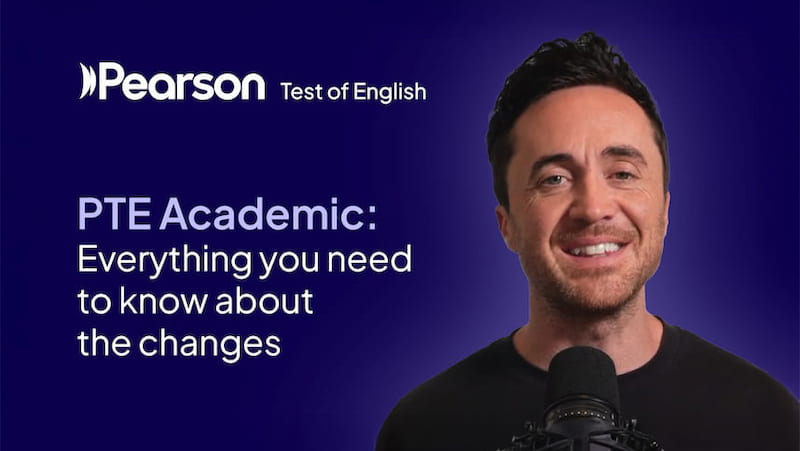
    We’ve made a few updates to the PTE Academic and PTE Academic UKVI tests. To make sure you’ve got the facts, we’ve created a short video that walks you through everything you need to know.

    Hosted by Jarrad, one of our product managers, this video covers what’s being updated, what’s staying the same, and how it all benefits you as a test taker.

    What’s covered in the video? 

    • The original 20 question types are still in the test.

    • We are adding two new speaking question types to give you even more chance to demonstrate your skills.  

    • Tips on how to prepare for the new speaking question types.

    • There are no changes to pricing, ID requirements, or score delivery time.

    • There are no changes to the way the test is taken (including the Speaking section).

  • [Asset] On test day during the test - 800 x 451 - for article use
    Busting the myths about English test centers
    By PTE Author
    Reading time: 5 mins

    By: Dan Doyle, Vice President, Assessments & Certifications, Pearson English Language Learning

    Every day, English tests help decide whether someone can start a new life abroad.

    For those taking a language test as part of a visa or migration process, the stakes couldn’t be higher. These are moments that decide futures, whether it’s studying at university, reuniting with family, or landing a first job overseas. That’s why, for tests like PTE Academic and PTE Core, test centers offer a secure, accurate, and trusted experience that governments can rely upon.

    But a few myths still persist, so let’s set the record straight.

    Myth one: “Test centers aren’t that secure”

    Reality: a test center environment provides security that starts before the test begins:

    • Biometric ID checks. Every test taker must show valid ID (like a passport) and confirm their identity with photos, palm-vein scans, and digital signatures.

    • Physical security checks. Trained staff check clothing and personal items before entry, stopping hidden notes or unauthorised materials from getting in.

    Once the test has begun, test centers combine secure-by-design exams with digital and human supervision to create a secure, fair environment:

    • Unique exams. Every PTE test is different. No two test takers get the same questions, and proctors can’t access the content.

    • Secure systems. The test runs on software and hardware fully controlled by Pearson, so it can’t be tampered with.

    • Multiple cameras, full visibility. Test centers use wide-angle CCTV to monitor the entire room.

    • Proctors in the room. Trained staff can spot hidden notes, off-screen help, and respond to anything suspicious straight away.

    Myth two: “Test centers rely on human proctors”

    Reality: human proctors play a key role, but they’re just one piece of what makes test centers secure.

    Test centers provide multiple types of security and supervision, all managed by the testing body — not the student — making them the most secure testing environment.

    As well as cameras, test centers can provide identity verification, physical checks, and in-person supervision needed for a high-stakes test.

    This real-time, multi-layered monitoring means if anything suspicious is flagged, a full investigation can be carried out centrally by Pearson, using CCTV footage, audio, AI checks, and human review.

    Myth three: “Test centers can’t detect cheating afterwards”

    Reality: Pearson carefully analyses every single test result using a combination of AI and trained human experts.

    After the test is completed, it goes through fraud analytics to identify unusual patterns or behaviours. If anything looks suspicious, the result is placed on hold and reviewed in detail by our security experts before it’s released.

    A quick summary: how test centers support high-stakes English testing

    • Biometric checks to confirm identity

    • Physical security checks to ensure no materials enter the test

    • Randomised computer-based test content for every candidate

    • Multiple cameras and full-room visibility

    • Real-time supervision by trained staff

    • AI and human experts working together to spot unusual patterns

    • A consistent environment and equipment for all test takers

    These measures make sure that every candidate has the same opportunity to succeed, and every institution can rely on the result. Behind every test is someone with a dream of a new life abroad, and PTE has the great privilege of helping them get there.

    Want to know more?

    Take a look at our latest PTE security whitepaper.