PTE inspiration and advice

Explore our latest articles, guidance and advice to support your test journey

  • Woman sitting in a classroom at a desk, holding a pen and looking up.

    Introducing Smart Prep: the new way to prep like a pro for PTE

    By PTE Author

    Are you gearing up to take an English language test, and feeling a bit overwhelmed? You’re not alone – many test takers share the same initial anxieties. But don’t worry, we are here to help!

    We’ve now launched Smart Prep, so that you can be test ready with one less worry. Smart Prep is a one-stop preparation portal to get you test ready for PTE Academic, PTE Core and PTE Home tests.

    It’s based on feedback from real test takers — we recently conducted a survey of 243 students preparing for PTE and learned:

    • 82% wanted to prepare skill-by-skill. For example, they might want to focus on speaking first, then writing, reading, and listening

    • Many expressed a need for free preparation resources, especially at the beginning of their journey

    • 82% preferred having all preparation materials in one place, organized logically in a step-by-step manner

    Why Smart Prep?

    • Smart Prep combines all our practice materials in one place, so it's easier for you to stay on track

    • It’s a clear path to test day, guiding you through the official paid and free resources available for your test

    • It can be accessed whether you’ve booked a test or not – just create, or sign in to your myPTE account

    • Preparation materials include guided practice tests, introductory videos, video courses and test tips. Note: the available resources depend on your chosen PTE test, please check Smart Prep in myPTE or visit the test preparation page for more details.

    Ready to get started?

    Create or sign in to your myPTE account

  • Image- study group 800px

    Part 1: English Speaking & Writing Test Introduction

    By PTE Author
    Reading time: 5 minutes

    Part 1 of PTE Academic will take 77-93 minutes and will test your speaking and writing skills.

    To test speaking skills, you will be assessed on your ability to produce spoken English in an academic environment.

    Your writing skills will be assessed by giving written responses in academic English using correct grammar, spelling, and structure.

    Personal Introduction

    First, you will be asked to give a personal introduction to give some information about yourself.

    You will have 25 seconds to read the prompt and prepare your response. You will only have 30 seconds to record a response and can only record this once.

    Don’t worry, your personal introduction is not scored but will be sent together with your score report to the institutions selected by you.

    For the speaking and writing test, there are seven types of questions that you will be scored on. Below, we will break down each part of this section of the test.

    Read Aloud

    The first question type to test your reading and speaking skills will be the Read Aloud assessment. In this test there are 6-7 questions.

    You will be shown a text prompt that will be up to 60 words. You will have 30-40 seconds to prepare by reading the passage. You will also have a set time to read aloud, which will vary by item, depending on the length of the text.

    To complete the question, speak clearly and straight away after you hear a tone. You must finish speaking before the progress bar on the screen reaches the end.

    You can receive a maximum of 3 points for the content spoken, a maximum of 5 points for oral fluency, and a maximum of 5 points for pronunciation.

    Repeat Sentence

    The second question type is Repeat Sentence, which will test listening and speaking skills.

    You will listen to a recording between 3-9 seconds and are given 15 seconds to answer.

    Once the microphone shows as recording, you will need to speak straight away and say all the words that the speaker uses, in the same order.

    For this question, you can receive a maximum score of 3 for content, a maximum 5 for oral fluency, and a maximum of 5 points for pronunciation.

    Describe Image

    The third question type will test speaking skills by describing an image. There are 6-7 questions.

    You will be shown an image and have 25 seconds to study the image and prepare your response. For this task, use the Erasable Noteboard Booklet to take short notes.

    After a short tone is heard, start speaking straight away. You will have 40 seconds to answer and must finish speaking before the progress bar reaches the end.

    In this question type, you can receive a maximum of 5 points for content, a maximum of 5 points for oral fluency, and a maximum of 5 points for pronunciation.

    Re-tell Lecture

    The fourth question type, Re-tell Lecture, will test your listening and speaking skills. There are 3-4 questions in this test.

    You will be given a prompt of up to 90 seconds and will have 40 seconds to answer.

    Audio will be played straight away and you may also see an image related to the audio. While you are listening use the Erasable Noteboard Booklet to take short notes.

    Once the audio finishes you have 10 seconds to prepare. To complete the task, in detail, you will need to cover the situation, characters, aspects, actions, and developments given in the recording.

    You can receive a maximum score of 5 points on content, a maximum of 5 points on your oral fluency, and a maximum of 5 points for pronunciation.

    Answer Short Question

    The fifth question type, Answer Short Question, will assess listening and speaking skills. There are 10-12 questions in this test.

    Here, you will be given a prompt of 3-9 seconds and will have 10 seconds to answer the question.

    You will be required to answer a short question with a clear, simple, single word or a few words. This will not test general knowledge, it will simply test your vocabulary.

    You will receive 1 point per correct word. No points are given for no response or incorrect response.

    Summarize Written Text

    In the first question type in the writing section, you will be required to Summarize Written Text, which will test reading and writing skills.

    You will read a text of up to 300 words and have 10 minutes to write your summary. You will do 2-3 of these questions depending on the combination of tasks in the given test.

    In this assessment, you must write just one sentence. Try using the Erasable Noteboard Booklet to take notes of the main points.

    Make sure to include the main points of the text in a full, single sentence of no more than 75 words.

    You can receive a maximum score of 2 points for content, maximum 1 point for the formal requirements, a maximum of 2 points for grammar and a maximum of 2 points for vocabulary.

    Essay

    The last question type of the Speaking and Writing Test will test writing skills.

    In this question type, you will be provided with 2-3 sentences of text prompt and have 20 minutes to answer, by writing a 200-300 word argumentative essay on a given topic.

    Time management is important for this task as you will need to plan, write and proofread your essay.

    In this question, there are many parts where you can receive points. You can receive a maximum of 3 points for the content, maximum of 2 points for the formal requirements and maximum 2 points for development, structure and coherence.

    You can also receive a maximum score of 2 points for grammar, maximum 2 points for general linguistic range, maximum 2 points for vocabulary range and a maximum of 2 points for no spelling errors.

    There is a total of 15 points that you can pick up in this question type.

    What's next?

    Read more about Part 2: Reading Test Introduction.

    Want more prep ideas?

    Plus, explore Smart Prep, which combines all our practice materials in one place, so it's easier for you to stay on track with your PTE preparation.

    • Smart Prep is a clear path to test day, guiding you through the official paid and free resources available for your test

    • It can be accessed whether you’ve booked a test or not – just create, or sign in to your myPTE account

    • Preparation materials include guided practice tests, introductory videos, video courses and test tips.

    Ready to get started?

  • Female-student-reading-and-studying-at-laptop-in-library 800px x 451px

    Listening: Core English skills part 2

    By PTE Author
    Reading time: 4 minutes

    During Part 3: Listening in PTE Academic, you will need to know pronunciation in order to understand what the speakers are saying.

    Pronunciation

    When completing PTE Academic, you will hear a variety of accents from both fluent English speakers and second language speakers, as you would in the real world. Don’t worry, the accents will be clear and regular users of English do not have trouble understanding them. To prepare you should choose texts from around the world and practice listening to a wide range of accents.

    The recordings in PTE Academic use authentic examples of speech, so there will be connected speech present. Connected speech includes: assimilation, elision, twinning, catenation, linking vowel sounds, intrusive sounds, the schwa /ə/, weak forms, and contractions. These words are not used in English when you pronounce each word separately. They are only used in connected speech.

    Assimilation

    In connected speech in English, the sound at the end of a word can change to sound the same as the beginning of the first word.

    Watch these videos from BBC Learning English to better understand assimilation:

    Elision

    Elision occurs when a sound is not pronounced at all by the speaker.

    For example, we say pos card, but we write postcard.

    This Pronunciation: The sound /s/ video shows how it works.

    Twinning

    When you finish a word with the same sound as the start of the next word, it’s called twinning.

    Watch the video below to learn more:

    Catenation

    Catenation is when one word ends in a consonant sound and the next one starts with a vowel and we say the two words as one.

    The below video will help you learn more about catenation:

    Linking vowel sounds

    When we speak, we use the /j/ (the first sound in yellow) and /w/ (the first sound in wet) to link words that end with a vowel to the next word that starts with a vowel.

    For example, we would say he yordered, but we write he ordered and you say go won, but write go on.

    To learn more about linking /j/ and linking /w/ you can view this video:

    Intrusive sounds

    When we speak, we add a /r/ (first sound in the word red) when the first word ends in some vowel sounds and the next word also starts with a vowel sound.

    For example, we say sawrants but we write saw ants.

    This video on intrusive sounds will help you understand better:

    The schwa /ə/

    The most common vowel sound in English is the schwa /ə/. It is used in connected speech and is when you pronounce a vowel, which is not stressed in a word.

    This video will better explain what it means and how it’s used:

    Weak forms

    In addition to the above, the schwa /ə/ is used to pronounce the vowel in weak forms of grammar words in connected speech. It can be a little confusing so we recommend watching all of the below videos to learn more:

    Contractions

    In connected speech, when we are not stressing the subject, verb, or not, we do not use the full form of the subject and verb with verbs be and have. These are contractions.

    Contractions are also used with be, have and do in the negative, as well as some modal verbs in the negative.

    For example:

    • I am =>I’m

    • You are =>you’re

    • We have =>we’ve

    • They have =>they’ve

    • You are not => you aren’t

    • They are not => they aren’t

    • He/she/it is not =>he/she/it isn’t (you can also use he’s/she’s/it’s not)

    We also use I’m not and we’re not and do not => don’t, did not => didn’t, cannot => can’t, will not => won’t, might not => mightn’t. They are used very often in connected spoken English so make sure to listen carefully to pick these up.

    The below video will take you through this type of connected speech:

    All of the above types of connected speech are important in the Fill in the BlanksHighlight Incorrect Words and Write from Dictation question types.

    As part of Part 3: Listening in your test, you will need to review your vocabulary and grammar skills, as well as learn cohesive devices and signal language. You can read more about these core English skills in part 3.

  • Video thumbnail for the video, 'Learn how PTE Academic uses AI to mark tests'

    How do you know PTE Academic’s computer marking works?

    By PTE Author
    Reading time: 2 minutes

    How do we know automated scoring works

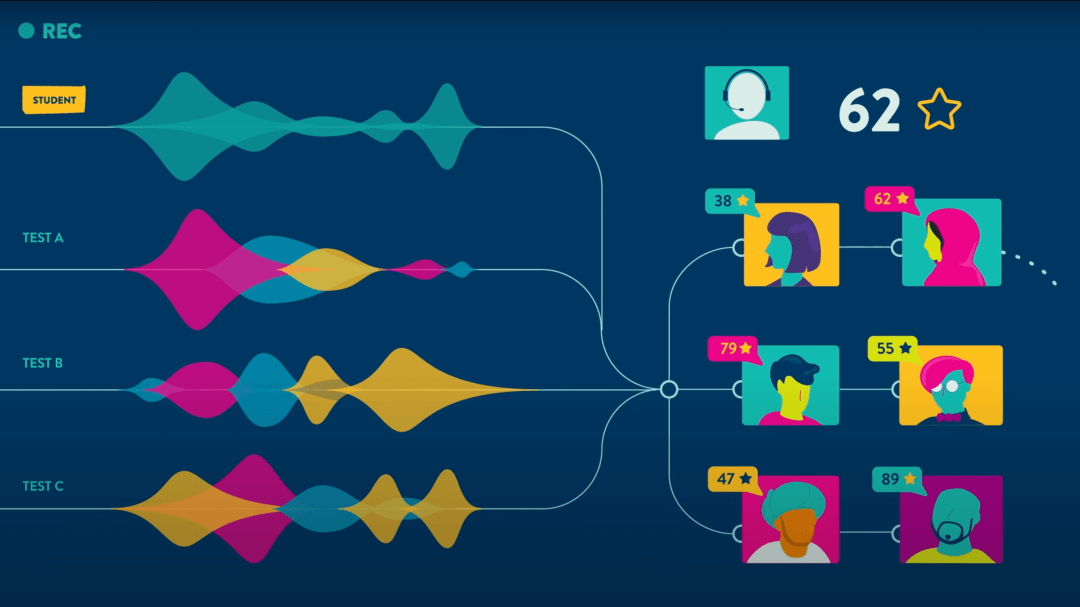
    Are you thinking of taking PTE Academic, or have you recently taken it, but you are wondering how it is that a computer can mark your test?

    Well, firstly the test has been designed by humans, all leading experts in their field. Our human experts design and write the questions, quality assure them, and then score them. At this point, computers are trained to use the patterns of highly trained language experts to attribute scores to questions. When the computer marks correlate highly with the human scores, we then allow the computer to mark test scripts from across the world.

    As a result of our processes and technology, the computer behaves like an expert human examiner – but without any possible bias, lack of concentration, or variation between individual examiners.

    The scoring criteria are exactly the same as human scoring – test takers are marked on their delivery, clarity, relevance, the accuracy of grammar, and appropriateness of vocabulary.

    Want to hear more?

    Take a couple of minutes and listen to one of our leading independent advisors, Dr. Alistair Van Moere, a member of Pearson’s Technical Advisory Group, as he explains how it all works.

  • Image- A guy with headphone 1080px

    Listening: Core English Skills Part 1

    By PTE Author
    Reading time: 3 minutes

    The last part of PTE Academic, Part 3: Listening, requires a large combination of core skills.

    The very first skill you will need to develop involves how you listen (listening methods).

    Below, is information on different types of listening and where you may need to use them during PTE Academic.

    Listening Methods

    Predicting

    One of the listening methods you will need to develop is predicting. Before listening, most people will have some idea about what they are going to listen to and prepare themselves for it. They predict.

    It helps to think about the recordings before you hear it spoken, it helps you listen more effectively.

    This listening method will help during Select Missing Word questions as the topic of the text you listen to is given in the instructions. It will also help in the Re-tell Lecture questions as the image will give you an idea of the general context of the listening text.

    Listening for Gist

    Listening for ‘gist’ will allow you to understand the general meaning of a text quickly. When someone is talking, listen in a general way and think about what the speaker is trying to communicate and how they might feel about the topic based on their tone of voice.

    When practicing, try to listen for the gist before listening for a second time more intensively for specific information.

    This reading method will help in the Multiple-choice, Choose Multiple Answer and Multiple-choice, Choose Single Answer questions. Remember in PTE Academic you can not replay the listening track.

    Listen for Specific Information

    You will also need to be able to listen effectively to find specific information. This is more detailed listening and is often used when you need to answer comprehension questions. You first need to understand what information you are looking for in the text.

    When practicing, if you listen to a text that does not have questions write some yourself. Questions that may help could be:

    • What happened?

    • When did it happen?

    • Where did it happen?

    • Why did it happen? Or, why did it happen in this way, and not another way?

    While listening for specific information, you should listen for synonyms and paraphrasing to match the meaning of the text with the meaning of the questions.  This is because you will not hear the exact words in the question.

    Listening to Infer Meaning

    At times you can understand what the speakers are saying by inferring meaning, as the information is not always stated by the speakers.

    To infer meaning, you need to listen for clues in the text or use general knowledge to guess the meaning of what the speakers are saying. Do this by working out the relationship between the speakers, the tone of voice or the words they use.

    You may need to use this listening method in the Multiple-choice, Choose Multiple Answer and Multiple-choice, Choose Single Answer questions.

    In addition to listening methods, you will also need to understand how words are pronounced on their own and together in a sentence. Read more about pronunciation in Part 2 of Core English Skills.

    Want more prep ideas?

    Explore Smart Prep, which combines all our practice materials in one place, so it's easier for you to stay on track with your PTE preparation.

    • Smart Prep is a clear path to test day, guiding you through the official paid and free resources available for your test

    • It can be accessed whether you’ve booked a test or not – just create, or sign in to your myPTE account

    • Preparation materials include guided practice tests, introductory videos, video courses and test tips.

    Ready to get started?

  • Image- Reading

    Reading: Core English skills part 2

    By PTE Author
    Reading time: 3 minutes

    Once you have practiced and improved your grammar and vocabulary, for Part 2: Reading in PTE Academic, you will need to learn reading methods and the different styles of writing.

    As the PTE Academic is an integrated skills test, the skills developed will be applicable to most sections of the test.

    Firstly, the reading methods you will need to learn and develop are:

    Skim Reading

    By quickly moving your eyes over the text you will be able to get the general meaning of the text. This is the fastest way to understand the text’s meaning.

    Scan Reading

    The fastest way to locate specific information in a text is to scan read. Scan reading helps you find the keywords in a text. Once you find the section of text needed, slow down and read intensively until you understand the information needed to answer the question.

    Intensive Reading

    Intensive reading is done at a slower pace and more carefully. After using scan reading to find the section of text containing the answer you need, you will then need to read intensively to locate the specific information required to answer the question.

    If you are unable to answer the question from the section read, go back to scan reading the whole text to find the correct section, then intensively read that section.

    Critical Reading

    To read critically, you need to think more deeply about what you are reading to understand the text at a deeper level. You will then be able to identify the writer’s purpose, as well as the organization of the text in order to make inferences or understand the textual value.

    You may have to read critically to answer the reading questions Multiple-Choice, Choose Single Answer and Multiple-Choice, Choose Multiple Answers. You may also need this skill to answer the writing question Summarize Written Text, as you will score zero points if you don’t correctly identify the purpose of the text.

    The last question type this skill is used for is the listening question Highlight Correct Summary, as you may need to clarify and organize information to identify the correct summary of the text heard.

    You will also need to be able to identify the style of writing used in the reading texts throughout the test.

    Style of Writing

    For PTE Academic, you will need to understand the style or register of English texts. The style or register refers to the way in which text, that has the same meaning, can be written in different ways.

    When writing, you will need to be able to choose the appropriate words to fit the correct style of the text, as well as understand the style of texts you are reading. For example, an email to your friend will be in an informal style. However, a journal article will be in the academic style. Abstract ideas are also usually written in the academic style.

    Two or three-part verbs (phrasal and prepositional verbs) are generally informal while Latinate verbs are formal, or academic. For example, find out (informal), pick up on (informal) and discover (formal or academic).

    You will need to be able to understand not just the meaning but also the style of a text for the Reading & Writing: Fill in the Blanks questions.

  • Image- A man working with laptop 950px

    How to excel in PTE Academic speaking & writing with David Booth

    By PTE Author
    Reading time: 5 minutes

    We recently had the opportunity to speak with David Booth about the ways you can excel when it comes to taking the PTE Academic Speaking and Writing sections. If you weren’t able to join us for the webinar, here are the highlights from the conversation.  

    Let’s take a look at David’s tips for the Speaking portion of the test first.  

    Pitch and accent 

    When asked if the pitch of the test-taker makes a difference to the score, David had this to say: ‘Pitch is a critical part of intonation. Having natural intonation is important in order to get a good score.’ Having an exaggerated pitch, however, will not help. It needs to be natural. The same can be said for accent, and it’s important to note that your accent will not affect the score.  

    Improving the ‘repeat sentences’ and ‘read aloud sections’ 

    If you’re wondering how you can improve your score in the ‘repeat sentences’ and ‘read aloud sections,’ the best thing you can do is to speak naturally. It’s important to understand how different words are stressed within sentences, so working on any pronunciation exercises that will allow you to identify and practice this will help.  

    The scoring system for both sections  

    We know many of you are curious about how the scoring system for both sections works. Because this is such a hot topic, we’re going to run another webinar in the future that will address this. In the meantime, the PTE Academic score guide provides a comprehensive break-down of the scores for each task, so we encourage you to take a look at the website for more information.  

    Summarizing spoken text 

    We asked David if there’s any structure that test-takers need to follow in order to summarize the spoken text. The key element here is to ensure that the main context points are addressed. It might feel easier to summarize the points in order, but you should be sure to identify the key point early on in your answer.  

    There were lots of questions about the Writing portion of the test which we asked David to explain more about. You can read about his top tips for this section of the test below.  

    Standard spelling 

    Test takers were curious to know which type of standard spelling the PTE Academic follows and if they should use the British or American versions and how that impacts their score. You’ll be glad to know that you can use any standard spelling conventions.  

    Using the IELTS template  

    We know that many test takers have practiced with multiple types of tests, so you want to know if your score will be impacted by choosing to use the IELTS template or method of writing. The important thing to remember here is that no test taker is penalized. To get a high score on the test, you need to think about how proficient writers in English would present their writing. The scoring engines are trained by using answers from a wide range of students. The answers which will receive higher scores are those that will have similar characteristics to other examples of writing that have also been given high scores by highly trained examiners.  

    Paraphrasing  

    We received a question around whether or not you should paraphrase the ‘summarize written text’ and ‘re-tell the lecture’ sections of the test in order to get a better score. David’s recommendation here is that you should be able to write in the same way that a highly proficient learner of English would write. Paraphrasing is very likely to be a characteristic of that writing, but just repeating key lexis is likely to be indicative of a lower proficiency learner.  

    Keywords in the writing summary 

    How can you find keywords in the writing summary and is there a certain number of conjunctions that should be used? Here, the advice is again that PTE Academic is primarily meaning-focused. When connecting ideas, you should think about how meaning is referenced in a text. In technical language, this is referred to as anaphoric or cataphoric referencing, referencing forward or backward in a text. You can also use different nouns and pronouns to connect ideas. Moreover, it’s important to remember that merely using common conjunctions would not necessarily indicate a high level of proficiency.  

    We hope these tips and techniques are useful to you! Learn more about ways you can improve your score in the Speaking & Writing Section.

  • Image- Students at library- 800px

    Part 3: Listening Test Introduction

    By PTE Author
    Reading time: 4 minutes

    Part 3 of PTE Academic will take 45-57 minutes to test your listening skills.

    This section is designed to test your ability to listen, read and write. PTE Academic is an integrated skills test, therefore, this test contains multiple question types that test up to 2 skills each.

    There are eight question types in the listening section. A breakdown of these question types is as below.

    Summarize Spoken Text

    The first question type you will need to complete is Summarize Spoken Text, which will tests listening and writing skills.

    To complete the task, a recording between 60-90 seconds long will be played for you to listen to. As you listen, try to use the Erasable Noteboard Booklet to take notes of key points to help you understand the context.

    After the recording, you will have 10 minutes to write a summary of what you heard.

    To answer this question type, you must write a minimum of 50 words but no more than 70 words.

    You can receive a maximum of 2 points for content, 2 for form, 2 for grammar, 2 for vocabulary and 2 for spelling.

    Multiple-choice, multiple answer

    The second question type, Multiple-Choice, Multiple Answer will test listening skills.

    First, you will be given information to help answer the question. You only have 7 seconds to read this. A recording will then play that is between 40-90 seconds long.

    Select all the response options that you think are correct.

    In this question type, you can receive 1 point for each correct option, but will lose -1 point for each incorrect option. You cannot score below 0.

    Fill in the blanks

    In the third question type, Fill in the Blanks, listening and writing skills will be tested.

    Similar to the previous task, you will be given 7 seconds to read some information before hearing the recording.

    A recording between 30-60 seconds will play. As you listen, type each word in the blank spaces as you hear them so that you do not miss any.

    Do not leave any spaces blank, you can review them at the end.

    You receive 1 point for each correct word which is spelled correctly.

    Highlight correct summary

    The fourth question type, Highlight Correct Summary, will test listening and reading skills.

    You will be given 10 seconds before the recording starts to read the options. A recording will be played that is between 30-90 seconds long.

    To complete the task, select only one correct response. If unsure, choose the one you think is correct as you cannot lose points in this question.

    Your response will either be marked as correct or incorrect.

    Multiple-choice, single answer

    The fifth question type, Multiple-Choice, Single Answer will test listening skills.

    To complete this task, you will be given information to read for context, you will then need to listen to a recording between 30-60 seconds long.

    Choose the option that best suits.

    Your response to this question type will be marked as correct or incorrect.

    Select missing word

    In the sixth question type, Select Missing Word, will test your listening skills.

    A recording between 20-70 seconds long will be played and you will need to predict the last word or words of the text to complete the task.

    You will be marked on this question type as either correct or incorrect.

    Highlight incorrect words

    In the seventh question type, Highlight Incorrect Words, your listening and reading skills will be tested.

    In this question type, you will be shown information and have 10 seconds to read it before a recording starts.

    A recording between 15-50 seconds will play and you will need to select the words that are incorrect and do not match the recording.

    You can receive 1 point for each correct word and lose -1 point for each incorrect word. You cannot score below 0.

    Write from dictation

    The eighth and final question type, Write from Dictation, tests listening and writing skills.

    You will have 7 seconds to read the instructions before the recording starts. The recording is between 3-5 seconds long and once it starts, listen and type the sentence in the response box.

    You can receive 1 point for each correct word you write. Write the words in the right order and spell them correctly in order to receive 1 point. Points are not lost for incorrect words.

    What's next?

    We recommend reviewing the core listening skills required for PTE Academic.

    Want more prep ideas?

    Plus, explore Smart Prep, which combines all our practice materials in one place, so it's easier for you to stay on track with your PTE preparation.

    • Smart Prep is a clear path to test day, guiding you through the official paid and free resources available for your test

    • It can be accessed whether you’ve booked a test or not – just create, or sign in to your myPTE account

    • Preparation materials include guided practice tests, introductory videos, video courses and test tips.

    Ready to get started?

  • Image- Asian woman using a laptop 800px

    Part 2: Reading test introduction

    By PTE Author
    Reading time: 4 minutes

    Part 2 of PTE Academic will take 32-41 minutes and will test your reading skills. This single-timed section contains 15-20 questions that test both independent and integrated skills.

    The sections within part 2 are designed to test your ability to read and write in English. PTE Academic is an integrated skills test, therefore, one question type in this part of the test also assesses writing skills.

    There are five questions types in the reading section. Below, we will break down each part of this section of the test.

    Multiple-choice, Choose Single Answer

    For the first question type, you will need to complete is Multiple-choice, Choose Single Answer question, which is designed to test your reading skills.

    You will be shown a text prompt for this assessment that will be up to 300 words. Possible response options will be given, with only one being correct.

    For this question, you need to read the text and answer a multiple-choice question by selecting one response based on the content or tone of the text.

    In this question type, you will earn 1 point for correct answers and 0 points for incorrect answers.

    Multiple-choice, Choose Multiple Answer

    The second question type will be similar to the previous. Multiple-Choice, Choose Multiple Answer will test your reading skills.

    In this question type, you will be given a text prompt of up to 300 words. Like the previous questions, you will need to answer the question by selecting the most suitable responses from the list of options, based on the content or tone of the text.

    For each correct answer you will earn 1 point, however, you will lose -1 point for each incorrect answer. Don’t worry, you cannot score below 0 in this assessment.

    Re-order Paragraphs

    The third question type to test reading skills will be to re-order paragraphs.

    You will be provided with a text prompt of up to 50 words and will be shown some text boxes on the screen in a random order.

    To complete the question, read the paragraph, then drag and drop or click the arrows on the screen to put your chosen responses in the correct order.

    You will earn 1 point for every pair of sentences that you place in the correct order and receive full marks if the whole paragraph is in the correct order.

    Reading: Fill in the Blanks

    Your reading skills will be tested in the fourth question type, Reading: Fill in the Blanks. You will do 4-5 of these questions.

    For this question, you will be provided with a text prompt of up to 80 words. There will be 3-5 missing words from the text.

    You will need to select a single correct answer from the 6-8 words given to fill the blanks. Not all words in the box will be used.

    You will earn 1 point for every blank that is filled in correctly for this question.

    Reading and Writing: Fill in the Blanks

    The last question type will test your reading and writing skills. Reading and Writing: Fill in the Blanks is an integrated skills question type.

    You will be shown a text prompt of up to 80 words with up to five blank spaces.

    To complete the question, select one of the five options in each drop-down list to fill in the blank spaces.

    You will earn 1 point for every blank space that is filled in correctly.

    To do well in the reading test there are many core skills you will need to learn to ensure a good score.

    If you have already attempted PTE Academic, were not happy with your score, and would like to improve, we recommend reviewing your test performance to see where you can improve.

    What's next?

    You can also read more about Part 3: Listening Test Introduction to learn everything you need for PTE Academic.

    Want more prep ideas?

    Plus, explore Smart Prep, which combines all our practice materials in one place, so it's easier for you to stay on track with your PTE preparation.

    • Smart Prep is a clear path to test day, guiding you through the official paid and free resources available for your test

    • It can be accessed whether you’ve booked a test or not – just create, or sign in to your myPTE account

    • Preparation materials include guided practice tests, introductory videos, video courses and test tips.

    Ready to get started?

Looking for news or press releases?