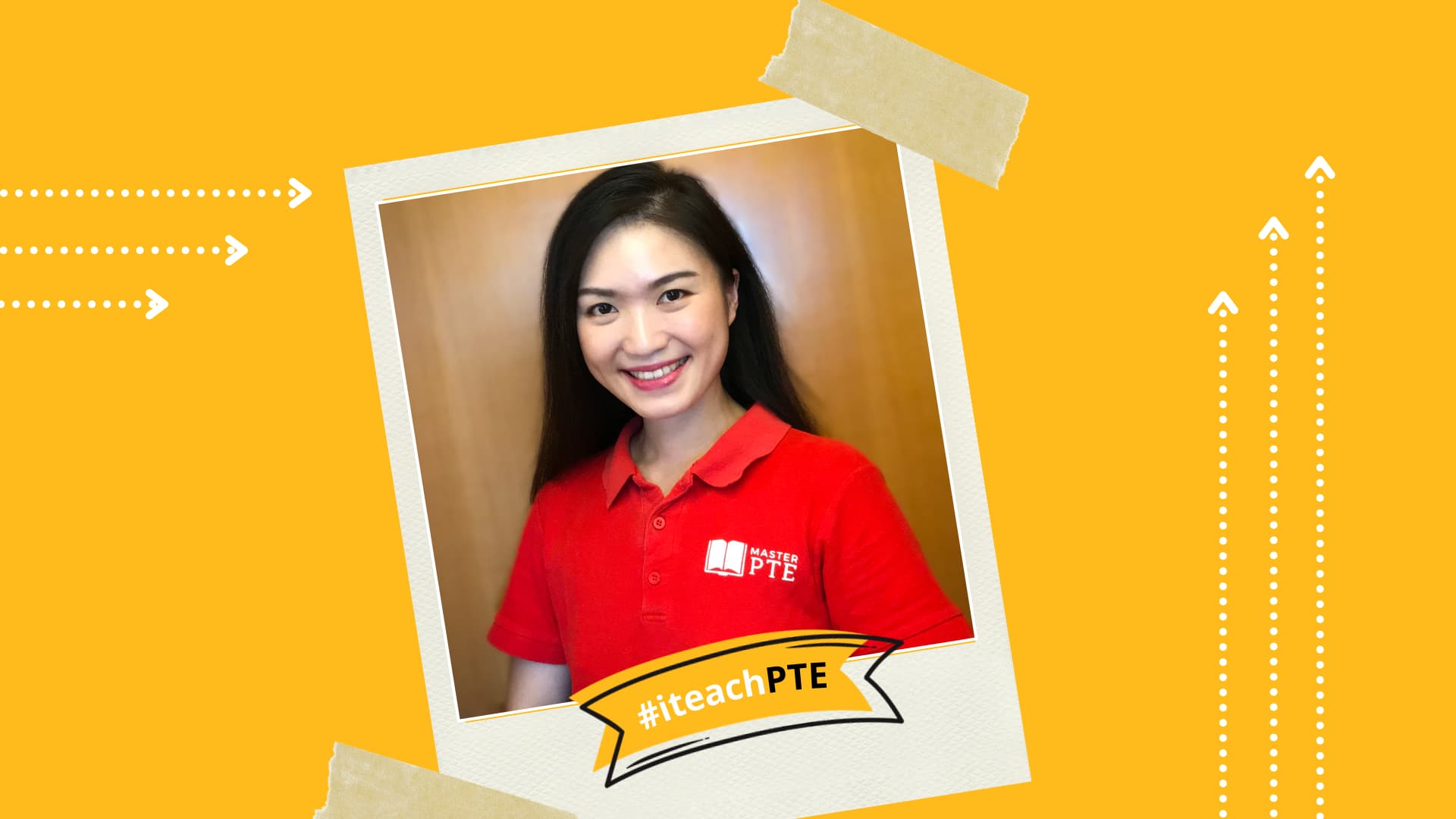

Teacher profile: Sharing the learning journey with PTE teacher Kelly Hoo

PTE Author
PTE Author
Image - Kelly Hoo #iteachPTE
Reading time: 6 minutes

Kelly Hoo is an English teacher based in Malaysia. She works with people from all over the world, helping them to prepare for PTE. But when Kelly first began learning English, she found it really difficult. She certainly never dreamed that one day she would be teaching English and running her own company!  

From student to teacher  

So how did Kelly go from learning English, to teaching other people how to get the score they need in PTE?  

Kelly’s first language was Mandarin, and she struggled a lot when first learning English. “I started my journey with IELTS,” she explains, “and then I discovered PTE.”  

Kelly was learning English in order to attend the University of Melbourne, where she studied for a Bachelor of Commerce. “I always thought I’d be an accountant,” she laughs. “But it wasn’t meant to be!”  

After graduating, Kelly went to work for Unilever, a big multinational corporation. But she found herself giving advice to people learning English, and being able to help people on their language-learning journey was really rewarding.  

“It started with sharing tips with other people who were learning English,” she says. “I’d been through the journey, so when I saw people struggling, I would always give them recommendations and advice.”  

Starting her own company 

From those small beginnings, Kelly went on to become a full-time teacher. The next step was starting her own English teaching company, Master PTE, where she is able to combine her passion for teaching with the expertise she gained in her business degree.   

But Kelly credits her success to the people around her. “It’s not just my own hard work,” she says. “Our team at Master PTE is amazing. My colleagues work so hard and do such a good job. Without them, I wouldn't be here, sharing my experience.”  

The company is now four years old, and in that time Kelly and her colleagues have helped lots of students build their English skills, prepare to sit PTE, and get the score they need.  

Helping students set manageable goals  

The team at Master PTE teaches students of all ages and levels, from all over the world, in a mix of online and in-person classes.  

“Thanks to Covid, we’re now doing hybrid classes,” explains Kelly, “a mix of online and face to face. Our clients are mainly working adults or students, so they’re very busy, and they need that flexibility.”  

At Master PTE, Kelly and her colleagues help students to break the big goal of getting the PTE score they need into smaller, more manageable goals.  

“We don’t ask them to do ten exam tasks in a day, because it’s impossible,” says Kelly. “We focus on what’s doable - a little bit of preparation each day, to make it easier for our students and give them a feeling of achievement, and the satisfaction that comes from that.”  

The skill that Kelly’s students struggle with the most is speaking. It’s a cultural problem, Kelly says, as in Malaysia, people are worried about making mistakes. “We want to boost their confidence and tell them to express themselves. I always tell students, Don’t be afraid to make a mistake. Just say what’s on your mind - it’s ok, we don’t judge people at Master PTE!”  

Speaking to a computer can also be a challenge for some students, but for others, a computer-based exam like PTE helps with their confidence. They prefer to speak to a computer rather than a human examiner.  

Kelly’s students are her inspiration  

One of the things Kelly loves about her job is meeting people from all over the world. “We have students from Japan, from Botswana, from India. It's amazing to connect with people and learn about their culture, their stories. The learning is definitely a two-way street in our classes!” she laughs.  

One of Kelly’s most inspirational students was from India. He was planning to sit PTE in order to move to Australia with his wife and young children. “When I first spoke to him, his English was at a really low level,” she explains. “I thought he would need a lot of preparation.”  

He started studying with Kelly, preparing for the test, and working hard every evening. “He was really burning the midnight oil,” she says, “as he was working full time too. He put in so much hard work, but he was doing it for his family, for his kids’ future, to give them a better life. I really admired his spirit - and I was so happy in the end when he got the score he needed after just two months of studying!”  

The importance of perspective 

Kelly has one piece of advice for other PTE teachers: always try to think from the students perspective.  

“Teaching English is easy for us,” she says. “We use English everyday. That’s why it’s so important to put yourself in your student’s shoes. Make sure they can absorb and retain the information you are teaching them.”  

From time to time, Kelly studies a new language like German, or Japanese, just to remind herself what it’s like to learn a new language.  

“I understand where the students are coming from,” she says. “I’ve been a learner too, and learning English as a second language isn’t easy.”  

That’s why Kelly is so focused on understanding each student’s situation, and making things a little easier for them by supporting them and creating a community that they are part of.  

“I always tell them, Don’t give up!” she says. “Learning can be fun and interesting.”  

Learn more 

For more insights into PTE preparation, have a look at the PTE blog, where you’ll find inspiration, advice, and lots of useful resources such as free lesson plans and preparation tools. And if you’d like to be featured on our PTE teacher profile series, just fill out this form!

Related Content

  • Image - iteachPTE Syed Wasi
    Teacher profile: Building a learning community in Dhaka
    By PTE Author
    Reading time: 5 minutes

    Syed Wasi is a pioneer in many ways. He was the first PTE trainer in Bangladesh, and the first Bangladeshi to score 90 in PTE – no mean feat in a country of 166 million people! Syed is the founder of the Center for Innovative Language Learning (CILL) where students come for his help in preparing for PTE. The center is renowned for its high student success rate.  

    So, how does Syed help his students to get the scores they need in PTE? Let’s find out.  

    How Syed teaches PTE  

    When a student arrives at CILL, their first step towards PTE success starts with a language assessment. “If we find that their language skills aren’t particularly strong,” says Syed, “the first thing we do is create a course which includes general language classes. We go step by step through the levels, helping them to improve their language skills – and once they are ready for PTE, they join a PTE preparation class.”  

    Once Syed’s students are part of a preparation class, they follow a carefully designed curriculum. Each language skill tested in PTE (speaking, writing, reading and listening) is covered in a module of three classes. The first class introduces the type of exam questions that students can expect. The second class gives students the practical tools and techniques that they’ll need to answer the exam questions, and the third class is a practice session. But the secret to Syed’s success? He doesn’t let the students sit PTE before they’re ready:  

    "The final step in PTE preparation is the mock test. We don’t let them take the test until they’re ready for the test, which is why we have a very high success rate.”  

    Flexibility is also important. The PTE preparation courses at CILL are blended courses; some students attend the center in person, and others join online. When the pandemic began, there was a massive shift to teaching online, and many schools had to adapt quickly. But Syed’s language school was ahead of the curve when it came to blended learning. “I did my masters in online teaching back in 2012,” says Syed. “We’ve been teaching with a blended learning model since 2016, so it was easy for us to adapt. Now, students are returning to the classroom, but we still offer the blended learning option.”  

    Building a community of learners  

    An important part of the school culture at CILL is the accessibility of the teachers. Learning isn’t confined to the classroom – the teachers are available to answer questions outside of class times. “We create WhatsApp groups for different classes, and it’s like a virtual hub,” Syed explains. What’s more, the teachers follow up with students after class. This dedicated service has helped Syed to build a loyal community of learners around the world. “Many of our students have moved to Australia, to the UK, or to other countries,” he says. “And wherever they go, if they meet anyone interested in PTE preparation, they refer them to our school. They’ll say, there’s a person in Bangladesh who can give you the support you’ll need to pass the test.”  

    Syed’s advice for PTE teachers 

    “If you’re new to PTE teaching, the most important thing is to make sure you have the expertise you need to prepare students for the test,” Syed says. After all, there’s a lot on the line when it comes to PTE. Students often need a certain score for a university application or a visa. So if you don’t prepare students thoroughly, it could have an impact not only on their score but on their careers. Syed recommends taking the test yourself in order to gain real insight into PTE.  

    And for more experienced teachers, Syed believes that honesty is the best policy when it comes to test preparation. “Tell your students exactly what they’ll need to do in order to get the score they need. Be honest with them, and that way they know what they have to do.”  

    PTE is a high stakes test. When you’re helping students to prepare for the exam, you’re helping them to change their lives, to do something new. “It’s not just a business,” says Syed. “We are helping students to reach their goals. It’s my passion, and my vocation.”  

    Learn more

    Each month, we feature the profile of a teacher from our PTE community. If you have advice and insights to share with other PTE preparation teachers, we’d like to hear from you! Fill out this form and we’ll be in touch shortly.  

    In previous months, we featured Jurine Ruperto, who teaches in Cebu in the Philippines, and Ramesh Thapa, a PTE teacher in Kathmandu. You can read all about them on our blog, where you’ll also find lots of resources for PTE preparation classes. And don’t forget to sign up to our monthly newsletter.

  • Image - Typing
    How to prepare for the PTE essay writing task
    By PTE Author
    Reading time: 6 minutes

    The PTE exam includes four main sections: reading, writing, speaking, and listening. You will do the speaking and writing tasks together in part one of the exams. While your writing will be assessed in your answers to other tasks, there are only two specific writing tasks: summarize a written text and write an essay.   

    The PTE essay writing task aims to test your grammar, spelling, vocabulary, and written discourse skills. Therefore, it’s important that you understand this section, and what’s expected before going into the exam.  

    If you’re looking for some tips and guidance on how to approach this part, look no further! 

    Read on to find out what the essay writing task is about, how to approach it, and what the examiners are looking for. 

    Essay Writing Task Structure 

    For this task, you will receive a 2 to 3 line prompt stating an opinion or statement. Prompts can be written in a number of ways.  

    For example, you may have to discuss problems or solutions, or argue for or against an opinion: 

  • Image - Canada, 1080px
    Canada’s post-graduation work permit: requirements and how to apply
    By PTE Author
    Reading time: 5 minutes

    Canada needs immigrants to grow its population. And there’s good news for students: foreign learners and people with a post-graduation work permit (PGWP) are some of the most important propellers of the country’s population growth.  

    So how does a PGWP work? In this guide, we cover what you need to know. You’ll learn about who’s eligible, how much it costs, and most importantly, how long you can stay in the country after graduation to gain Canadian work experience.  

    Canada’s post-graduation work permit: how does it work? 

    The PGWP lets international students who have graduated from an eligible designated learning institution to stay in Canada and work for up to three years. Not surprisingly, the program is a big draw to work and study in Canada for international students – and it’s grown in popularity over the last several years.  

    Just take a look at the numbers: between 2005 and 2016, the amount of permits issued to new graduates increased by 15 times – from 7,400 to 117,700 per year. By 2018, 143,000 permits were issued. And in the first quarter of 2021, PGWPs increased 160% year-over-year.  

    The PGWP is an open work permit, which means you can work for any employer in Canada. You also don’t need a job offer to apply. The length of your PGWP depends on how long you’ve studied in Canada. For example, if your program was: 

    • Under 8 months, you won’t be eligible for a PGWP. 

    • Less than 2 years, you may get a permit for the same amount of time as you studied (for example if your program was one year, you might get a permit for one year).

    • More than 2 years, you could be eligible for a 3-year permit. 

    If you studied more than 1 program, you may also get a PGWP that combines the length of each program.  

    Who is eligible?  

    To be eligible for a PGWP, you need to meet a number of criteria. For example, you need to have graduated from a program that was at least 8 months long at a designated learning institution – and have earned a degree, diploma, or certificate from that. 

    International students who were approved for a study permit and are studying online outside Canada due to the pandemic are also eligible for a PGWP.  

    However, people who’ve only studied English or French as a second language in Canada are not.  

    For a full list of criteria, make sure to check out the Government of Canada website.  

    How can you apply? 

    Before you begin the application process, you need to have proof that you’ve completed your studies. You need to show either: 

    • An official letter from your institution 

    • An official transcript  

    • A degree or diploma  

    After you’ve got one of these, you need to apply for a PGWP within 180 days.  

    Instructions for exactly how to apply depending on whether you’re applying from inside or outside Canada. You can find the step-by-step instructions on the Government of Canada website – including an official guide and a document checklist.  

    How much does it cost? 

    It costs $255 CAD to apply for a PGWP. Processing times differ, but it can take up to 73 days to be approved on average. However, the good news is that many graduates can work while they’re waiting on a decision.  

    Other visa options  

    Being able to work and study in Canada for international students around the world is often a dream come true. However if you’re not eligible for a PGWP, you do have some other visa options.  

    An employer-specific work permit 

    This type of work permit allows you to work for a certain amount of time for a specific employer. You might be eligible for this if you’ve gotten a job to be a researcher at a university, or a charitable worker at an NGO, for example.  

    Canada has a tool to help you learn more about what type of work permit you could be eligible for. You can check it out here.  

    Permanent residence  

    If you’ve worked full-time for 12 months after graduation in a skilled trade, a professional job that requires a degree, or a management-level job, you could be eligible for permanent residence.