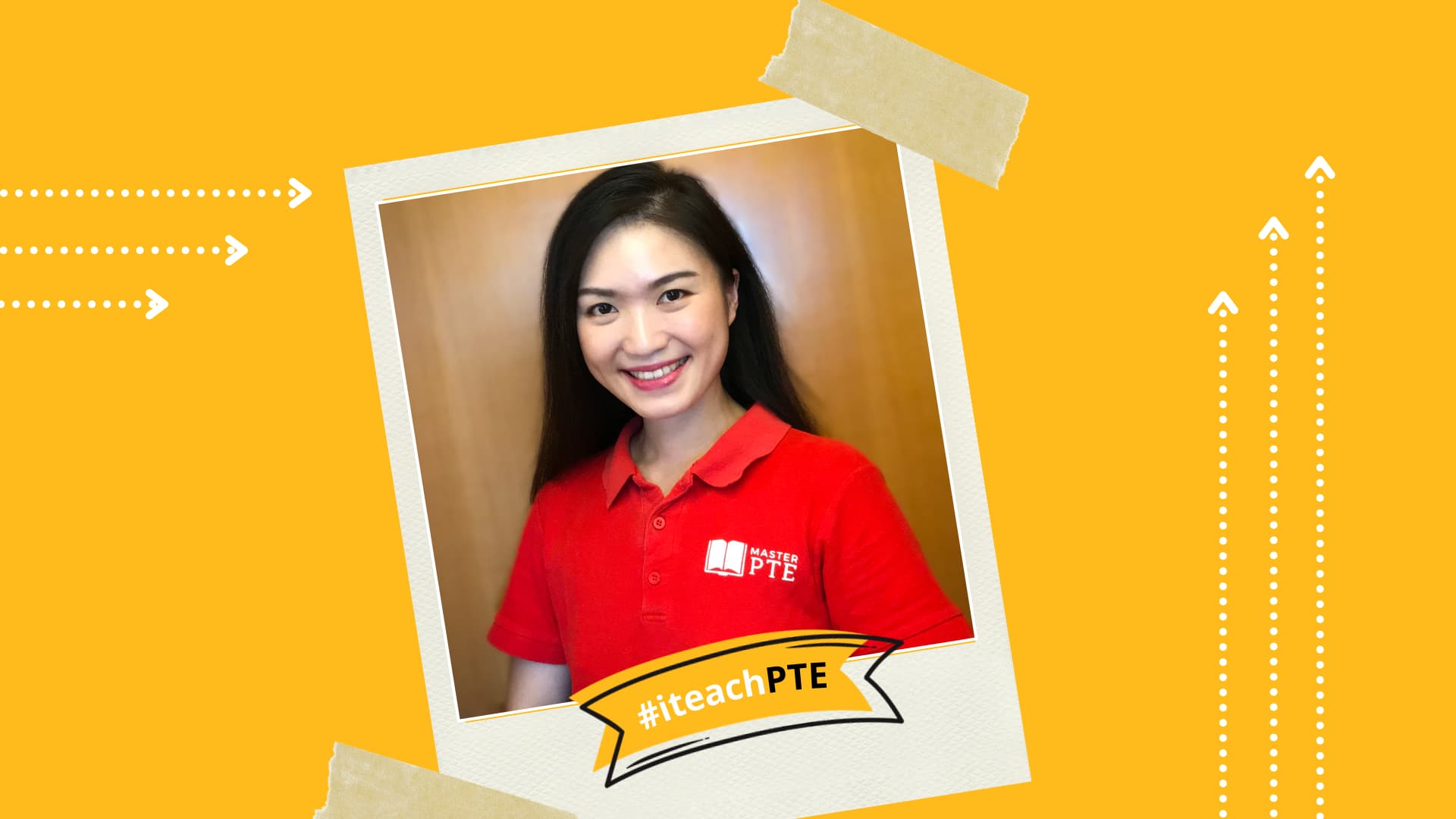
Teacher profile: Sharing the learning journey with PTE teacher Kelly Hoo

PTE Author
PTE Author
Image - Kelly Hoo #iteachPTE
Reading time: 6 minutes

Kelly Hoo is an English teacher based in Malaysia. She works with people from all over the world, helping them to prepare for PTE. But when Kelly first began learning English, she found it really difficult. She certainly never dreamed that one day she would be teaching English and running her own company!  

From student to teacher  

So how did Kelly go from learning English, to teaching other people how to get the score they need in PTE?  

Kelly’s first language was Mandarin, and she struggled a lot when first learning English. “I started my journey with IELTS,” she explains, “and then I discovered PTE.”  

Kelly was learning English in order to attend the University of Melbourne, where she studied for a Bachelor of Commerce. “I always thought I’d be an accountant,” she laughs. “But it wasn’t meant to be!”  

After graduating, Kelly went to work for Unilever, a big multinational corporation. But she found herself giving advice to people learning English, and being able to help people on their language-learning journey was really rewarding.  

“It started with sharing tips with other people who were learning English,” she says. “I’d been through the journey, so when I saw people struggling, I would always give them recommendations and advice.”  

Starting her own company 

From those small beginnings, Kelly went on to become a full-time teacher. The next step was starting her own English teaching company, Master PTE, where she is able to combine her passion for teaching with the expertise she gained in her business degree.   

But Kelly credits her success to the people around her. “It’s not just my own hard work,” she says. “Our team at Master PTE is amazing. My colleagues work so hard and do such a good job. Without them, I wouldn't be here, sharing my experience.”  

The company is now four years old, and in that time Kelly and her colleagues have helped lots of students build their English skills, prepare to sit PTE, and get the score they need.  

Helping students set manageable goals  

The team at Master PTE teaches students of all ages and levels, from all over the world, in a mix of online and in-person classes.  

“Thanks to Covid, we’re now doing hybrid classes,” explains Kelly, “a mix of online and face to face. Our clients are mainly working adults or students, so they’re very busy, and they need that flexibility.”  

At Master PTE, Kelly and her colleagues help students to break the big goal of getting the PTE score they need into smaller, more manageable goals.  

“We don’t ask them to do ten exam tasks in a day, because it’s impossible,” says Kelly. “We focus on what’s doable - a little bit of preparation each day, to make it easier for our students and give them a feeling of achievement, and the satisfaction that comes from that.”  

The skill that Kelly’s students struggle with the most is speaking. It’s a cultural problem, Kelly says, as in Malaysia, people are worried about making mistakes. “We want to boost their confidence and tell them to express themselves. I always tell students, Don’t be afraid to make a mistake. Just say what’s on your mind - it’s ok, we don’t judge people at Master PTE!”  

Speaking to a computer can also be a challenge for some students, but for others, a computer-based exam like PTE helps with their confidence. They prefer to speak to a computer rather than a human examiner.  

Kelly’s students are her inspiration  

One of the things Kelly loves about her job is meeting people from all over the world. “We have students from Japan, from Botswana, from India. It's amazing to connect with people and learn about their culture, their stories. The learning is definitely a two-way street in our classes!” she laughs.  

One of Kelly’s most inspirational students was from India. He was planning to sit PTE in order to move to Australia with his wife and young children. “When I first spoke to him, his English was at a really low level,” she explains. “I thought he would need a lot of preparation.”  

He started studying with Kelly, preparing for the test, and working hard every evening. “He was really burning the midnight oil,” she says, “as he was working full time too. He put in so much hard work, but he was doing it for his family, for his kids’ future, to give them a better life. I really admired his spirit - and I was so happy in the end when he got the score he needed after just two months of studying!”  

The importance of perspective 

Kelly has one piece of advice for other PTE teachers: always try to think from the students perspective.  

“Teaching English is easy for us,” she says. “We use English everyday. That’s why it’s so important to put yourself in your student’s shoes. Make sure they can absorb and retain the information you are teaching them.”  

From time to time, Kelly studies a new language like German, or Japanese, just to remind herself what it’s like to learn a new language.  

“I understand where the students are coming from,” she says. “I’ve been a learner too, and learning English as a second language isn’t easy.”  

That’s why Kelly is so focused on understanding each student’s situation, and making things a little easier for them by supporting them and creating a community that they are part of.  

“I always tell them, Don’t give up!” she says. “Learning can be fun and interesting.”  

Learn more 

For more insights into PTE preparation, have a look at the PTE blog, where you’ll find inspiration, advice, and lots of useful resources such as free lesson plans and preparation tools. And if you’d like to be featured on our PTE teacher profile series, just fill out this form!

Related Content

  • Image- Woman reading - 800px
    Reading: Self-Improvement
    By PTE Author
    Reading time: 3 minutes

    There are many ways you can improve your chances of gaining points in Part 2: Reading during PTE Academic.

    To improve your reading skills, practice increasing your reading speed and comprehension at the same time. In turn, you will improve your writing, grammar and vocabulary skills.

    To do well in this part of the test, you need to be able to read quickly, using effective reading strategies, as there is a limited time to answer all questions.

    Speed reading tasks will help improve your reading speed. Practice speed reading every day and:

    • Aim to be reading at least 220 words per minute

    • Reading short articles of around 300 words

    • Read often for short periods of time

    You can also try this as a challenge with your friends to help keep motivated. Once you are happy with your comprehension and speed, focus on chunks (groups of words) rather than individual words.

    When your reading skills reach a level you are happy with, you will feel more confident to answer the questions.

    Multiple-choice, choose single answer

    In the Multiple-Choice, Single Answer question type, some test takers make the mistake of scan reading and matching the words in the text to the words in the answer. Generally, the words in the text are not used in the correct answer, therefore it is important to learn how to use synonyms and paraphrasing as it will be used in the test.

    Learn how to improve your grammar in our Reading: Core Skills part 1 article.

    Multiple-choice, choose multiple answers

    In this question type, you will need more time than in the Multiple-Choice, Choose Single Answer question typeas you need to intensively read the stem (the part before the options) as well as the options, then scan read the text on the screen until you find the part of the text that contains information that was in the stem.

    Read the options very carefully and match the meaning of the option with the text. Do not match the words – this is something test takers may make errors with.

    You should also make sure not to choose all the options since you lose one point for each incorrect choice. However, you cannot score below zero.

    Re-order paragraphs

    To do well in the Re-order Paragraphs questions, you will need to have a strong understanding of cohesive devices and how they work. You will also need to understand how articles work, as well as the logical and chronological order of information.

    In this question type, skim-read the text to get the ideas of the topic of the text. From there, you should read all the sentences carefully.

    Fill in the blanks and reading & writing: fill in the blanks

    For both Fill in the Blanks and Reading & Writing: Fill in the Blanks question types, you will need to understand a range of vocabulary, collocations, grammar, pronouns, and cohesive devices, as well as being able to identify when plural nouns are needed.

    You will also need to be able to skim read to get an idea of the meaning of the text, then read intensively before and after each blank. If unsure, you should guess based on the context.

    Make sure you do not leave any spaces blank. You do not need to correctly fill in all spaces to get points.

    To go back and review the question types within the reading test, we suggest learning more about the reading questions.

    Want more prep ideas?

    Explore Smart Prep, which combines all our practice materials in one place, so it's easier for you to stay on track with your PTE preparation.

    • Smart Prep is a clear path to test day, guiding you through the official paid and free resources available for your test

    • It can be accessed whether you’ve booked a test or not – just create, or sign in to your myPTE account

    • Preparation materials include guided practice tests, introductory videos, video courses and test tips.

    Ready to get started?

  • Image- Writing journal with the UK gimmick-800px
    A Complete Guide to Applying for a UK Student Visa
    By PTE Author
    Reading time: 4 minutes

    Do you have your heart set on studying in England, Scotland, Wales, or Northern Ireland? The UK is a wonderful place to live and learn, but you’ll most likely need to get a UK study visa before you start packing your bags.

    This comprehensive guide covers who needs a UK student visa, the requirements for getting one, how to apply, how much it costs, and how long it takes.

    Who needs a UK student visa? 

    If you’re an international student hoping to study in the UK, you’ll most likely need a student visa. The only exceptions are nationals of Switzerland and countries in the European Economic Area (EEA), who don’t need a visa to enter the UK. * 

    * Please note: The outcome of Brexit may alter this after 2020. Check the UK government’s website for up-to-date information about this. 

    What are the UK student visa requirements I need to meet? 

    There are several UK study visa requirements you’ll need to meet to successfully apply. These include: 

    • You’ve been offered a place in a full-time course from an eligible university (i.e. the school must be a licensed Student route visa*Tier 4 sponsors)

    • You can understand English (both written and spoken)

    • You have enough funds to support yourself and any dependants, while also paying for the course.

    These requirements apply to students from all over the world. This means the UK student visa requirements for Indian students and American students are exactly the same for Chinese students and Australian students (and so on).  

    Which type of visa do I need to apply for? 

  • Image- Scrabble WFH 800px
    10 new English words
    By PTE Author
    Reading time: 5 minutes

    Hundreds of new words are added to the dictionary each year, and it often takes months of consideration to decide which ones. But when the pandemic began in 2020, many words we’d never heard of suddenly became part of our day-to-day vocabulary – think words like “furlough”, “stay at home order”, and COVID-19 (which was only invented in February 2020). With this, dictionaries raced to add new entries, and helped us to define our “new normal”. So, what are some of the words that got added last year? Let’s explore 10 new words you’ll need:  

    1. Adulting 

    DefinitionThe action of becoming or acting like an adult 

    In December 2020, the Oxford English Dictionary added the word “adulting.” It’s often used by young people when they talk about doing tasks that are essential to every-day life – like cooking meals, buying insurance, or paying taxes.  

    How to use it: My roommates and I are adulting all the time. We clean the whole house every Saturday! 

    2. Awe walk 

    DefinitionTaking a walk outside and making an effort to look at the things around you 

    “Awe walk” hasn’t been added to the Cambridge Dictionary yet – but they have noticed it’s been used quite a bit. The word “awe” means a feeling of respect. So when someone says they will take an awe walk, it means they’ll notice – and feel grateful for – all the small things around them. 

    The word was actually coined by the authors of a psychological study, which found older people who took awe walks felt more positive and less stressed over time.  

    How to use it: Today on our awe walk we noticed a tree we’d never seen before.  

    3. Contactless 

    Definition: not having to physically touch or interact with people, or relating to a technological system for payments, where information is transmitted over short distances without physical contact

    “Contactless” delivery became a popular option for shoppers during the pandemic. People who choose contactless delivery get their groceries or food delivered to the doorsteps, but don’t have to go out to receive them. Merriam-Webster added the word to their dictionary in April, right at the beginning of the pandemic. Contactless is also referred to when talking about contactless payment technology.

    How to use it: Our family started to shop at a new grocery store, because we wanted the option to have contactless delivery.  

    The limit on contactless payments has increased. 

    4. Doomscrolling 

    Definition: the action of constantly scrolling through and reading depressing news on a news site or on social media, especially on a phone  

    Dictionary.com added “doomscrolling” in summer 2020. And, we’ve all done it. Doomscrolling is when you become obsessed with staying up to date with bad news. It’s a combination of the noun “doom” and verb “scroll” – and was made popular by the journalist Karen Ho last year.  

    How to use it: I was doomscrolling on Twitter today while reading about Covid-19 cases. I think it’s why I feel so anxious now.  


    5. PPE

    Definition: an abbreviation for personal protective equipment 

    Many of us first heard the word “PPE” at the beginning of the pandemic, and the word was added by Merriam-Webster last April. PPE is the abbreviation of personal protective equipment. This is the clothing people wear to protect themselves from danger. Masks, gloves, face shields, and goggles are all examples of PPE. 

    How to use it: Many healthcare professionals and essential workers did not have access to PPE at the beginning of the pandemic.  


    6. Quarenteen

    Definitiona teenager during the COVID-19 pandemic  

    Do you know a “quarenteen?” It’s another word that’s been observed by Cambridge Dictionary – but hasn’t been added quite yet. If it is added, quarenteen will be a homophone for the word “quarantine.” It’ll also be a compound noun of “quarantine” and “teenager.”  

    How to use it: My sister was a quarenteen and spent a lot of time on TikTok. 


    7. Thirsty 

    DefinitionHaving a need for attention or approval  

    But doesn’t thirsty mean needing to drink? Well, Merriam-Webster added a new definition of the word last year. “Thirsty” means having a strong desire for attention – especially on social media. Thirsty is informal, and it’s mostly used by young people. 

    How to use it: My brother is thirsty. He posts so many photos of our dog Jellybean on Instagram because he wants her to be a dog model.


    8. Truthiness 

    Definitionsomething that seems true but isn’t backed up by evidence 

    The word “truthiness” became popular after American comedian Stephen Colbert talked about it on his show The Colbert Report back in 2005. It was meant to be a joke, but many dictionaries have now included the word – including Merriam-Webster. With so much disinformation going around right now, we think it’s a great word for today's world.  

    How to use it: In this class, you can’t speak truthiness and expect to get away with it.  


    9. Unconscious bias 

    Definitionunconscious prejudice against people of a certain race, gender, or group 

    “Unconscious bias” is a negative term, which was added to the Oxford English Dictionary last year. Everyone has unconscious beliefs about other groups, and these beliefs can cause them to discriminate against others. There is also conscious bias. When people are consciously biased, their discrimination is intentional.   

    How to use it: In this day and age, I hope more workplaces will address their conscious and unconscious bias.


    10. WFH

    Definition:  An abbreviation for work (or working) from home  

    The word “WFH” was added to Merriam-Webster in April 2020 when many people were WFH! This is an important word to know if you're part of an English-speaking workplace.  

    How to use it: My co-workers say they’re WFH on Slack everyday.

    So, what’s your favorite new word? We recommend keeping up on all the new words added to dictionaries throughout the year –  it’s a great way to expand your vocab!  

    For more English-learning resources, don’t forget to check out our articles and click on the 'Test tips & advice' filter.