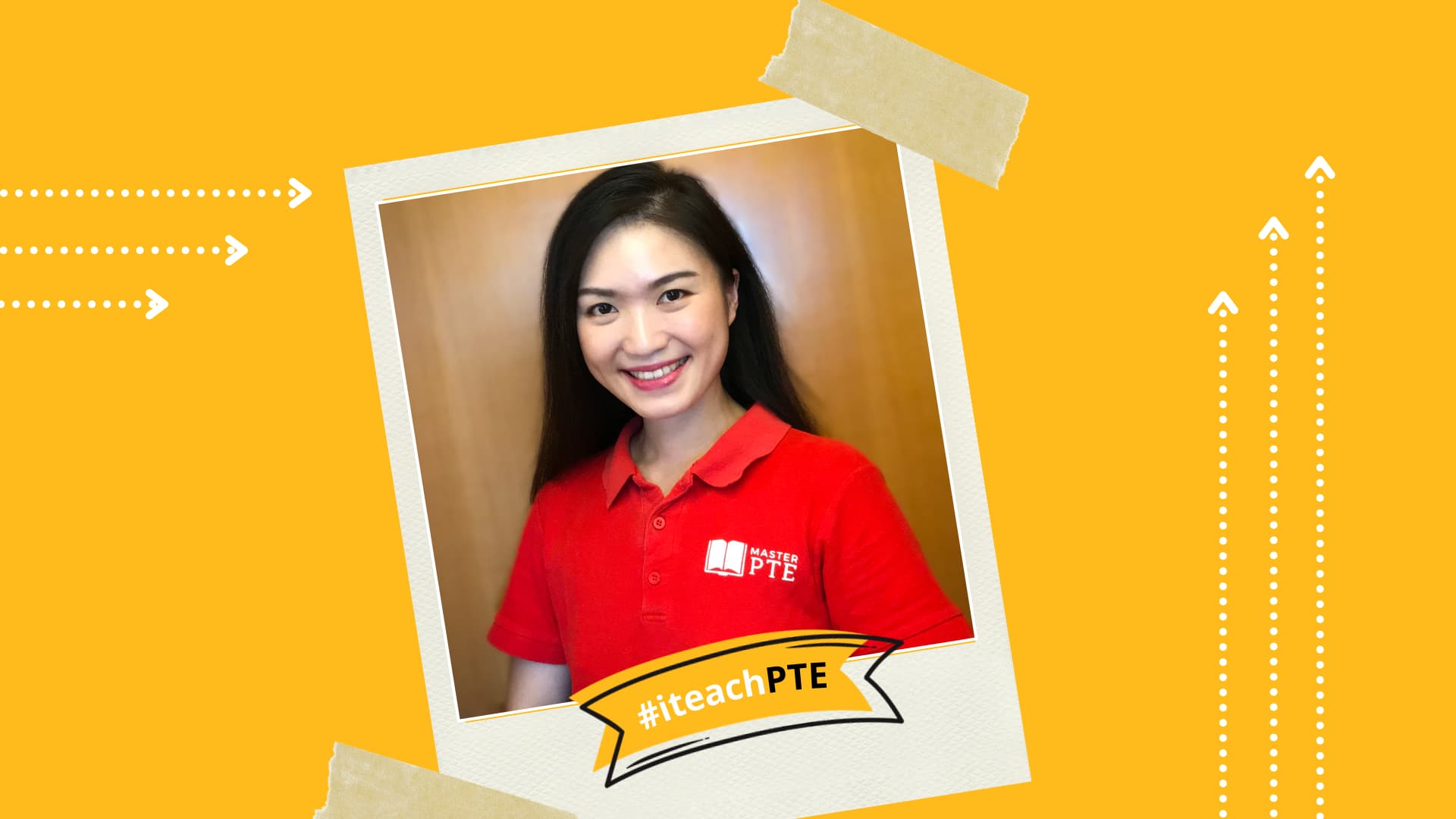

Teacher profile: Sharing the learning journey with PTE teacher Kelly Hoo

PTE Author
PTE Author
Image - Kelly Hoo #iteachPTE
Reading time: 6 minutes

Kelly Hoo is an English teacher based in Malaysia. She works with people from all over the world, helping them to prepare for PTE. But when Kelly first began learning English, she found it really difficult. She certainly never dreamed that one day she would be teaching English and running her own company!  

From student to teacher  

So how did Kelly go from learning English, to teaching other people how to get the score they need in PTE?  

Kelly’s first language was Mandarin, and she struggled a lot when first learning English. “I started my journey with IELTS,” she explains, “and then I discovered PTE.”  

Kelly was learning English in order to attend the University of Melbourne, where she studied for a Bachelor of Commerce. “I always thought I’d be an accountant,” she laughs. “But it wasn’t meant to be!”  

After graduating, Kelly went to work for Unilever, a big multinational corporation. But she found herself giving advice to people learning English, and being able to help people on their language-learning journey was really rewarding.  

“It started with sharing tips with other people who were learning English,” she says. “I’d been through the journey, so when I saw people struggling, I would always give them recommendations and advice.”  

Starting her own company 

From those small beginnings, Kelly went on to become a full-time teacher. The next step was starting her own English teaching company, Master PTE, where she is able to combine her passion for teaching with the expertise she gained in her business degree.   

But Kelly credits her success to the people around her. “It’s not just my own hard work,” she says. “Our team at Master PTE is amazing. My colleagues work so hard and do such a good job. Without them, I wouldn't be here, sharing my experience.”  

The company is now four years old, and in that time Kelly and her colleagues have helped lots of students build their English skills, prepare to sit PTE, and get the score they need.  

Helping students set manageable goals  

The team at Master PTE teaches students of all ages and levels, from all over the world, in a mix of online and in-person classes.  

“Thanks to Covid, we’re now doing hybrid classes,” explains Kelly, “a mix of online and face to face. Our clients are mainly working adults or students, so they’re very busy, and they need that flexibility.”  

At Master PTE, Kelly and her colleagues help students to break the big goal of getting the PTE score they need into smaller, more manageable goals.  

“We don’t ask them to do ten exam tasks in a day, because it’s impossible,” says Kelly. “We focus on what’s doable - a little bit of preparation each day, to make it easier for our students and give them a feeling of achievement, and the satisfaction that comes from that.”  

The skill that Kelly’s students struggle with the most is speaking. It’s a cultural problem, Kelly says, as in Malaysia, people are worried about making mistakes. “We want to boost their confidence and tell them to express themselves. I always tell students, Don’t be afraid to make a mistake. Just say what’s on your mind - it’s ok, we don’t judge people at Master PTE!”  

Speaking to a computer can also be a challenge for some students, but for others, a computer-based exam like PTE helps with their confidence. They prefer to speak to a computer rather than a human examiner.  

Kelly’s students are her inspiration  

One of the things Kelly loves about her job is meeting people from all over the world. “We have students from Japan, from Botswana, from India. It's amazing to connect with people and learn about their culture, their stories. The learning is definitely a two-way street in our classes!” she laughs.  

One of Kelly’s most inspirational students was from India. He was planning to sit PTE in order to move to Australia with his wife and young children. “When I first spoke to him, his English was at a really low level,” she explains. “I thought he would need a lot of preparation.”  

He started studying with Kelly, preparing for the test, and working hard every evening. “He was really burning the midnight oil,” she says, “as he was working full time too. He put in so much hard work, but he was doing it for his family, for his kids’ future, to give them a better life. I really admired his spirit - and I was so happy in the end when he got the score he needed after just two months of studying!”  

The importance of perspective 

Kelly has one piece of advice for other PTE teachers: always try to think from the students perspective.  

“Teaching English is easy for us,” she says. “We use English everyday. That’s why it’s so important to put yourself in your student’s shoes. Make sure they can absorb and retain the information you are teaching them.”  

From time to time, Kelly studies a new language like German, or Japanese, just to remind herself what it’s like to learn a new language.  

“I understand where the students are coming from,” she says. “I’ve been a learner too, and learning English as a second language isn’t easy.”  

That’s why Kelly is so focused on understanding each student’s situation, and making things a little easier for them by supporting them and creating a community that they are part of.  

“I always tell them, Don’t give up!” she says. “Learning can be fun and interesting.”  

Learn more 

For more insights into PTE preparation, have a look at the PTE blog, where you’ll find inspiration, advice, and lots of useful resources such as free lesson plans and preparation tools. And if you’d like to be featured on our PTE teacher profile series, just fill out this form!

Related Content

  • Image - student, 800px x 451px
    How to write a personal statement for your UCAS application
    By PTE Author
    Reading time: 6 minutes

    Applying to university and college is an exciting experience. However, it can also be nerve-wracking. After all, the UK’s Universities and Colleges Admissions Service (UCAS) manages three million applications each year.  

    So, how can you make your application stand out? Writing an interesting, enthusiastic and genuine UCAS personal statement is one of the best ways to catch an institution’s attention.  

    But if you’re still not sure what to write about, there’s no need to panic. In this blog, we’ll explore how to write a UCAS personal statement that will open doors – including how to brainstorm ideas and some UCAS personal statement examples.   

    What is a UCAS personal statement for? 

    UCAS personal statement is all about you, and it’s your time to shine.  

    In it, you’ll talk about why you’re interested in what you’re applying for. You’ll also talk about your skills, and how they’ll help you succeed in your studies. It’s a good idea to use concrete examples, and talk about how you have already used these skills in your life.   

    Institutions want to see why you’ll make an excellent student. So, don’t be shy – you’ve got to sell yourself! 

    How to brainstorm ideas 

    We know it can be hard to write about yourself. That’s why we always recommend brainstorming ideas before you begin. This will make your writing process a lot more efficient, and let you communicate your thoughts better. Here are some things that can help:  

    Write a list 

    Make a list of all the topics you may include in your personal statement. Separate the list into three parts: why you’re applying, what you’re interested in, and what skills you want to highlight.  

    Write down everything that comes to mind. With all your thoughts on the page, it will be easier to narrow down the most important ideas.  

    On their blog, UCAS also shares a great tip. “Every course you can apply for is listed in our search tool, together with entry requirements and a description of what it covers. Find the courses you’re interested in and try to match up your strengths and experiences to the course requirements,” they write.   

    Think about what makes you unique

    What makes you special? Perhaps you’ve overcome a big challenge, or have an interesting hobby. Write about whatever comes naturally to you. This will ensure your statement is genuine. It’ll also make your personality shine through. If you’re an international student, don’t forget to talk about why you want to study in the UK.  

    Talk to your teachers or mentors

    If you’re still stuck for ideas, ask your teachers or mentors to help. What do they think makes you a unique student? You never know: they might even point out some transferable skills you didn’t realize you had.  

    Use the tools designed by UCAS

    Don’t forget to check out what resources are on the UCAS website. The UCAS personal statement brainstorming worksheet is a very helpful tool, for example.  

    We also recommend taking a look at the UCAS personal statement builder. This will help you think of topics to write about, and understand how to put your statement together.  

    How to structure your statement 

    There is no right or wrong way to structure your UCAS statement. It all depends on what information you decide to include – and sometimes, even what institution you are applying to.  

    This video by UCAS explores one way to structure your statement. It suggests including: 

    • A catchy introduction that talks about why you’re so excited about the course.

    • A middle paragraph that talks about why you’re so interested in the course – which includes concrete evidence and the skills that’ll help you succeed.

    • And a final paragraph that talks about why you’re so unique.

    Many universities and colleges also have tips on how to structure a UCAS personal statement. So, you should always see what advice the institutions you are applying to have to offer. The University of Sussex, for example, recommends applicants focus 80% on why they want to study the course and just 20% on their skills.  

    And Amy Smith, who works in admissions at Nottingham Trent University, recommends focusing on your skills first. “Put your notes in order according to what the course you’re interested in is looking for. If you have any skills and experience relevant to the entry requirements, make sure you say so at the start of your personal statement,” she said in a popular UCAS blog.  

    As you can see, there is lots of different advice out there. So, just do your research and focus on what works best for you.  

    But don’t forget: you must stick to the word count. So just how long is a UCAS personal statement? It can only be up to 4000 characters or 47 lines – including spaces. 

    Personal statement examples  

    Many institutions provide personal statement examples. These are great for inspiration – especially if you are struggling with how to start or how to end a UCAS personal statement. 

    We especially like the list of examples the University of Essex has put together. They provide examples of personal statements for more than 2 dozen areas of study. None of the statements are perfect – each has their own set of strengths and weaknesses. But with this, students get an excellent idea of what institutions are looking for.  

    You can take a look at their examples here

    Dos and Don’ts  

    We’ve covered a lot of information in this blog. So now, let’s quickly take a look at some dos and don’ts for writing a UCAS personal statement.  

    Don’t

    • Don’t mention any institutions by name. Your application will be sent to all the universities and colleges you are applying to

    • Don’t plagiarize. UCAS uses software to detect this

    • Don’t include jokes or informal hyperboles. This is meant to be a formal document. Still, do make sure you write in plain English 

    Do  

    • Do start your application early and have others read it over. The UCAS has a great timeline to help you plan, which you can check out here  

    • Do be honest and genuine. You’re great – so just put your best foot forward!

    • Do be enthusiastic. Let admissions staff know how excited you are to be applying for the course; they want to offer a place to students with great attitudes

    Ready to apply to study in the UK? 

    At PTE Academic, we want to help you get there. Our secure English language test is accepted by 99% of universities across the UK – and you can check out our minimum score requirements for UK universities here.

  • Image- Australia, 609px
    The benefits of studying in Australia
    By PTE Author
    Reading time: 3 minutes

    Do you dream of studying in Australia? In 2020, more than 878,000 international students enrolled in courses in Australia – with 45% of students coming from China and India alone.

    The country offers a range of benefits for international students, including prestigious universities, multicultural cities, beautiful landscapes to explore, and more.

    Let’s delve into everything that makes Australia a great study abroad destination:

    Quality education

    Did you know that Australia has one of the best education systems in the world? Australian universities and educational institutions have a great reputation, and are looked upon favorably by international students and employers alike. In fact, according to the QS World University Rankings 2025, a number of Australian universities are ranked among the best in the world, including: 

    • The University of Melbourne ranked at 13 

    • The University of Sydney ranked at 18 

    • The University of New South Wales (UNSW Sydney) ranked at 19 

    • And the Australian National University at 30 

    The global university rankings take into account things like quality of education, fees, faculty and employer reputation – all important things to consider when deciding on a place to study.

    Cost of living

    Compared to other study abroad destinations, like the UK or the US, the cost of living in Australia is relatively affordable. The Australian Dollar is the currency in Australia. Keep in mind that $1 AUD is equivalent to about $0.64 USD, so your money is likely to go further here. 

    The cost of living varies depending on the city you live and the lifestyle you pursue. You can use the Course Search Tool to find out detailed tuition fee for your dream course and the Cost of Living Calculator to estimate the living cost.  

    Use of English

    If you’re looking to master English, Australia is a great place to put your language skills to the test. About 73% of the population in Australia only speak English at home.

    Australian slang – which many people consider part of their national identity – can be difficult for international students to grasp. But, learning the slang is all part of studying in Australia, mate.

    A multicultural lifestyle

    Australia is diverse and multicultural, which makes studying here a truly unique experience. Roughly 30% of the population is made up of immigrants; in 2019, people from every single country in the world lived in Australia! You can learn more about immigration trends in the country.

    Beautiful landscapes

    Australia boasts stunning cities, beautiful beaches and arid deserts. Students who study here have the opportunity to places like the Great Barrier Reef, the 12 Apostles, the famous Sydney Opera House – and so much more. What’s not to love?

    Job opportunities before and after graduation

    Most student visas in Australia allow you to work up to 48 hours every two weeks while studying and unlimited hours during study breaks on an Australian student visa. Better yet, the minimum wage is $24.10 per hour or $915.90 per week. This is a huge plus for people studying in Australia. 

    For students that want to work in Australia full time after graduation, the Australian government also offers temporary graduate visas. These allow students to remain in Australia to live and work temporarily – as well as bring their families with them. 

    Don’t forget to read our Australian student visa application guide.

    Feeling excited?

    PTE Academic can help you achieve your Australian study dreams. Our English language tests are fast, flexible, secure, and accepted by all universities in Australia. 

    Learn more about PTE Academic in Australia or book your test today.

    Last updated 20 December 2024.

  • Image- Visa, 1080px
    How to apply for permanent residence in the UK
    By PTE Author
    Reading time: 4 minutes

    Do you want to settle in the UK? With great healthcare, world-class education, and lots of art, history, and culture, it’s an excellent place to call home.

    In this guide, we’ll explore how to take up permanent residence in the UK. We’ll delve into who can apply, and the online resources you’ll need to start your application.  

    Why Live in the UK 

    The UK is very multicultural. In fact, about 14% of the population in the UK was born abroad, according to the Migration Observatory at the University of Oxford.  About 35% of the immigrant population lives in London.  

    The UK has an excellent healthcare system, too. The National Health Service (NHS) is free for residents and has been ranked among the best in the world for its affordability, safety, and efficiency. UK countries also boast world-class research facilities, universities, and a strong education system in general. 

    How to apply for permanent residence in the UK  

    Permanent residence in the UK is also known as Indefinite Leave To Remain (ILR). With this, you can live and work in the UK permanently. You may also be able to apply for British citizenship after 12 months.

    There are different ways to apply to live permanently in the UK, depending on your situation. For example, you might be able to apply for ILR if: 

    You’ve lived in the UK for 5 years or more 

    If you have lived in the UK for 5 or more years, you should be able to apply for permanent residence in the UK. There are exceptions, though. For example, you won’t be able to apply for ILR if you’ve lived in the UK on a Tier 2 ICT work visa – given to people who’ve transferred to a UK company branch from abroad to work on a specific project.  

    You’re a family member of a UK citizen or permanent resident  

    If you’re the spouse, parent, or dependent relative to a UK citizen or permanent resident, you might also be eligible for ILR. Depending on the type of visa you’ve been living in the UK on, you might be able to apply for permanent residence as soon as 2 years.

    Check if you can get indefinite leave to remain and learn about the financial requirements needed to apply.   

    You have a work visa  

    You can apply for ILR if you’ve had a Tier 2 (General) work visa for five years. Your employer will need to sponsor you. You’ll also likely have to prove you earn at least £25,600 per year unless you work in healthcare or in a profession that’s in short supply in the UK.  

    Learn more about how to apply through ILR through your work visa

    Fees and processing times 

    According to UK Visas and Immigration, ILR takes about 6 months to process. The application for ILR costs £2,389. But keep in mind that many categories have financial requirements, which can make applying much for expensive. 

    English requirements 

    To apply for ILR, you might have to demonstrate your English skills are at least a B1 level. And, our PTE Academic UKVI secure English language test is recognized by the UK Home Office for all UK visas. The test is computer-based to reduce human bias, fast, and convenient – you get your results within 48 hours.  

    Discover how PTE Academic UKVI can help 

    The EU Settlement Scheme  

    If you’re an EU citizen – and don’t have IRL – you can apply for the EU Settlement Scheme.  

    Applying for the scheme is free, and with it, you’re granted either “settled” or “pre-settled status.” With settled status, you can stay in the UK indefinitely. With pre-settled status, you can stay for another 5 years – but can always apply for settled status later.  

    With both, you’ll get the right to work and study in the UK, access NHS, access public benefits and pensions, leave the UK to travel – and apply for British citizenship after 12 months.  

    Read our article about applying for the EU Settlement Scheme

    Ready to apply for permanent residence? 

    At PTE Academic, we’re here to help make your dream come true.

    Prepare for – and book – your approved English language test for permanent residence in the UK today.