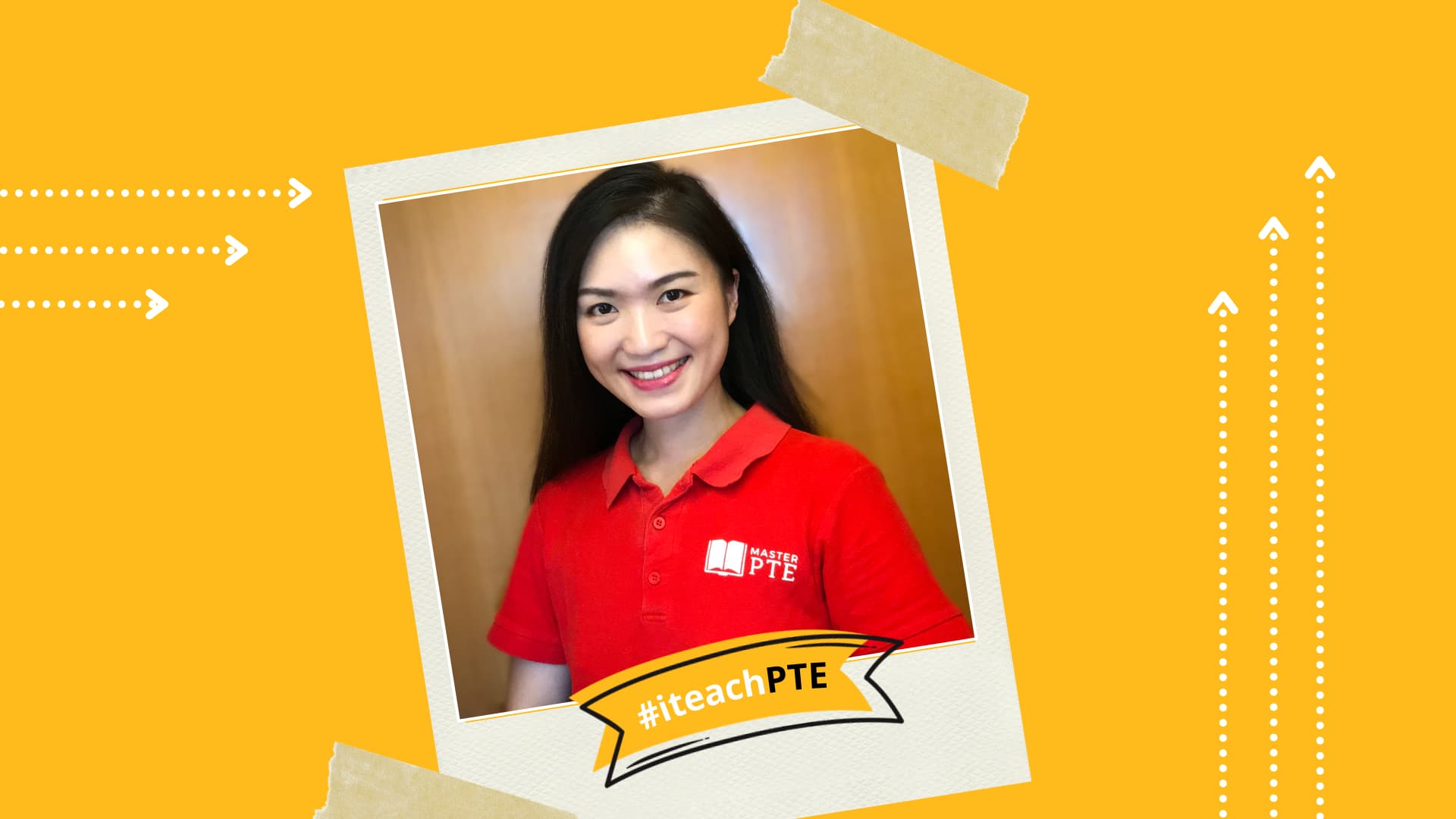

Teacher profile: Sharing the learning journey with PTE teacher Kelly Hoo

PTE Author
PTE Author
Image - Kelly Hoo #iteachPTE
Reading time: 6 minutes

Kelly Hoo is an English teacher based in Malaysia. She works with people from all over the world, helping them to prepare for PTE. But when Kelly first began learning English, she found it really difficult. She certainly never dreamed that one day she would be teaching English and running her own company!  

From student to teacher  

So how did Kelly go from learning English, to teaching other people how to get the score they need in PTE?  

Kelly’s first language was Mandarin, and she struggled a lot when first learning English. “I started my journey with IELTS,” she explains, “and then I discovered PTE.”  

Kelly was learning English in order to attend the University of Melbourne, where she studied for a Bachelor of Commerce. “I always thought I’d be an accountant,” she laughs. “But it wasn’t meant to be!”  

After graduating, Kelly went to work for Unilever, a big multinational corporation. But she found herself giving advice to people learning English, and being able to help people on their language-learning journey was really rewarding.  

“It started with sharing tips with other people who were learning English,” she says. “I’d been through the journey, so when I saw people struggling, I would always give them recommendations and advice.”  

Starting her own company 

From those small beginnings, Kelly went on to become a full-time teacher. The next step was starting her own English teaching company, Master PTE, where she is able to combine her passion for teaching with the expertise she gained in her business degree.   

But Kelly credits her success to the people around her. “It’s not just my own hard work,” she says. “Our team at Master PTE is amazing. My colleagues work so hard and do such a good job. Without them, I wouldn't be here, sharing my experience.”  

The company is now four years old, and in that time Kelly and her colleagues have helped lots of students build their English skills, prepare to sit PTE, and get the score they need.  

Helping students set manageable goals  

The team at Master PTE teaches students of all ages and levels, from all over the world, in a mix of online and in-person classes.  

“Thanks to Covid, we’re now doing hybrid classes,” explains Kelly, “a mix of online and face to face. Our clients are mainly working adults or students, so they’re very busy, and they need that flexibility.”  

At Master PTE, Kelly and her colleagues help students to break the big goal of getting the PTE score they need into smaller, more manageable goals.  

“We don’t ask them to do ten exam tasks in a day, because it’s impossible,” says Kelly. “We focus on what’s doable - a little bit of preparation each day, to make it easier for our students and give them a feeling of achievement, and the satisfaction that comes from that.”  

The skill that Kelly’s students struggle with the most is speaking. It’s a cultural problem, Kelly says, as in Malaysia, people are worried about making mistakes. “We want to boost their confidence and tell them to express themselves. I always tell students, Don’t be afraid to make a mistake. Just say what’s on your mind - it’s ok, we don’t judge people at Master PTE!”  

Speaking to a computer can also be a challenge for some students, but for others, a computer-based exam like PTE helps with their confidence. They prefer to speak to a computer rather than a human examiner.  

Kelly’s students are her inspiration  

One of the things Kelly loves about her job is meeting people from all over the world. “We have students from Japan, from Botswana, from India. It's amazing to connect with people and learn about their culture, their stories. The learning is definitely a two-way street in our classes!” she laughs.  

One of Kelly’s most inspirational students was from India. He was planning to sit PTE in order to move to Australia with his wife and young children. “When I first spoke to him, his English was at a really low level,” she explains. “I thought he would need a lot of preparation.”  

He started studying with Kelly, preparing for the test, and working hard every evening. “He was really burning the midnight oil,” she says, “as he was working full time too. He put in so much hard work, but he was doing it for his family, for his kids’ future, to give them a better life. I really admired his spirit - and I was so happy in the end when he got the score he needed after just two months of studying!”  

The importance of perspective 

Kelly has one piece of advice for other PTE teachers: always try to think from the students perspective.  

“Teaching English is easy for us,” she says. “We use English everyday. That’s why it’s so important to put yourself in your student’s shoes. Make sure they can absorb and retain the information you are teaching them.”  

From time to time, Kelly studies a new language like German, or Japanese, just to remind herself what it’s like to learn a new language.  

“I understand where the students are coming from,” she says. “I’ve been a learner too, and learning English as a second language isn’t easy.”  

That’s why Kelly is so focused on understanding each student’s situation, and making things a little easier for them by supporting them and creating a community that they are part of.  

“I always tell them, Don’t give up!” she says. “Learning can be fun and interesting.”  

Learn more 

For more insights into PTE preparation, have a look at the PTE blog, where you’ll find inspiration, advice, and lots of useful resources such as free lesson plans and preparation tools. And if you’d like to be featured on our PTE teacher profile series, just fill out this form!

Related Content

  • Image- teachers 1080px
    10 free lesson plans for PTE preparation
    By PTE Author
    Reading time: 6 minutes

    When you’re preparing students for a high-stakes exam like PTE Academic, it’s important to give them the strategies they need to succeed. But teaching exam techniques can be challenging as there’s often a lot to cover in a short space of time.  

    A good lesson plan will help you to give your students all the information they need while making sure you are using your class time as effectively as possible. 

    So, let’s take a look at some of the free lesson plans available on the PTE website, and see how they can help you save time planning your PTE Academic classes.  

    1. Reading & writing: Fill in the blanks 

    The Reading & writing: Fill in the blanks task type requires students to use their knowledge of collocation and grammar to help them predict which word best fits in each blank. There are several strategies which students can employ to help them narrow down their choices.  

    In the lesson plan, there is an example task for students to practice, pair work activities, and finally a test item for students to use the strategies they have learned. 

    Download the lesson plan now

    2. Reading: Fill in the blanks  

    In the Reading: Fill in the blanks task, test takers will need to use contextual and grammatical cues to choose the correct answer.  

    This lesson plan covers a few of the different techniques that students need to learn to answer correctly; reading for gist, word prediction, and analyzing optional answers. There are also two examples for students to practice these techniques and see which ones are the most helpful. 

    Download the lesson plan now

    3. Read aloud  

    The Read aloud task in PTE Academic integrates speaking and reading skills, requiring students to read a short text with the correct pronunciation and intonation. There are three distinct strategies which students need to use to ensure success. They’ll have to decode word meaning from context, and use phonemic awareness to pronounce unfamiliar words. They’ll also need to link words together when speaking to appear fluent.  

    In the lesson plan, you’ll see how to teach your students these strategies, step by step, and then use them to answer an example question.  

    Download the lesson plan now

    4. Highlight correct summary  

    The Highlight correct summary task type requires students to listen and read at the same time. They’ll have to understand and analyze information from a recording in order to identify the most accurate summary of this information.  

    So, what strategies can they use? This lesson will show you how to help your students develop effective note-taking skills, which are essential for this task. They’ll also need to skim the text, identify the topic sentence and the main ideas, and connect the information they’ve read with the recording.  

    Download the lesson plan now

    5. Describe image  

    Test takers often find the Describe image task to be one of the most challenging questions in PTE Academic. However, when you break it down into logical steps, as suggested in this lesson plan, your students will find it a lot easier.  

    Your class will need to study the image and identify the most important features of the graph, then use the appropriate statistical vocabulary to talk about pie charts, bar graphs, and trends in line graphs in a well-structured and simple description.   

    If you find these resources useful, you might also like to read our PTE Teacher profiles and get insider tips from PTE professionals. 

    Download the lesson plan now

    6. Answer short question  

    The Answer short question exam task is fairly straightforward and doesn’t require a particular strategy to answer. However, students will need to do a lot of reading to increase their general knowledge, boost their vocabulary and develop their word skills.  

    The lesson plan offers suggestions for helping your students to build their academic vocabulary knowledge and details a few strategies which can help students when they are listening to the question, such as listening for direction words. 

    Download the lesson plan now

     7. Summarize written text  

    In the Summarize written text task, your students will need to use two different reading skills. They’ll have to skim the text for gist, then scan it for keywords. They’ll also need to make notes, and then condense them into one sentence between 5 and 75 words long which summarizes the text.  

    In this lesson, your students will practice each step, learning how to identify keywords, making notes, and sharing them with the class. They will then work in pairs to create summarizing sentences.  

    Download the lesson plan now

    8. Re-order paragraphs  

    The Re-order paragraphs reading task requires your students to be familiar with the organization and cohesion, or academic texts. In this lesson, you’ll teach your students how to recognize a topic or opening sentence, and then use that information to identify a flow within the passage. In groups of four, students will swap work and read their reordered paragraphs aloud, then get feedback from their peers. 

    Download the lesson plan now

    9. Reading: Multiple-choice, choose multiple answers 

    In the Reading: Multiple-choice, choose multiple answers task, students will need to use a variety of reading skills. Sometimes, they’ll be able to use their own background knowledge of a topic to help them answer the question - but at other times, this won’t be appropriate.  

    You’ll teach them how to choose which approach to use by identifying the focus of the question. Then, they will share their ideas on the type of text they are reading, learn how to find specific information, and work in pairs to rule out inappropriate answers.  

    Download the lesson plan now

    10. Listening: Fill in the blanks  

    When it comes to Listening: Fill in the blanks, your students will need to use both listening and writing skills to answer this question type successfully. They will need to listen for missing words in a recording, and then type the missing words into a transcript of the recording.  

    In this lesson, you will explain and practice the strategies to succeed in this question. Timing is of the essence. That makes it important for your students to get lots of practice in listening to long words and taking note of the word roots.  

    Download the lesson plan now

    What’s included in your lesson plan pack? 

    There are twenty lesson plans available to download in total; one for each question type in PTE Academic.  

    Download the full lesson plan pack and get a PDF of each lesson plan and the audio files you’ll need to use for sample tasks which require them. Also included are model answers, so your students can see what they are working towards.  

    Discover more PTE Academic preparation resources 

    For more preparation resources, head to the PTE Academic website, where there are lots more PTE Academic resources for teachers who are helping students to prepare for their tests.  

    And finally, sign up for our monthly PTE Teacher newsletter, where you’ll get advice, resources, and inspiration. 

  • Image - Canada
    7 top universities in Canada for international students
    By PTE Author
    Reading time: 8 minutes

    Canada is one of the most educated countries in the world. In fact, 63% of people aged 24-34 have completed their post-secondary education; only South Korea ranks higher among OECD countries.  

    It comes as no surprise, then, that Canada is also home to some of the best universities in the world. From coast to coast, Canadian universities excel at innovation and research - and they work hard to support international students who’ve chosen to call the country home.  

    So, which institutions should you have on your radar? Here are seven top international universities in Canada:  

    1. University of British Columbia  

    Founded in 1908, the University of British Columbia boasts some of the most beautiful campuses in Canada. It's largest

    is in Vancouver and sits against a backdrop of the Pacific Ocean. Its second campus a few hours away is nestled in the unique Okanagan wine region.

    But, the University of British Columbia doesn’t make our list just for its incredible locations. The university is also one of the world’s best research universities - it’s ranked 45th globally by the QS World University Rankings, and number three in Canada.  It’s also home to a top subatomic physics research lab, which possesses the world’s biggest cyclotron (a particle accelerator).  

    And guess what? The University of British Columbia is also ranked North America’s most international university. Students from 166 countries are enrolled there, and the university also has a regional office in Hong Kong.  

    Cost of living: Vancouver is the most expensive city in Canada. A one-bedroom apartment in downtown Vancouver costs about $2,050 CAD/month. Learn more about how much on-campus housing costs here.  

    Tuition: Read more about the university’s fees here.  

    You might like: How to apply for a Canadian student visa

    2. University of Ottawa  

    What better place to study than in Ottawa, the capital city of Canada? Sat on the border between Ontario and Quebec, the University of Ottawa is the largest bilingual university in the world. It was founded in 1848, and today offers more than 450 programs in French and English.  

    The University of Ottawa campus features historic buildings, is close to the famous Rideau Canal, and was named number 6 in Canada for sustainability in 2020, according to the UI Greenmetric World University Rankings.  

    In recent years, the university has also invested in five new state-of-the-art facilities and research labs - including a black box theatre and an innovative STEM complex. You can take a virtual tour of the whole campus here

    Cost of living: A one-bedroom apartment downtown costs $1,618 CAD/month on average. Check out how much on-campus housing costs here.  

    Tuition: Learn more about tuition fees with the University of Ottawa’s fee calculator

    3. University of Alberta 

    The University of Alberta is located in and around Edmonton, which is the capital city of the province of Alberta. It was also founded in 1908 and boasts 18 faculties stretched across five campuses - where students from 156 countries are enrolled.  

    According to QS University Rankings, the University of Alberta is ranked 6th in Canada. It’s also ranked among the best in the world by the Centre for World University Rankings for a range of subjects - including forestry (5), geology (5), as well as - this one is cool -  paleontology (3)! In fact, a few hours from the University of Alberta is Dinosaur Provincial Park, which has been recognized by UNESCO for containing many of the most important fossils discovered from the “Age of the Dinosaurs.” 

    Cost of living: A one-bedroom apartment in downtown Edmonton costs $1,171/month on average. Learn more about University of Alberta on-campus housing here.  

    Tuition: Learn more about tuition fees at the University of Alberta here.  

    4. Dalhousie University   

    Dalhousie University is a research-intensive university in Halifax, Nova Scotia. It was founded in 1818, and offers students more than 190 undergraduate and graduate programs. Like a few other universities on our list, Dalhousie University is part of the U15 - a group of 15 leading Canadian research universities. Nearly 20% of students at the school are international. 

    Dalhousie boasts four campuses - three in Halifax and one a couple of hours away in a town called Truro. And, the province of Nova Scotia is an excellent place for international students to call home. It’s located in the heart of the Atlantic maritime, and students here will enjoy beautiful ocean views, vibrant nightlife, great live music, and friendly people. In fact, Canadian magazine Maclean’s named Halifax the best city in Canada to live and work remotely in 2021.  

    Cost of living: Halifax is an affordable city in Canada. For example, a one-bedroom apartment downtown costs about $1,415/month. Check out how much on-campus housing at Dalhousie University costs here.  

    Tuition: Learn more about tuition fees at Dalhousie University here.  

    5. York University  

    Founded in 1959, York University is the third-largest university in Canada. It’s located in Toronto - a great student city - and is home to 11 faculties. York excels in a range of courses - from education to psychology, to business. In fact, its executive master of business administration (EMBA) program was ranked first in Canada and number 21 in the world by Financial Times in 2020.  

    York University has one main campus in Toronto, as well as a smaller bilingual campus closeby. It also boasts a Hyberbad campus, where students have the opportunity to split their two-year master of business administration (MBA) course between Canada and India, as well as Las Nubes EcoCampus, located on 414 acres of protected land in Costa Rica!  

    Cost of living: A one-bedroom apartment in downtown Toronto costs about $2,100/month on average. But since York University is located outside the city center, rent may be cheaper. You can also find out more about on-campus housing at York University here.  

    Tuition: Learn more about tuition fees at York University here.  

    6. University of Manitoba  

    The University of Manitoba is located in Winnipeg, right in the center of Canada. It was founded in 1877 - making it the oldest university in Western Canada! The university offers more than 100 programs, and more than 20% of students are international. The University of Manitoba also has one of the largest Indigenous student populations in the country.  

    The university has two campuses; the largest one features 60+ buildings spread out through 692 acres, and the second is a world-class health sciences center located downtown Winnipeg. It’s also home to the Smartpark Research and Technology Park, an innovative hub that’s home to 10 buildings and 20 companies working in areas like ICT, engineering, and health and biotechnology.  

    Cost of living: Winnipeg is very affordable. A one-bedroom apartment downtown costs just $1,077/month on average. Learn more about on-campus housing at the university here.  

    Tuition: Learn more about tuition fees at University of Manitoba here. 

    7. McGill University  

    McGill University is based in Montreal, Quebec. Founded in 1821, it’s one of the most prestigious universities in Canada - and ranked 2nd in the country by QS University Rankings (31st in the world).  

    For the last 16 years, McGill’s also been ranked by Maclean’s Magazine as the best medical school in Canada. The university also has a global research focus - for example, they have international research partners in 99 countries. If you’re interested in the research they do, you can read about the 7 themes they focus most on here

    One of the best parts of enrolling at McGill? You get to live in Montreal! McGill University boasts two campuses; the main downtown campus is filled with green space and historic buildings, while the second sits on 1606 acres about 45 minutes from the city. And with its incredible arts, culture, and diversity, Montreal was named the world’s best student city for international students this year.  

    Check out our blog: 6 reasons to study in Quebec 

    Cost of living: Montreal is also one of the most affordable big cities in Canada. It costs about 1,300 CAD/month on average to rent a one-bedroom apartment. Learn more about student residence costs here.  

    Tuition: Learn more about tuition fees at McGill University here.  

    Canada is home to many world-class universities - and we can help you earn a spot. Our computer-based, unbiased English language exam PTE Academic is accepted by the majority of Canadian universities and colleges. 

    Discover more about PTE English tests for Canada.

  • Image, a girl using ATM
    A practical guide to moving to the UK as a student
    By PTE Author
    Reading time: 7 minutes

    Studying abroad is the experience of a lifetime. You’ll have an untold number of opportunities,  make friends, grow your network and broaden your horizons. But there are nerves too – and lots of questions before you start packing your bags.  

    So, if you’re considering moving to the UK to study for a pre-sessional English language course, a degree, or even a Ph.D., we have some top tips.  

    Read on to explore our short guide to studying in the UK for international students. 

    1. Setting up a bank account 

    Unless you plan to stuff your money in your mattress (not recommended), you’ll probably need to open a bank account in the UK. The process is usually completed in one or two days and is much simpler if you do it once you’re living in the country.   

    If you’re a student and come from abroad, you’ll need to show the bank a number of things before you can open your account, including: 

    • A valid passport and visa; 

    • Proof you are studying in the UK (your student ID or a letter from your university); 

    • Recent proof of address in the form of a utility bill that’s less than three months old (e.g. electricity bill); 

    • A bank or credit card statement that’s less than three months old. 

    Note that the requirements may differ from bank to bank and you may also need to show proof of employment. Some banks, like HSBC, also allow you to set up your account in your own country before leaving for the UK.  

    2. Student accommodation in the UK 

    You have two main options when it comes to student accommodation in the UK:  

    On-campus accommodation 

    In the UK, on-campus student accommodation is often referred to as living in halls. When you apply to live in halls, you are given a room in shared accommodation. Your room is usually private, however you will often share bathrooms, kitchen, and other communal areas with other students.  

    Living in halls is recommended if you’re coming from abroad. Not only does the university manage the housing, but it will be easier for you to find a place with other students.  

    Shared student accommodation 

    You can also opt to go through the university and find a place in privately rented accommodation. Second and third year students usually choose this option and move in with friends. Generally, this type of housing has been approved by the university, but you will be responsible for paying rent to a private landlord.  

    Ask your university admissions department or student services about the right option for you.  

    Alternatively, you may wish to rent privately, through a real estate agent. However, this is likely to be a far more expensive option and you won’t necessarily have university support. 

    Average student rental prices 

    The cost of living in the UK varies from region to region. According to a Save the Student survey in 2021, the average rent for students in the UK is £146 per week.  

    Here’s the breakdown of costs: 

    • Scotland: £127 per week 

    • Northern England: £122  

    • Wales and the Midlands: £119 to £129 per week 

    • East Anglia: £132 per week 

    • Southwest: £147 per week 

    • Southeast:  £146 per week 

    • London:  £152 per week 

    Living cost in the UK for international students 

    On top of rent, you also have to consider how much food, leisure, transport, and other expenses will be. Our handy guide to living expenses in the UK for international students, outlines the following, and also compares costs in different cities: 

    • Groceries – £100 per month  

    • Going out – £46 per month  

    • Transportation– £46 per month  

    • Household bills (like electricity and water) – £37 per month 

    • University tuition fees for international students – £10,000–£38,000 per year (Reddin survey of university tuition fees) 

    3. Health care systems in the UK