PTE: You Know the Score – Partner Webinar Series

Sarah Hughes
Reading time: 4 minutes

Sarah Hughes – Join me for a free partner webinar series 

As PTE partners, you play a vital role in helping students understand their results, make informed decisions and move forward with confidence. Every day, agents, teachers and institutions answer questions about PTE scores, score reports and assessment processes.

Over the past few months, we've been listening closely to your feedback. One message came through clearly: while partners trust PTE, many would welcome more support when explaining scores, handling unexpected results and answering detailed questions from test takers. That feedback directly shaped our new webinar programme. 

As part of the PTE: You Know the Score campaign, I'm delighted to invite you to a free three-part webinar series designed specifically for PTE partners. Together, we'll explore the questions partners ask most often and provide practical, evidence-based answers you can use with confidence .

Why join?

These sessions have been created to help you:

  • understand PTE scores and score reports more confidently
  • explain complex scoring topics in simple, clear language
  • respond to common student concerns and misconceptions
  • gain practical talking points you can use in real conversations
  • access trusted information directly from the PTE team.

Whether you're supporting prospective students, test takers or institutional stakeholders, these webinars will help you build confidence in every PTE scoring conversation. 

Webinar 1: Know the Score

Understanding PTE Scores and Score Reports

Wednesday 14 October | 12:00pm BST

In our first session, we'll explore how PTE scores are calculated, what score reports reveal and how to confidently explain results to students.

We'll cover:

  • understanding overall and communicative skill scores
  • how to interpret score reports
  • common questions from students about results
  • practical ways to explain scores clearly and accurately

Webinar 2: Know What to Say

Explaining unexpected scores and student questions

Wednesday 21 October | 12:00pm BST

Sometimes students receive results that differ from their expectations. These conversations can be among the most challenging for partners.

In this webinar, we'll explore:

  • understanding score differences between attempts
  • explaining uneven score profiles
  • addressing common misconceptions about scoring
  • supporting students when they have questions about their results
  • practical approaches for handling difficult conversations with confidence.

This session was developed directly in response to partner feedback and focuses on one of the areas where partners told us they would like more support. 

Webinar 3: Know How It's Scored

Inside speaking, writing and PTE assessment

Wednesday 28 October | 12:00pm BST

Speaking and Writing are often the areas partners find hardest to explain. In our final session, we'll take a deeper look at how these skills are assessed in PTE.

We'll discuss:

  • how Speaking and Writing are evaluated
  • the role of assessment technology within PTE
  • common questions about fluency, pronunciation and written responses
  • what partners should know when helping students prepare
  • how to explain assessment processes with clarity and confidence.

If you've ever been asked "How is Speaking scored?" or "What impacts my Writing score?", this session is for you.

Register for the full series

The strongest partner relationships are built on trust, confidence and knowledge. My goal with these webinars is simple: to help you feel better equipped to answer PTE scoring questions and support your students throughout their journey.

I hope you'll join me for one, two or all three sessions.

Together, let's build confidence through understanding. 

PTE. You Know the Score.

Register today:

Related Content

  • Video thumbnail for the video, 'Learn how PTE Academic uses AI to mark tests'
    How do you know PTE Academic’s computer marking works?
    By PTE Author
    Reading time: 2 minutes

    How do we know automated scoring works

    Are you thinking of taking PTE Academic, or have you recently taken it, but you are wondering how it is that a computer can mark your test?

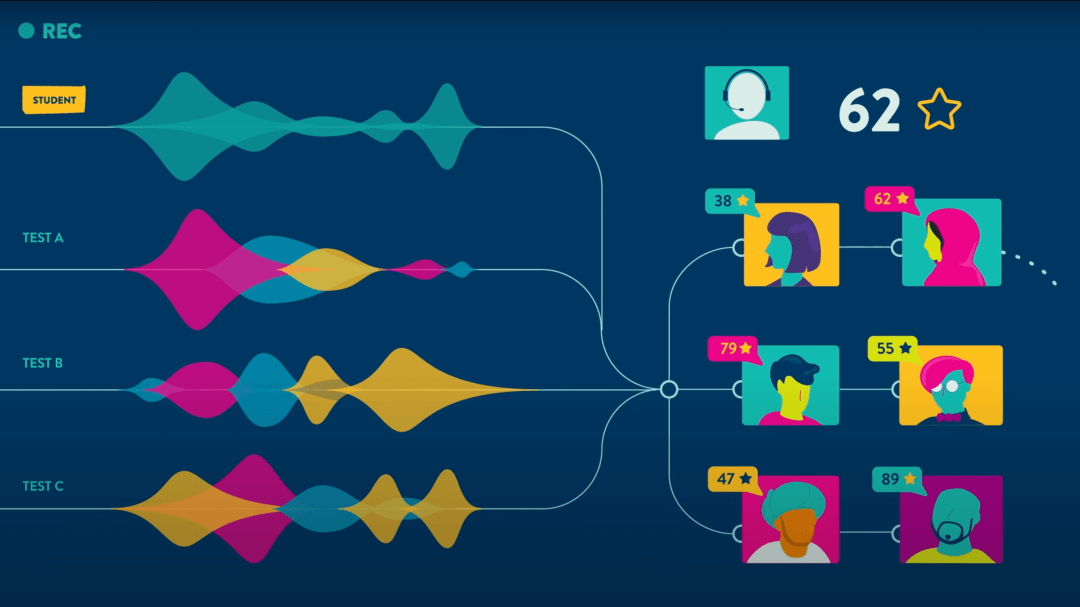
    Well, firstly the test has been designed by humans, all leading experts in their field. Our human experts design and write the questions, quality assure them, and then score them. At this point, computers are trained to use the patterns of highly trained language experts to attribute scores to questions. When the computer marks correlate highly with the human scores, we then allow the computer to mark test scripts from across the world.

    As a result of our processes and technology, the computer behaves like an expert human examiner – but without any possible bias, lack of concentration, or variation between individual examiners.

    The scoring criteria are exactly the same as human scoring – test takers are marked on their delivery, clarity, relevance, the accuracy of grammar, and appropriateness of vocabulary.

    Want to hear more?

    Take a couple of minutes and listen to one of our leading independent advisors, Dr. Alistair Van Moere, a member of Pearson’s Technical Advisory Group, as he explains how it all works.

  • Image- student at class 800px
    Reviewing Test Performance
    By PTE Author
    Reading time: 2 minutes

    If you have completed PTE Academic, you would know by now that it is scored against the Global Scale of English and that you need to practice many skills for each part of the test: Speaking & Writing, Reading, and Listening.

    After completing PTE Academic you will receive an email notification that your results are available online. Typically within 2 days. Learn how to access your Score Report.

    What does my Score Report mean?

    When you receive your Score Report it will show you your overall score, which is based on your performance across all test items. Your communicative skills that are measured are listening, reading, speaking and writing.

    This is an example of what your Score Report may look like.

    The enabling skills are those skills that are required to fulfill the question types in the test. It’s important to know what each of these skills refers to.

    Grammar

    Correct use of language with respect to word form and word order at the sentence level.

    Oral Fluency

    Smooth, effortless and natural-paced delivery of speech.

    Pronunciation

    Production of speech sounds in a way that is easily understandable to most regular speakers of the language. Regional or national varieties of English pronunciation are considered correct to the degree that they are easily understandable to most regular speakers of the language.

    Spelling

    Writing of words according to the spelling rules of the language. All national variations are considered correct, but one spelling convention should be used consistently in a given response.

    Vocabulary

    Appropriate choice of words used to express meaning, as well as lexical range.

    Written Discourse

    Correct and communicatively efficient production of written language at a textual level. Written discourse skills are represented in the structure of a written text, its internal coherence, logical development, and the range of linguistic resources used to express meaning precisely.

    How do I identify my areas of weakness?

    From the visual graph on your Score Report, you will be able to see areas you need to improve on. You should aim to develop your core (enabling) skills required across all areas of the test.

    The following resources will help you develop your enabling skills:

    How can I improve in each part of the test?

    It’s also worth focusing on particular parts of the test or questions you think you had trouble with. The following articles may help you improve your skills across questions:

    If you don’t already have one, it’s recommended to work with an English teacher to work through areas that may need improvement.

    Good luck!

  • Image- A guy with headphones and laptop
    Listening: Self-Improvement Part 1
    By PTE Author
    Reading time: 3 minutes

    After working through the strategies to improve your English listening skills, you can work on specific areas of the test. In this part, you will need to apply a number of listening and writing skills.

    Below are improvement tips on the question types that combine writing and listening skills.

    Summarize Spoken Text

    In the Summarize Spoken Text questions you will be scored on content, form, grammar, vocabulary, and spelling.

    Content and Form

    Make sure you write a good, clear summary of all the key points in the text and also condense the most important supporting points.

    In this question, you will not be given the context of the recording before it starts. Make sure to listen carefully from the start to help understand the context and the information given.

    Some helpful tips for the content and form, to maximize your score are:

    • Take notes on your Erasable Noteboard Booklet or in the response box on the screen

    • Do not try to write down sentences (you will not have enough time)

    • Use symbols and abbreviations in your notes

    • Write down key points and their relationships with others

    • Start with an overview sentence to introduce your summary

    • Use cohesive devices to link the information as you write

    • Try to write between 50 and 70 words

    Overall, make sure you summarize the text in your own words as this will show that you have understood the purpose of the text. If you do not write in your own words, you will score zero for content.

    If you write less than 40 or more than 100 words, you will score zero.

    Grammar

    It is important that grammar is correct as you will be tested on sentence structure, punctuation and capitalization.

    Try not to be too ambitious with your grammar to avoid making mistakes. Try to use grammatical structures you feel comfortable with.

    In this question type you should:

    • Communicate meaning clearly and concisely

    • Use complex sentences where possible to score more points

    • Write sentences between 18 and 30 words – long sentences are hard to control grammar

    • Check your response for common errors before submitting

    Vocabulary and Spelling

    You will score points if you use the correct and appropriate vocabulary in the Summarize Spoken Text question type. Use words from the recording if you use them appropriately, however, try to use synonyms to replace words already used.

    You will also need to make sure to spell every word correctly to receive maximum points. Try to type as carefully as possible during this question. If you can not remember how to spell a word, guess as it is better to include the word than leave it out, even if it is incorrect.

    Don’t forget to use the space bar to show the end of each word.

    Write from Dictation

    Another question that tests both listening and writing is the Write from Dictation question type.

    In this question type, you will need to write the words in the correct order with the correct spelling in order to score points.

    Before the recording starts, place your cursor in the response box and get ready to type as soon as you hear the recording. Make sure to reproduce what you hear exactly as you heard it as the recording will only be played once.

    Remember to start the sentence with a capital letter and end it with a full stop (period).

    Type as you hear it and when finished, check for any mistakes. Always make sure that to read over your answer before clicking next.

    Continue improving your listening skills by reading our Listening: Self-Improvement Part 2 article.