PTE changes 2025: everything you need to know

PTE Author
PTE Author

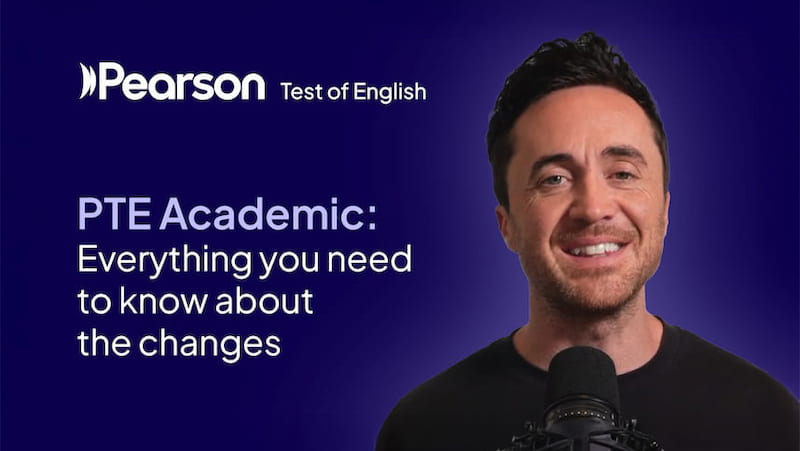
We’ve made a few updates to the PTE Academic and PTE Academic UKVI tests. To make sure you’ve got the facts, we’ve created a short video that walks you through everything you need to know.

Hosted by Jarrad, one of our product managers, this video covers what’s being updated, what’s staying the same, and how it all benefits you as a test taker.

What’s covered in the video? 

  • The original 20 question types are still in the test.

  • We are adding two new speaking question types to give you even more chance to demonstrate your skills.  

  • Tips on how to prepare for the new speaking question types.

  • There are no changes to pricing, ID requirements, or score delivery time.

  • There are no changes to the way the test is taken (including the Speaking section).

Play
Privacy and cookies
By watching, you agree Pearson can share your viewership data for marketing and analytics for one year, revocable upon changing cookie preferences. Disabling cookies may affect video functionality. More info...

For more information on the test enhancements, explore our test updates page.

Key takeaways

Here are some key questions and answers which are also covered in the video:

What are the PTE Academic changes? 

The updated PTE Academic test is almost exactly the same:

  • It still has the original 20 questions that you're familiar with. 

  • The format of the questions has not changed.

There are, however, two new speaking question types, and there are some minor scoring enhancements. 

Why is PTE Academic changing? 

Well, first of all, tests should change from time to time. It means they're evolving, are staying up to date with technology and society, and our understanding of how language is used. So these latest test updates will allow you to show off your English skills better than ever. 

Is PTE Academic becoming more difficult?

No, the changes are designed for test takers to showcase a broader range of English skills. But this doesn't mean the test is more difficult. It simply means that with a broader range of question types, you have even more opportunity to showcase your English skills.

Will I still get my PTE Academic score within two days? 

We know how important fast results are for you. You'll still get your scores back within two days in almost all cases. In rare instances it may take slightly longer, but we'll keep you updated every step of the way. 

Is PTE Academic still being accepted by the same institutions? 

Yes. There are no changes here. The same institutions still accept PTE. To find an up-to-date list, visit our Who accepts PTE? page.

Is the price of PTE Academic changing? 

No. The price stays the same. We do occasionally change our test prices, so for up-to-date prices by country, please visit our test centers and fees page.

Which PTE tests are impacted by the recent changes? 

The changes only affect PTE Academic and PTE Academic UKVI. PTE Core and PTE Home are not affected. 

Will institutions change their PTE Academic score requirements? 

Institutions do review their score requirements from time to time, so we recommend checking with your chosen institution before taking the test.

Do the ID requirements for PTE Academic stay the same? 

Yes, there are no changes whatsoever to the ID requirements that you'll need. And if you need to apply for an ID exception, please visit our ID policy page

Will retake limits on PTE Academic still remain the same? 

Yes, the retake limits stay the same. Please visit our retake policy page for full information. 

Has the PTE Academic booking process changed?

No, the booking process for PTE tests hasn't changed. You can still book a test online or by contacting our customer support team over the phone

Are the existing PTE Academic question types changing?

The original 20 question types – that is, the tasks themselves, the format, the timings, and the types of responses expected – are exactly the same. 

What are the two new PTE Academic question types? 

There are two new question types:

  • Respond to a Situation, and

  • Summarize Group Discussion

They're both speaking tasks, and you can find out more information about them on our updates page.

Will PTE Academic now be longer?

The average test duration will still be around two hours. While we have added two new questions and have increased the number of some existing tasks, it's typical for many test takers to take less than two hours to complete their test.

How should I prepare for PTE Academic?

You can still prepare for PTE Academic in the same way that you've always prepared, but we recommend that you pay close attention to the two new speaking question types and prepare specifically for how to answer these questions. Visit our PTE Academic preparation page for more information on the preparation resources we offer.  

Do you have any tips for the two new PTE Academic question types?

We have created two full length videos on the two new question types:

There is also a test tip document which will help you to prepare properly for the two new question types. 

Is the PTE Academic Score Report changing? 

No, the PTE Academic Score Report will still show your Overall , Reading, Listening, Speaking and Writing scores on a scale of 10-90.

Why are you introducing more human marking in PTE Academic? 

By using the best of AI combined with the best of human expertise, you get the most accurate score. As long as you continue to provide genuine responses to all the questions, you won't notice a difference. 

Is human marking being introduced to all PTE Academic question types?  

No. Double marking – that is, human and AI scoring for content – is used for seven of the 22 PTE Academic question types. 

That question types which use double marking are:

  • Describe Image

  • Retell Lecture

  • Summarize Written Text

  • Write Essay

  • Summarize Spoken Text

  • Summarize Group Discussion

  • Respond to a Situation

Is PTE Academic still a fair test? 

Yes, absolutely. PTE Academic is still a primarily AI-scored test taken at a computer in a test center. 

A human marker will never mark your pronunciation or fluency, as these aspects continue to be marked by a machine. For these reasons, you can be sure that your accent or appearance will not be judged. 

What PTE Academic rating scales will humans use to mark my content scores? 

The human experts always use the exact same rating scales as the AI. These rating scales are published in the Score Guide.

What information can a human expert see? 

The human expert will only see your response. They will not see your photograph, and they will not know your name or where you're from or anything about you. In fact, your test is likely to be marked by multiple human experts because all the responses that require human input get distributed to different markers. It's only your English language skills that are being judged, nothing else. 

Who are these human experts? 

All PTE Academic human scoring is done by highly qualified expert raters who are managed by Pearson. 

The PTE Academic responses that require human double marking are distributed anonymously and scored at response level, so your test is likely to be marked by multiple people. 

For any response where a machine and a human score differ, a second human makes a final judgement. 

Will my accent now be judged by a person? 

No, the human expert will never score your pronunciation or oral fluency. These traits will continue to be scored only by the AI.  You can rest assured that your accent will not affect your score. 

I thought PTE Academic was an AI-powered test? It doesn't seem that way anymore. 

PTE Academic still uses an AI-first approach to scoring. Every response gets an AI score. The AI understands different accents and doesn't see what you look like. 

The human review is a small part of the process and is only used to validate the AI score on some aspects. 

If the human score differs from the AI score, a second human expert will make the final score decision to ensure the fairest, most accurate result.

What happens to my existing PTE Academic booking? 

Your existing booking remains unchanged, so if you want to change the date of your test, you can reschedule it. For more information, you can read our reschedule and cancellation policy.

How do the PTE Academic changes benefit me, the test taker? 

The PTE Academic changes are designed to assess a broader range of real-world academic skills for study and in the workplace, making the test more relevant and authentic. 

The test continues to be trusted by governments and institutions worldwide, so you can continue to use it to reach your goals.

Related Content

  • Image- A guy with headphones and laptop
    Listening: Self-Improvement Part 1
    By PTE Author
    Reading time: 3 minutes

    After working through the strategies to improve your English listening skills, you can work on specific areas of the test. In this part, you will need to apply a number of listening and writing skills.

    Below are improvement tips on the question types that combine writing and listening skills.

    Summarize Spoken Text

    In the Summarize Spoken Text questions you will be scored on content, form, grammar, vocabulary, and spelling.

    Content and Form

    Make sure you write a good, clear summary of all the key points in the text and also condense the most important supporting points.

    In this question, you will not be given the context of the recording before it starts. Make sure to listen carefully from the start to help understand the context and the information given.

    Some helpful tips for the content and form, to maximize your score are:

    • Take notes on your Erasable Noteboard Booklet or in the response box on the screen

    • Do not try to write down sentences (you will not have enough time)

    • Use symbols and abbreviations in your notes

    • Write down key points and their relationships with others

    • Start with an overview sentence to introduce your summary

    • Use cohesive devices to link the information as you write

    • Try to write between 50 and 70 words

    Overall, make sure you summarize the text in your own words as this will show that you have understood the purpose of the text. If you do not write in your own words, you will score zero for content.

    If you write less than 40 or more than 100 words, you will score zero.

    Grammar

    It is important that grammar is correct as you will be tested on sentence structure, punctuation and capitalization.

    Try not to be too ambitious with your grammar to avoid making mistakes. Try to use grammatical structures you feel comfortable with.

    In this question type you should:

    • Communicate meaning clearly and concisely

    • Use complex sentences where possible to score more points

    • Write sentences between 18 and 30 words – long sentences are hard to control grammar

    • Check your response for common errors before submitting

    Vocabulary and Spelling

    You will score points if you use the correct and appropriate vocabulary in the Summarize Spoken Text question type. Use words from the recording if you use them appropriately, however, try to use synonyms to replace words already used.

    You will also need to make sure to spell every word correctly to receive maximum points. Try to type as carefully as possible during this question. If you can not remember how to spell a word, guess as it is better to include the word than leave it out, even if it is incorrect.

    Don’t forget to use the space bar to show the end of each word.

    Write from Dictation

    Another question that tests both listening and writing is the Write from Dictation question type.

    In this question type, you will need to write the words in the correct order with the correct spelling in order to score points.

    Before the recording starts, place your cursor in the response box and get ready to type as soon as you hear the recording. Make sure to reproduce what you hear exactly as you heard it as the recording will only be played once.

    Remember to start the sentence with a capital letter and end it with a full stop (period).

    Type as you hear it and when finished, check for any mistakes. Always make sure that to read over your answer before clicking next.

    Continue improving your listening skills by reading our Listening: Self-Improvement Part 2 article.

  • Image- A guy with headphone 1080px
    Listening: Core English Skills Part 1
    By PTE Author
    Reading time: 3 minutes

    The last part of PTE Academic, Part 3: Listening, requires a large combination of core skills.

    The very first skill you will need to develop involves how you listen (listening methods).

    Below, is information on different types of listening and where you may need to use them during PTE Academic.

    Listening Methods

    Predicting

    One of the listening methods you will need to develop is predicting. Before listening, most people will have some idea about what they are going to listen to and prepare themselves for it. They predict.

    It helps to think about the recordings before you hear it spoken, it helps you listen more effectively.

    This listening method will help during Select Missing Word questions as the topic of the text you listen to is given in the instructions. It will also help in the Re-tell Lecture questions as the image will give you an idea of the general context of the listening text.

    Listening for Gist

    Listening for ‘gist’ will allow you to understand the general meaning of a text quickly. When someone is talking, listen in a general way and think about what the speaker is trying to communicate and how they might feel about the topic based on their tone of voice.

    When practicing, try to listen for the gist before listening for a second time more intensively for specific information.

    This reading method will help in the Multiple-choice, Choose Multiple Answer and Multiple-choice, Choose Single Answer questions. Remember in PTE Academic you can not replay the listening track.

    Listen for Specific Information

    You will also need to be able to listen effectively to find specific information. This is more detailed listening and is often used when you need to answer comprehension questions. You first need to understand what information you are looking for in the text.

    When practicing, if you listen to a text that does not have questions write some yourself. Questions that may help could be:

    • What happened?

    • When did it happen?

    • Where did it happen?

    • Why did it happen? Or, why did it happen in this way, and not another way?

    While listening for specific information, you should listen for synonyms and paraphrasing to match the meaning of the text with the meaning of the questions.  This is because you will not hear the exact words in the question.

    Listening to Infer Meaning

    At times you can understand what the speakers are saying by inferring meaning, as the information is not always stated by the speakers.

    To infer meaning, you need to listen for clues in the text or use general knowledge to guess the meaning of what the speakers are saying. Do this by working out the relationship between the speakers, the tone of voice or the words they use.

    You may need to use this listening method in the Multiple-choice, Choose Multiple Answer and Multiple-choice, Choose Single Answer questions.

    In addition to listening methods, you will also need to understand how words are pronounced on their own and together in a sentence. Read more about pronunciation in Part 2 of Core English Skills.

    Want more prep ideas?

    Explore Smart Prep, which combines all our practice materials in one place, so it's easier for you to stay on track with your PTE preparation.

    • Smart Prep is a clear path to test day, guiding you through the official paid and free resources available for your test

    • It can be accessed whether you’ve booked a test or not – just create, or sign in to your myPTE account

    • Preparation materials include guided practice tests, introductory videos, video courses and test tips.

    Ready to get started?

  • Image- Reading
    Reading: Core English skills part 2
    By PTE Author
    Reading time: 3 minutes

    Once you have practiced and improved your grammar and vocabulary, for Part 2: Reading in PTE Academic, you will need to learn reading methods and the different styles of writing.

    As the PTE Academic is an integrated skills test, the skills developed will be applicable to most sections of the test.

    Firstly, the reading methods you will need to learn and develop are:

    Skim Reading

    By quickly moving your eyes over the text you will be able to get the general meaning of the text. This is the fastest way to understand the text’s meaning.

    Scan Reading

    The fastest way to locate specific information in a text is to scan read. Scan reading helps you find the keywords in a text. Once you find the section of text needed, slow down and read intensively until you understand the information needed to answer the question.

    Intensive Reading

    Intensive reading is done at a slower pace and more carefully. After using scan reading to find the section of text containing the answer you need, you will then need to read intensively to locate the specific information required to answer the question.

    If you are unable to answer the question from the section read, go back to scan reading the whole text to find the correct section, then intensively read that section.

    Critical Reading

    To read critically, you need to think more deeply about what you are reading to understand the text at a deeper level. You will then be able to identify the writer’s purpose, as well as the organization of the text in order to make inferences or understand the textual value.

    You may have to read critically to answer the reading questions Multiple-Choice, Choose Single Answer and Multiple-Choice, Choose Multiple Answers. You may also need this skill to answer the writing question Summarize Written Text, as you will score zero points if you don’t correctly identify the purpose of the text.

    The last question type this skill is used for is the listening question Highlight Correct Summary, as you may need to clarify and organize information to identify the correct summary of the text heard.

    You will also need to be able to identify the style of writing used in the reading texts throughout the test.

    Style of Writing

    For PTE Academic, you will need to understand the style or register of English texts. The style or register refers to the way in which text, that has the same meaning, can be written in different ways.

    When writing, you will need to be able to choose the appropriate words to fit the correct style of the text, as well as understand the style of texts you are reading. For example, an email to your friend will be in an informal style. However, a journal article will be in the academic style. Abstract ideas are also usually written in the academic style.

    Two or three-part verbs (phrasal and prepositional verbs) are generally informal while Latinate verbs are formal, or academic. For example, find out (informal), pick up on (informal) and discover (formal or academic).

    You will need to be able to understand not just the meaning but also the style of a text for the Reading & Writing: Fill in the Blanks questions.