
PTE changes 2025: everything you need to know

PTE Author
PTE Author

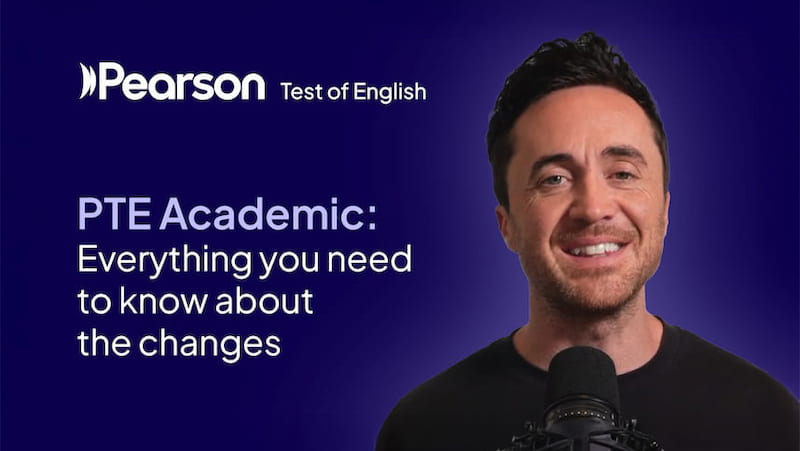
We’ve made a few updates to the PTE Academic and PTE Academic UKVI tests. To make sure you’ve got the facts, we’ve created a short video that walks you through everything you need to know.

Hosted by Jarrad, one of our product managers, this video covers what’s being updated, what’s staying the same, and how it all benefits you as a test taker.

What’s covered in the video? 

  • The original 20 question types are still in the test.

  • We are adding two new speaking question types to give you even more chance to demonstrate your skills.  

  • Tips on how to prepare for the new speaking question types.

  • There are no changes to pricing, ID requirements, or score delivery time.

  • There are no changes to the way the test is taken (including the Speaking section).

Play
Privacy and cookies
By watching, you agree Pearson can share your viewership data for marketing and analytics for one year, revocable upon changing cookie preferences. Disabling cookies may affect video functionality. More info...

For more information on the test enhancements, explore our test updates page.

Key takeaways

Here are some key questions and answers which are also covered in the video:

What are the PTE Academic changes? 

The updated PTE Academic test is almost exactly the same:

  • It still has the original 20 questions that you're familiar with. 

  • The format of the questions has not changed.

There are, however, two new speaking question types, and there are some minor scoring enhancements. 

Why is PTE Academic changing? 

Well, first of all, tests should change from time to time. It means they're evolving, are staying up to date with technology and society, and our understanding of how language is used. So these latest test updates will allow you to show off your English skills better than ever. 

Is PTE Academic becoming more difficult?

No, the changes are designed for test takers to showcase a broader range of English skills. But this doesn't mean the test is more difficult. It simply means that with a broader range of question types, you have even more opportunity to showcase your English skills.

Will I still get my PTE Academic score within two days? 

We know how important fast results are for you. You'll still get your scores back within two days in almost all cases. In rare instances it may take slightly longer, but we'll keep you updated every step of the way. 

Is PTE Academic still being accepted by the same institutions? 

Yes. There are no changes here. The same institutions still accept PTE. To find an up-to-date list, visit our Who accepts PTE? page.

Is the price of PTE Academic changing? 

No. The price stays the same. We do occasionally change our test prices, so for up-to-date prices by country, please visit our test centers and fees page.

Which PTE tests are impacted by the recent changes? 

The changes only affect PTE Academic and PTE Academic UKVI. PTE Core and PTE Home are not affected. 

Will institutions change their PTE Academic score requirements? 

Institutions do review their score requirements from time to time, so we recommend checking with your chosen institution before taking the test.

Do the ID requirements for PTE Academic stay the same? 

Yes, there are no changes whatsoever to the ID requirements that you'll need. And if you need to apply for an ID exception, please visit our ID policy page

Will retake limits on PTE Academic still remain the same? 

Yes, the retake limits stay the same. Please visit our retake policy page for full information. 

Has the PTE Academic booking process changed?

No, the booking process for PTE tests hasn't changed. You can still book a test online or by contacting our customer support team over the phone

Are the existing PTE Academic question types changing?

The original 20 question types – that is, the tasks themselves, the format, the timings, and the types of responses expected – are exactly the same. 

What are the two new PTE Academic question types? 

There are two new question types:

  • Respond to a Situation, and

  • Summarize Group Discussion

They're both speaking tasks, and you can find out more information about them on our updates page.

Will PTE Academic now be longer?

The average test duration will still be around two hours. While we have added two new questions and have increased the number of some existing tasks, it's typical for many test takers to take less than two hours to complete their test.

How should I prepare for PTE Academic?

You can still prepare for PTE Academic in the same way that you've always prepared, but we recommend that you pay close attention to the two new speaking question types and prepare specifically for how to answer these questions. Visit our PTE Academic preparation page for more information on the preparation resources we offer.  

Do you have any tips for the two new PTE Academic question types?

We have created two full length videos on the two new question types:

There is also a test tip document which will help you to prepare properly for the two new question types. 

Is the PTE Academic Score Report changing? 

No, the PTE Academic Score Report will still show your Overall , Reading, Listening, Speaking and Writing scores on a scale of 10-90.

Why are you introducing more human marking in PTE Academic? 

By using the best of AI combined with the best of human expertise, you get the most accurate score. As long as you continue to provide genuine responses to all the questions, you won't notice a difference. 

Is human marking being introduced to all PTE Academic question types?  

No. Double marking – that is, human and AI scoring for content – is used for seven of the 22 PTE Academic question types. 

That question types which use double marking are:

  • Describe Image

  • Retell Lecture

  • Summarize Written Text

  • Write Essay

  • Summarize Spoken Text

  • Summarize Group Discussion

  • Respond to a Situation

Is PTE Academic still a fair test? 

Yes, absolutely. PTE Academic is still a primarily AI-scored test taken at a computer in a test center. 

A human marker will never mark your pronunciation or fluency, as these aspects continue to be marked by a machine. For these reasons, you can be sure that your accent or appearance will not be judged. 

What PTE Academic rating scales will humans use to mark my content scores? 

The human experts always use the exact same rating scales as the AI. These rating scales are published in the Score Guide.

What information can a human expert see? 

The human expert will only see your response. They will not see your photograph, and they will not know your name or where you're from or anything about you. In fact, your test is likely to be marked by multiple human experts because all the responses that require human input get distributed to different markers. It's only your English language skills that are being judged, nothing else. 

Who are these human experts? 

All PTE Academic human scoring is done by highly qualified expert raters who are managed by Pearson. 

The PTE Academic responses that require human double marking are distributed anonymously and scored at response level, so your test is likely to be marked by multiple people. 

For any response where a machine and a human score differ, a second human makes a final judgement. 

Will my accent now be judged by a person? 

No, the human expert will never score your pronunciation or oral fluency. These traits will continue to be scored only by the AI.  You can rest assured that your accent will not affect your score. 

I thought PTE Academic was an AI-powered test? It doesn't seem that way anymore. 

PTE Academic still uses an AI-first approach to scoring. Every response gets an AI score. The AI understands different accents and doesn't see what you look like. 

The human review is a small part of the process and is only used to validate the AI score on some aspects. 

If the human score differs from the AI score, a second human expert will make the final score decision to ensure the fairest, most accurate result.

What happens to my existing PTE Academic booking? 

Your existing booking remains unchanged, so if you want to change the date of your test, you can reschedule it. For more information, you can read our reschedule and cancellation policy.

How do the PTE Academic changes benefit me, the test taker? 

The PTE Academic changes are designed to assess a broader range of real-world academic skills for study and in the workplace, making the test more relevant and authentic. 

The test continues to be trusted by governments and institutions worldwide, so you can continue to use it to reach your goals.

Related Content

  • Image- At cafe
    Speaking: Self-Improvement Part 1
    By PTE Author
    Reading time: 3 minutes

    In Part 1 of PTE Academic, you will require many core English skills to pass. It is very important that you prepare and look at ways you can maximize your score.

    We’ve put together some tips to help based on each question type.

    Read aloud

    In the Read Aloud question type, you will be scored based on content, oral fluency and pronunciation.

    As part of this question type, you will need to speak aloud and say all the words in the correct order.

    Here are some tips to help maximize your chances of receiving points:

    • Make sure you do not replace any words, leave any words out or add any. If you make a mistake and try to correct it, it will be counted as added words.

    • Once prompted, you must speak into the microphone right away and read with a smooth, easy natural speed. Try not to speak too fast or too slow.

    • Use English rhythm with chunking and sentence stress used correctly.

    • Try not to hesitate or repeat words as you will lose points.

    Repeat sentence

    The Repeat Sentence question type is scored based on the same elements as the Read Aloud question type: content, oral fluency and pronunciation.

    Here are some tips to help gain points in this question type:

    • Say all of the words in the exact same order. Do not rush.

    • Do not use the Erasable Noteboard Booklet, keep the sentence in your head.

    • It’s easier to keep the sentence in your mind if you understand the meaning. Try to understand the meaning.

    • If unsure of a word the speaker used, say what you think you heard.

    • Do not speak too fast or slow.

    • Similar to read aloud, use English rhythm with chunking and sentence stress. You will also lose points in this question type if you hesitate, repeat words or stumble to start.

    • Speak with the sounds of an English speaker and copy the intonation pattern of the speaker, but do not change your accent.

    Describe image

    In the Describe Image question type, you will be scored based on content, oral fluency and pronunciation.

    To be able to describe the image, you will need to understand it as it could be a graph, picture, map, chart or table. Always read the title and make sure you understand the parts that make up the image.

    Some extra tips include:

    • Use the Erasable Noteboard Booklet to take notes about the image, which you can use in your answer. For example, if the image is a graph, chart or table, is there a trend you can comment on? If it’s a map or picture, what are the important features?

    • Include all aspects and elements of the image in your answer.

    • Start with a general statement about the image then summarize the most important points.

    • If there are words on the image you want to use but are unsure how to pronounce them, don’t worry, just say them how you think they should be said.

    • Try using connector words to link the information you give. For example, use words such as: also, however, as or besides.

    You can receive up to 5 points based on your content. In order to score above 1, you will need to include the relationships between parts of the image, possible developments and conclusions or implications of the information in the image.

    Don’t forget to talk with a smooth, natural speed at all times during the speaking test.

    In total, there are five speaking sections of Part 1: Speaking and Writing.

    We recommend that you read more about the other question types such as Re-tell Lecture and Short Answer Question types and learn how to pick up points for these.

    Want to learn more about the smart way to prepare for PTE?

    Smart Prep brings all our free and paid preparation into one convenient place, so you can mix and match to fit your unique needs.

    • Smart Prep provides a clear path to test day, guiding you through the official paid and free resources available for your test

    • It can be accessed whether you’ve booked a test or not – just create, or sign in to your myPTE account

    • Preparation materials include guided practice tests, introductory videos, video courses and test tips.


  • Image- study group, 750px
    Why fluent English speakers don’t always get a perfect score
    By PTE Author
    Reading time: 2 minutes

    Being an experienced English speaker does not guarantee you a high score

    It can come as a surprise to test takers, who consider themselves to be fluent in English, that they can score less well in an English test than they expect.

    Dr. Alistair Van Moere, a member of Pearson’s Technical Advisory Group, explains that it’s not unusual for people who have recently learned English to score higher than those that have spoken English for a long time. This happens on all high-stakes tests, not just on PTE Academic, as fluent speakers are often not prepared to do the test. PTE Academic contains question types that a fluent English speaker may not have done for a long time, for example, writing an essay.

    This is why all test takers, including fluent English speakers, should prepare before test day.

  • Image - 2 Asian students - 800x600px
    Sitting PTE Academic for the first time
    By PTE Author
    Reading time: 3 minutes

    Choosing to study or migrate abroad is a big decision and may require you to demonstrate your skills in English.

    The Pearson Test of English Academic (PTE Academic) is widely trusted by universities, colleges, and governments around the world. Taking PTE Academic can create opportunities for you around the world.

    If you are taking the test for the first time, study each part of the test thoroughly to demonstrate your English skills as best you can.

    Even people that consider themselves to be fluent in English need to prepare as they can sometimes score fewer points than they should have as they have not prepared.

    We can help you achieve your best!

    What should I expect on test day?