How to choose the best English test for US college admissions

Reading time: 4 minutes

Applying to a US college as an international student means proving your English language proficiency. But with so many exam providers—PTE Academic, TOEFL, IELTS, and Duolingo—it can be challenging to decide which one fits your goals best. 

The best test for US college admission depends on several factors: which exams your chosen university or college accept, your preferred format, budget, and how soon you need your scores. This guide walks you through each key step, helping you select the right test and prepare with confidence.

Confirm program acceptance and score requirements

Your first step should be confirming which English proficiency tests your target colleges accept. While many institutions list general requirements, individual departments—especially in competitive majors, can have different policies or higher score thresholds.

Make a master list of your target colleges, recording accepted tests and minimum scores. A minimum score or section cutoff is the lowest score required on an English test, either for the total or for specific skills like speaking or writing.

Many US colleges accept Pearson PTE Academic alongside TOEFL, IELTS, and Duolingo. Checking official college websites early prevents costly surprises and helps you plan effectively.

You can organize your research in a simple table:

College name Accepted tests Minimum score Notes
Example University
  • PTE Academic
  • TOEFL iBT
  • IELTS Academic
PTE 55 overall  Engineering requires 60+ in writing

Set competitive target scores

Once you know each program’s minimum requirements, set your personal goal higher to boost your admission chances. A competitive score is one that exceeds the listed minimum, strengthening your profile and potentially supporting scholarships or honors program consideration.

Aim 5–10 points above the minimum required score on PTE Academic or TOEFL iBT, or about one band higher in band-scaled tests like IELTS Academic. This buffer protects against test-day variability and can help in competitive admissions.

Confirm if your programs require skill-specific scores for each section (speaking, writing, reading and listening). Some universities only consider applicants who meet every individual section requirement, not just overall.

Consider creating a helpful reference table:

College Minimum (overall) Target (recommended)
State University PTE 55 PTE 60–65
Tech Institute TOEFL 80 TOEFL 90+

Evaluate test formats for your strengths

Different English tests suit different learning preferences. Exploring official practice questions and preparation resources helps you find which format feels most natural.

Test design varies. Fixed-format tests , like PTE Academic or TOEFL iBT, and use academic content designed to assess the language skills needed for university study, which is one reason they remain the most widely accepted tests for university admissions. An adaptive test, such as the Duolingo English Test, adjusts question difficulty as you progress through the exam.

Here’s how the main exams compare:

Test  Format & skills Delivery Duration Key feature
Duolingo English Test Adaptive, integrated tasks Online 45–60 mins Fast, low cost
IELTS Academic 4 skills, speaking face to face Paper or computer ~2 hrs 45 mins Conversation-based speaking
Pearson PTE Academic Fully computer-based, all skills integrated Global test centers ~2 hrs Secure AI scoring and fast results
TOEFL iBT Reading, listening, speaking, writing Computer or at-home ~2 hrs Academic content focus

Frequently asked questions

Related Content

  • Video thumbnail for the video, 'Learn how PTE Academic uses AI to mark tests'
    How do you know PTE Academic’s computer marking works?
    By PTE Author
    Reading time: 2 minutes

    How do we know automated scoring works

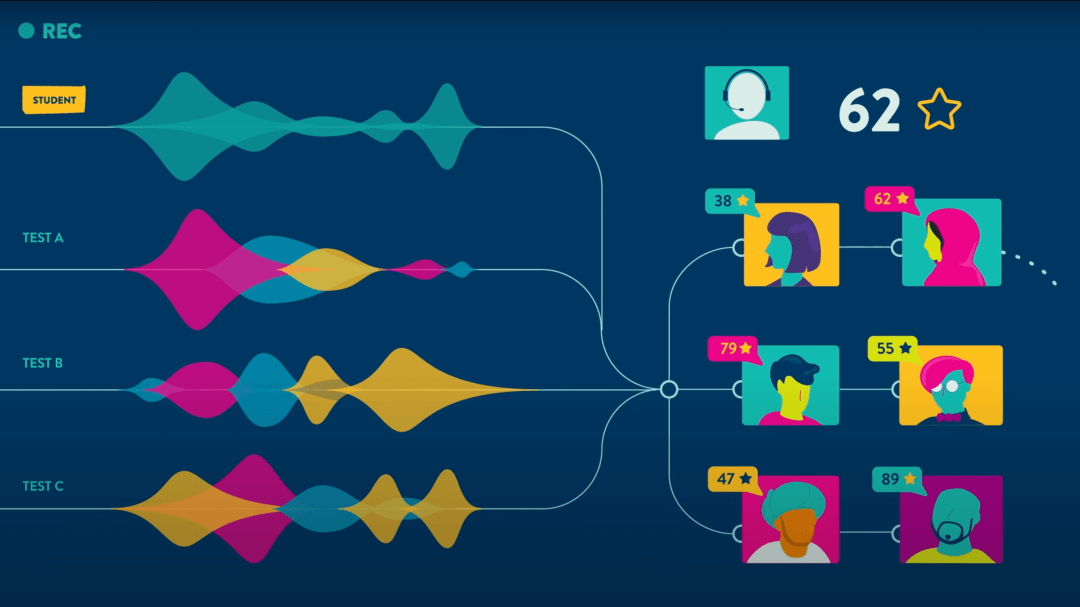
    Are you thinking of taking PTE Academic, or have you recently taken it, but you are wondering how it is that a computer can mark your test?

    Well, firstly the test has been designed by humans, all leading experts in their field. Our human experts design and write the questions, quality assure them, and then score them. At this point, computers are trained to use the patterns of highly trained language experts to attribute scores to questions. When the computer marks correlate highly with the human scores, we then allow the computer to mark test scripts from across the world.

    As a result of our processes and technology, the computer behaves like an expert human examiner – but without any possible bias, lack of concentration, or variation between individual examiners.

    The scoring criteria are exactly the same as human scoring – test takers are marked on their delivery, clarity, relevance, the accuracy of grammar, and appropriateness of vocabulary.

    Want to hear more?

    Take a couple of minutes and listen to one of our leading independent advisors, Dr. Alistair Van Moere, a member of Pearson’s Technical Advisory Group, as he explains how it all works.

  • Image- student at class 800px
    Reviewing Test Performance
    By PTE Author
    Reading time: 2 minutes

    If you have completed PTE Academic, you would know by now that it is scored against the Global Scale of English and that you need to practice many skills for each part of the test: Speaking & Writing, Reading, and Listening.

    After completing PTE Academic you will receive an email notification that your results are available online. Typically within 2 days. Learn how to access your Score Report.

    What does my Score Report mean?

    When you receive your Score Report it will show you your overall score, which is based on your performance across all test items. Your communicative skills that are measured are listening, reading, speaking and writing.

    This is an example of what your Score Report may look like.

    The enabling skills are those skills that are required to fulfill the question types in the test. It’s important to know what each of these skills refers to.

    Grammar

    Correct use of language with respect to word form and word order at the sentence level.

    Oral Fluency

    Smooth, effortless and natural-paced delivery of speech.

    Pronunciation

    Production of speech sounds in a way that is easily understandable to most regular speakers of the language. Regional or national varieties of English pronunciation are considered correct to the degree that they are easily understandable to most regular speakers of the language.

    Spelling

    Writing of words according to the spelling rules of the language. All national variations are considered correct, but one spelling convention should be used consistently in a given response.

    Vocabulary

    Appropriate choice of words used to express meaning, as well as lexical range.

    Written Discourse

    Correct and communicatively efficient production of written language at a textual level. Written discourse skills are represented in the structure of a written text, its internal coherence, logical development, and the range of linguistic resources used to express meaning precisely.

    How do I identify my areas of weakness?

    From the visual graph on your Score Report, you will be able to see areas you need to improve on. You should aim to develop your core (enabling) skills required across all areas of the test.

    The following resources will help you develop your enabling skills:

    How can I improve in each part of the test?

    It’s also worth focusing on particular parts of the test or questions you think you had trouble with. The following articles may help you improve your skills across questions:

    If you don’t already have one, it’s recommended to work with an English teacher to work through areas that may need improvement.

    Good luck!

  • Image- A guy with headphones and laptop
    Listening: Self-Improvement Part 1
    By PTE Author
    Reading time: 3 minutes

    After working through the strategies to improve your English listening skills, you can work on specific areas of the test. In this part, you will need to apply a number of listening and writing skills.

    Below are improvement tips on the question types that combine writing and listening skills.

    Summarize Spoken Text

    In the Summarize Spoken Text questions you will be scored on content, form, grammar, vocabulary, and spelling.

    Content and Form

    Make sure you write a good, clear summary of all the key points in the text and also condense the most important supporting points.

    In this question, you will not be given the context of the recording before it starts. Make sure to listen carefully from the start to help understand the context and the information given.

    Some helpful tips for the content and form, to maximize your score are:

    • Take notes on your Erasable Noteboard Booklet or in the response box on the screen

    • Do not try to write down sentences (you will not have enough time)

    • Use symbols and abbreviations in your notes

    • Write down key points and their relationships with others

    • Start with an overview sentence to introduce your summary

    • Use cohesive devices to link the information as you write

    • Try to write between 50 and 70 words

    Overall, make sure you summarize the text in your own words as this will show that you have understood the purpose of the text. If you do not write in your own words, you will score zero for content.

    If you write less than 40 or more than 100 words, you will score zero.

    Grammar

    It is important that grammar is correct as you will be tested on sentence structure, punctuation and capitalization.

    Try not to be too ambitious with your grammar to avoid making mistakes. Try to use grammatical structures you feel comfortable with.

    In this question type you should:

    • Communicate meaning clearly and concisely

    • Use complex sentences where possible to score more points

    • Write sentences between 18 and 30 words – long sentences are hard to control grammar

    • Check your response for common errors before submitting

    Vocabulary and Spelling

    You will score points if you use the correct and appropriate vocabulary in the Summarize Spoken Text question type. Use words from the recording if you use them appropriately, however, try to use synonyms to replace words already used.

    You will also need to make sure to spell every word correctly to receive maximum points. Try to type as carefully as possible during this question. If you can not remember how to spell a word, guess as it is better to include the word than leave it out, even if it is incorrect.

    Don’t forget to use the space bar to show the end of each word.

    Write from Dictation

    Another question that tests both listening and writing is the Write from Dictation question type.

    In this question type, you will need to write the words in the correct order with the correct spelling in order to score points.

    Before the recording starts, place your cursor in the response box and get ready to type as soon as you hear the recording. Make sure to reproduce what you hear exactly as you heard it as the recording will only be played once.

    Remember to start the sentence with a capital letter and end it with a full stop (period).

    Type as you hear it and when finished, check for any mistakes. Always make sure that to read over your answer before clicking next.

    Continue improving your listening skills by reading our Listening: Self-Improvement Part 2 article.