


Great movies to help you learn English

PTE Author
PTE Author
A female model watching movie
Reading time: 5 minutes

Learning a language is much easier when you’re enjoying yourself – which is why watching movies can be a great way to immerse yourself in the language.

What better way is there to pick up new phrases and slang terms that you would not learn in the classroom, all with popcorn in hand?

It can be hard to know which movie to choose so here are our top ten to help you get started. These films are chosen for their language clarity and cultural insights, offering a fun way to improve English skills for beginners and advanced learners alike.

If you are not feeling confident, watch with subtitles and you will soon pick things up.

1. Forrest Gump (1994)

A fantastic choice for beginners, this film teaches English while taking you through the heart of American history. This movie is one of the best English movies for learners as Forrest speaks so slowly throughout the entire movie. It is also an iconic 90’s movie which will make you laugh and cry in equal measure.

2. Harry Potter series

Perfect for all ages, these films are a treasure trove of rich vocabulary set in a magical world. Many things make the Harry Potter series great for your linguistics skills! Aside from the rich vocabulary, due to the sheer number of films in the series you will get to build up your understanding of different characters, their personalities, accents and ways of communicating.

3. The King's Speech (2010)

What a great idea for learning English – watching a film where the main character – a historic British figure – is learning to speak! King George VI struggles to communicate due to a speech impediment, which means pronunciation is a very big focus in this movie.

4. Pride and Prejudice (2005)

For lovers of classic literature, this film offers a window into historical British English. The movie adaptation of Pride and Prejudice will also expose you to societal norms, colloquial expressions, formal language and phrases as this movie is set in the early 19th century England.

5. Home Alone (1990)

This is one of the best English movies to watch, especially for beginners. It is full of day-to-day phrases and a slower pace, so it is easier to follow along. It is also a Christmas classic for all the family.

6. Love Actually (2010)

Great for picking up informal turns of phrases, slang and expressions used by British people. It also showcases a variety of British (and Irish) accents, so you can expose yourself to a breadth of British ways of speaking.

7. Little Miss Sunshine (2006)

A charming film for mastering conversational American English.

8. The Pursuit of Happyness (2006)

Immerse in everyday conversational English set in contemporary America.

9. Brave (2012)

Animated and perfect for beginners, this film is set in Medieval Scotland so you will get to experience the Scottish accent and culture as well as learning some everyday phrases and idioms.

10. Inception (2010)

This movie should be on your list if you are focusing on advanced language learning. The language and the plot are both really complex. You will be exposed to advanced vocabulary and narratives which are really thought-provoking.

These films offer an immersive, engaging, and often emotionally resonant context for language learning. Whether you're just starting or looking to refine your skills, each movie is a step forward in your language-learning adventure.

More ways to prep

Ready to prepare for your English language test? Explore Smart Prep, which combines all our practice materials in one place, so it's easier for you to stay on track with your PTE preparation.

  • Smart Prep is a clear path to test day, guiding you through the official paid and free resources available for your test

  • It can be accessed whether you’ve booked a test or not – just create, or sign in to your myPTE account

  • Preparation materials include guided practice tests, introductory videos, video courses and test tips.

Play
Privacy and cookies
By watching, you agree Pearson can share your viewership data for marketing and analytics for one year, revocable upon changing cookie preferences. Disabling cookies may affect video functionality. More info...

2. The Social Network (2010)

The Social Network is an interesting movie. Although it’s an English language film, it tackles a subject matter that almost every person in every country is familiar with: social media.  

The Social Network stars Jesse Eisenberg as Harvard University student, Mark Zuckerberg, the real-life current CEO of Facebook. As Zuckerberg establishes a social network that will go on to be one of the most dominant forms of media in the current age, he is being sued by twins who claim he stole their idea, as well as the co-founder who was eventually ousted from the business. 

The familiarity of the subject matter is bound to be helpful to those learning English, especially when trying to understand the context and gravity of this film in a new language. 

Play
Privacy and cookies
By watching, you agree Pearson can share your viewership data for marketing and analytics for one year, revocable upon changing cookie preferences. Disabling cookies may affect video functionality. More info...

3. Jurassic Park (1993)

Jurassic Park is a ridiculously entertaining movie and memorable due to its impressive special effects, sweeping score and some of the most iconic scenes in modern cinema history. After dinosaurs are brought back to life using DNA samples, a park is opened where the beasts can roam. Paleontologist Dr. Alan Grant (Sam Neill) is invited to inspect the park before it is opened, but when a storm knocks out the park’s power and security systems, the dinosaurs are let loose and the race to escape the park is on. 

If you have been learning English for some time already, Jurassic Park is one of the great movies to learn English too, with some fancy scientific terminology thrown in that can really open up your vocabulary. The sheer entertainment factor will have you coming back again and again for more in-depth learning. 

Play
Privacy and cookies
By watching, you agree Pearson can share your viewership data for marketing and analytics for one year, revocable upon changing cookie preferences. Disabling cookies may affect video functionality. More info...

 4. Australia (2008)

Directed by iconic Australian filmmaker Baz Luhrmann, Australia is a fantastic choice for learning through movies for various reasons. Set in northern Australia before World War II, Australia follows the journey of English aristocrat Lady Sarah Ashley (Nicole Kidman) as she comes to Australia and reluctantly teams up with stock-man Drover (Hugh Jackman) in order to protect her newly inherited property from a takeover plot. This sees them drive 2,000 cattle across the harsh Australian Outback. 

Australia is a great movie that can be used as a tool to understand the English language, Australian accents, and unique slang, and the many facets of Australian culture.

Play
Privacy and cookies
By watching, you agree Pearson can share your viewership data for marketing and analytics for one year, revocable upon changing cookie preferences. Disabling cookies may affect video functionality. More info...

5. The King’s Speech (2010)

The King’s Speech is a fantastic introduction to British accents and is a rare film that focuses on an individual’s manner of speech – which is rather important when you’re the king of England and World War II is approaching. It almost works as an English lesson on its own, as King George (Colin Firth) works under a speech therapist (Geoffrey Rush) to tackle his stammer. 

This highly acclaimed film is another that does more than cover the English language; it also brings in plenty of colloquialisms (get ready to hear “bloody” used in a new context!) and a rich lesson in British history.

Play
Privacy and cookies
By watching, you agree Pearson can share your viewership data for marketing and analytics for one year, revocable upon changing cookie preferences. Disabling cookies may affect video functionality. More info...

6. The Shawshank Redemption (1994)

Considered to be one of the best English movies of all time – perhaps the best – The Shawshank Redemption is a long film, but a must-see if you’re learning English and want to appreciate an absolute classic. The story follows two imprisoned men and their years spent in an American prison, and the ways that they deal with their torturous lives. 

A highly emotional film, The Shawshank Redemption might be difficult to follow until the advanced stages of English, but regardless it is a film that all English-speakers should one day see.

Play
Privacy and cookies
By watching, you agree Pearson can share your viewership data for marketing and analytics for one year, revocable upon changing cookie preferences. Disabling cookies may affect video functionality. More info...

7. Harry Potter And The Philosopher’s Stone (2001) 

With seven movies to follow the first, Harry Potter And The Philosopher’s Stone. is a fantastical look into a hidden wizarding world and the magical school of Hogwarts School of Witchcraft and Wizardry. With a cast made up almost entirely of UK actors, it gives you excellent exposure to many English, Scottish and Irish accents and a great sense of British culture as well as fun words that are entirely unique to the Harry Potter franchise, such as “Muggle” (a non-magical person) – and plenty of British slang, too. 

The film’s plot is thoroughly enjoyable and easy to follow but eventually builds in intricacy as the franchise goes on.  

Play
Privacy and cookies
By watching, you agree Pearson can share your viewership data for marketing and analytics for one year, revocable upon changing cookie preferences. Disabling cookies may affect video functionality. More info...

 8. Forrest Gump (1994)

This charming and funny film follows the life of Forrest Gump (Tom Hanks) and his unknowing involvement in parts of America’s history, including the Vietnam War and teaching Elvis Presley how to dance. Due to the simpler way Forrest speaks throughout the film (as is part of his character), he is easy to understand, especially for those who are new to learning English, although he does speak with a strong southern American accent.  

Play
Privacy and cookies
By watching, you agree Pearson can share your viewership data for marketing and analytics for one year, revocable upon changing cookie preferences. Disabling cookies may affect video functionality. More info...

As you can see, English language movies are an excellent aid in becoming a proficient English-speaker – and it’s a lot more fun than staring down at a textbook all day! And when it comes time for you to test your understanding of English, Pearson PTE Academic can help to set you up for the future.

Related Content

  • Image- Big Ben
    Olivia’s Chevening dream: a decade in the making
    By PTE Author
    Reading time: 5 minutes

    The Chevening scholarship is a route to studying in the UK for people all over the world. It offers the brightest and best the opportunity to study for a Master’s at a British university. Since 1983, Chevening has helped over 50,000 professionals pursue their studies and become leaders within their communities and sectors.  

    Chevening scholar Olivia Rondonuwu grew up in Jakarta, Indonesia. Her background was in journalism and she dreamed of studying social policy in the UK. But her path to becoming an international Master’s student wasn’t a straightforward one.  

    The importance of determination 

    Olivia knew several successful people working in journalism who’d been awarded Chevening scholarships. As a journalist, she’d interviewed high profile people who were alumni of LSE. Her ambition was to become one of the female leaders in the Indonesian media, focusing on Indonesian social policy.  

    “I had been thinking about the scholarship for ten years,” she says. “My dream was to study social policy at the London School of Economics, but of course, I couldn’t afford it.”  

    Competition for the scholarships is fierce, as Olivia discovered the first time she applied to the Chevening scholarship. She got to the interview stage, but she wasn’t successful. Then she applied again - and this time, she didn’t reach the interview stage.  

    However, Olivia wasn’t deterred from pursuing her dream of studying in the UK - and on her third application for the Chevening scholarship, her persistence paid off. “I couldn’t believe it,” she says. “It didn’t seem real until I got on the plane to London. It had been such a long process - I was so happy to finally be going to study in the UK.”  

    Studying at the London School of Economics  

    So how was Olivia’s first day in London? “It was horrible,” she laughs. “The weather was awful, and my bus got stuck in a traffic jam. In Indonesia, if you’re in a traffic jam, you can just get off the bus and jump on a motorbike taxi – but in London, you can’t do that! And at lunchtime, it seemed like the only option was cold sandwiches – British people love bread!” 

    As Olivia started the MSc in Social Policy and Development, doubts started creeping in. Had moving to London to study been the right choice for her after all?  

    Imposter syndrome affects a lot of students who are studying at top universities. At times, they can feel that they don’t belong there. And Olivia felt that, as an older student, she was at a disadvantage, compared to other students who’d gone straight into the Master’s from their undergraduate degree. “I was thirty six,” she explains, “so I was older than a lot of the other students. I felt that I was too old to be there.”  

    Luckily, it didn’t take Olivia long to shake off these doubts. As the course went on, she was able to recognise the value of her experience as a journalist, and gain in confidence and self-belief.  

    “You have to look inside yourself,” she explains, “and find the confidence to say, I’m a future leader.” And of course, she’d been waiting for so long to study at LSE -  meaning that she really appreciated every moment, and was able to make the most of this amazing opportunity.  

    A personal transformation and a new network 

    Once Olivia got over her imposter syndrome, she found herself gaining more and more confidence, thanks in part to the academic culture at LSE and the focus on critical thinking. “It was quite different from Indonesian academic culture,” Olivia explains.  

    “Here, you are encouraged to think more critically about your opinion on a topic.” She found that building her critical thinking skills helped with her self-belief. “Once you have the confidence in yourself, it helps you to dare to be different,” she says.  

    The other thing that Olivia loved about her Chevening experience was meeting other students from all over the world. “I was amazed by how international the group was - there were students from Latin America, from Afghanistan,” she says. “It was very competitive, but very international.”  

    Studying in the melting pot of a London university was a fantastic way to build a global, professional network. 

    Advice for other international students 

    Before Olivia travelled to London, she was given lots of advice by the UK embassy in Jakarta. “They warned us about the weather,” she says. “They even recommended getting a special lamp in case we suffered from seasonal affective disorder!”  

    But when Olivia is asked what her words of advice were for other international students, her answer is perhaps surprising. “Be brave and embrace it, the bad and the good,” she says. “Enjoy every minute. Yeah, some days the weather will be grey, but enjoy it! It’s all part of the experience of studying in the UK. So enjoy every minute - learning, networking, living in London.”  

    Though she will admit – she still doesn’t like sandwiches for lunch!  

    Learn more 

    In order to study at a UK university and apply for a UK student visa, you’ll need to prove your level of English. PTE Academic is a fast, reliable, computer-based test that is accepted by 99% of UK universities and the UK Home Office as proof of your English language skills. You’ll typically receive your scores in just two days - so you won’t have a long wait for your results, and can get on with the application process!  

    Learn more about how PTE Academic can help you study in the UK.
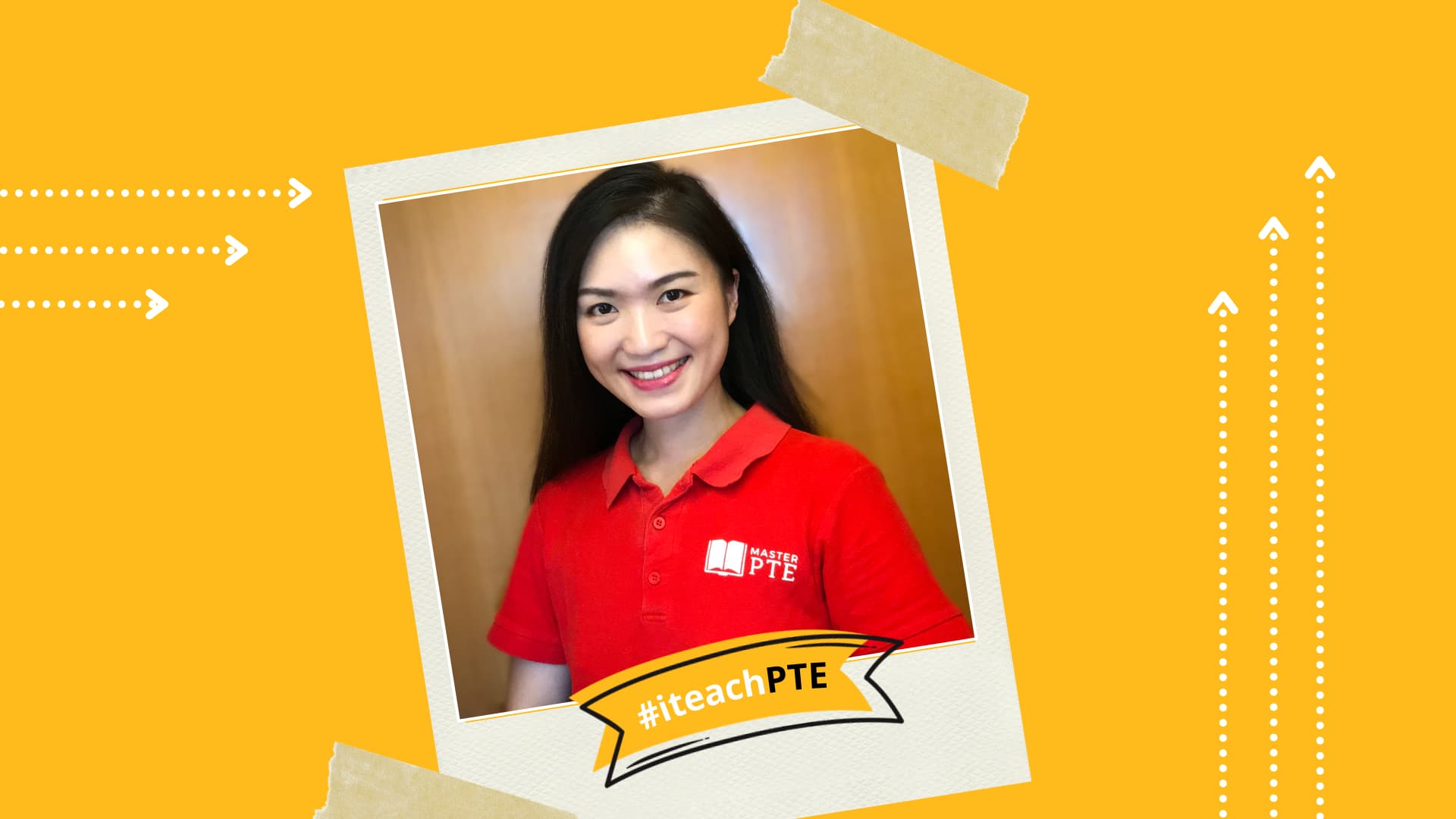
  • Image - Kelly Hoo #iteachPTE
    Teacher profile: Sharing the learning journey with PTE teacher Kelly Hoo
    By PTE Author
    Reading time: 6 minutes

    Kelly Hoo is an English teacher based in Malaysia. She works with people from all over the world, helping them to prepare for PTE. But when Kelly first began learning English, she found it really difficult. She certainly never dreamed that one day she would be teaching English and running her own company!  

    From student to teacher  

    So how did Kelly go from learning English, to teaching other people how to get the score they need in PTE?  

    Kelly’s first language was Mandarin, and she struggled a lot when first learning English. “I started my journey with IELTS,” she explains, “and then I discovered PTE.”  

    Kelly was learning English in order to attend the University of Melbourne, where she studied for a Bachelor of Commerce. “I always thought I’d be an accountant,” she laughs. “But it wasn’t meant to be!”  

    After graduating, Kelly went to work for Unilever, a big multinational corporation. But she found herself giving advice to people learning English, and being able to help people on their language-learning journey was really rewarding.  

    “It started with sharing tips with other people who were learning English,” she says. “I’d been through the journey, so when I saw people struggling, I would always give them recommendations and advice.”  

    Starting her own company 

    From those small beginnings, Kelly went on to become a full-time teacher. The next step was starting her own English teaching company, Master PTE, where she is able to combine her passion for teaching with the expertise she gained in her business degree.   

    But Kelly credits her success to the people around her. “It’s not just my own hard work,” she says. “Our team at Master PTE is amazing. My colleagues work so hard and do such a good job. Without them, I wouldn't be here, sharing my experience.”  

    The company is now four years old, and in that time Kelly and her colleagues have helped lots of students build their English skills, prepare to sit PTE, and get the score they need.  

    Helping students set manageable goals  

    The team at Master PTE teaches students of all ages and levels, from all over the world, in a mix of online and in-person classes.  

    “Thanks to Covid, we’re now doing hybrid classes,” explains Kelly, “a mix of online and face to face. Our clients are mainly working adults or students, so they’re very busy, and they need that flexibility.”  

    At Master PTE, Kelly and her colleagues help students to break the big goal of getting the PTE score they need into smaller, more manageable goals.  

    “We don’t ask them to do ten exam tasks in a day, because it’s impossible,” says Kelly. “We focus on what’s doable - a little bit of preparation each day, to make it easier for our students and give them a feeling of achievement, and the satisfaction that comes from that.”  

    The skill that Kelly’s students struggle with the most is speaking. It’s a cultural problem, Kelly says, as in Malaysia, people are worried about making mistakes. “We want to boost their confidence and tell them to express themselves. I always tell students, Don’t be afraid to make a mistake. Just say what’s on your mind - it’s ok, we don’t judge people at Master PTE!”  

    Speaking to a computer can also be a challenge for some students, but for others, a computer-based exam like PTE helps with their confidence. They prefer to speak to a computer rather than a human examiner.  

    Kelly’s students are her inspiration  

    One of the things Kelly loves about her job is meeting people from all over the world. “We have students from Japan, from Botswana, from India. It's amazing to connect with people and learn about their culture, their stories. The learning is definitely a two-way street in our classes!” she laughs.  

    One of Kelly’s most inspirational students was from India. He was planning to sit PTE in order to move to Australia with his wife and young children. “When I first spoke to him, his English was at a really low level,” she explains. “I thought he would need a lot of preparation.”  

    He started studying with Kelly, preparing for the test, and working hard every evening. “He was really burning the midnight oil,” she says, “as he was working full time too. He put in so much hard work, but he was doing it for his family, for his kids’ future, to give them a better life. I really admired his spirit - and I was so happy in the end when he got the score he needed after just two months of studying!”  

    The importance of perspective 

    Kelly has one piece of advice for other PTE teachers: always try to think from the students perspective.  

    “Teaching English is easy for us,” she says. “We use English everyday. That’s why it’s so important to put yourself in your student’s shoes. Make sure they can absorb and retain the information you are teaching them.”  

    From time to time, Kelly studies a new language like German, or Japanese, just to remind herself what it’s like to learn a new language.  

    “I understand where the students are coming from,” she says. “I’ve been a learner too, and learning English as a second language isn’t easy.”  

    That’s why Kelly is so focused on understanding each student’s situation, and making things a little easier for them by supporting them and creating a community that they are part of.  

    “I always tell them, Don’t give up!” she says. “Learning can be fun and interesting.”  

    Learn more 

    For more insights into PTE preparation, have a look at the PTE blog, where you’ll find inspiration, advice, and lots of useful resources such as free lesson plans and preparation tools. And if you’d like to be featured on our PTE teacher profile series, just fill out this form!

  • Image study buddy 1080px
    Everything you need to know about the new PTE Score Report and Skills Profile
    By PTE Author
    Reading time: 4 minutes

    When it comes to PTE Academic test preparation, it’s important that teachers know everything about the test-taking process so you can guide your learners each step of the way. From the type of questions and exam timings, to how the test is scored, both you and your students need to stay up to date with changes. That way, you can make sure there are no surprises on exam day and test takers can understand and even learn from their PTE results.  

    After sitting PTE, each test taker receives a Score Report, typically within 48 hours. In November, the format of the Score Report changed to make the scoring clearer for everyone.  

    Let's take a look at what students can now expect after sitting PTE Academic.  

    How has the PTE Score Report changed?  

    When a test taker completes their PTE Academic test, they receive a Score Report and now, a new Skills Profile, which are both available on myPTE. The report and profile tell students their test score and language skill level and show them where they can make improvements.  

    Here are some changes that have been made: 

    1. No more enabling skills  

    The PTE Academic Score Report offers test takers an overview of how well they performed during their test. It consists of an overall score of between 10 and 90, which grades their English ability against the Global Scale of English (GSE). They will also see individual scores for the four communicative skills: speaking, listening, reading and writing. These scores are based on their responses to all the exam tasks.  

    Test takers can share their score report with an unlimited number of institutions by providing their Score Report Code or assigning results directly via MyPTE. 

    Before November 2021, the Score Report also showed an Enabling Skills section. This has been replaced by a new personalized Skills Profile which uses the candidates’ test performance to provide specific feedback. The aim of this is to help guide test takers’ future English language learning. It can also be useful for teachers, especially if test takers don’t reach their required score the first time around and are looking to retake the test.