Great movies to help you learn English

PTE Author
PTE Author
A female model watching movie
Reading time: 5 minutes

Learning a language is much easier when you’re enjoying yourself – which is why watching movies can be a great way to immerse yourself in the language.

What better way is there to pick up new phrases and slang terms that you would not learn in the classroom, all with popcorn in hand?

It can be hard to know which movie to choose so here are our top ten to help you get started. These films are chosen for their language clarity and cultural insights, offering a fun way to improve English skills for beginners and advanced learners alike.

If you are not feeling confident, watch with subtitles and you will soon pick things up.

1. Forrest Gump (1994)

A fantastic choice for beginners, this film teaches English while taking you through the heart of American history. This movie is one of the best English movies for learners as Forrest speaks so slowly throughout the entire movie. It is also an iconic 90’s movie which will make you laugh and cry in equal measure.

2. Harry Potter series

Perfect for all ages, these films are a treasure trove of rich vocabulary set in a magical world. Many things make the Harry Potter series great for your linguistics skills! Aside from the rich vocabulary, due to the sheer number of films in the series you will get to build up your understanding of different characters, their personalities, accents and ways of communicating.

3. The King's Speech (2010)

What a great idea for learning English – watching a film where the main character – a historic British figure – is learning to speak! King George VI struggles to communicate due to a speech impediment, which means pronunciation is a very big focus in this movie.

4. Pride and Prejudice (2005)

For lovers of classic literature, this film offers a window into historical British English. The movie adaptation of Pride and Prejudice will also expose you to societal norms, colloquial expressions, formal language and phrases as this movie is set in the early 19th century England.

5. Home Alone (1990)

This is one of the best English movies to watch, especially for beginners. It is full of day-to-day phrases and a slower pace, so it is easier to follow along. It is also a Christmas classic for all the family.

6. Love Actually (2010)

Great for picking up informal turns of phrases, slang and expressions used by British people. It also showcases a variety of British (and Irish) accents, so you can expose yourself to a breadth of British ways of speaking.

7. Little Miss Sunshine (2006)

A charming film for mastering conversational American English.

8. The Pursuit of Happyness (2006)

Immerse in everyday conversational English set in contemporary America.

9. Brave (2012)

Animated and perfect for beginners, this film is set in Medieval Scotland so you will get to experience the Scottish accent and culture as well as learning some everyday phrases and idioms.

10. Inception (2010)

This movie should be on your list if you are focusing on advanced language learning. The language and the plot are both really complex. You will be exposed to advanced vocabulary and narratives which are really thought-provoking.

These films offer an immersive, engaging, and often emotionally resonant context for language learning. Whether you're just starting or looking to refine your skills, each movie is a step forward in your language-learning adventure.

More ways to prep

Ready to prepare for your English language test? Explore Smart Prep, which combines all our practice materials in one place, so it's easier for you to stay on track with your PTE preparation.

  • Smart Prep is a clear path to test day, guiding you through the official paid and free resources available for your test

  • It can be accessed whether you’ve booked a test or not – just create, or sign in to your myPTE account

  • Preparation materials include guided practice tests, introductory videos, video courses and test tips.

Play
Privacy and cookies
By watching, you agree Pearson can share your viewership data for marketing and analytics for one year, revocable upon changing cookie preferences. Disabling cookies may affect video functionality. More info...

2. The Social Network (2010)

The Social Network is an interesting movie. Although it’s an English language film, it tackles a subject matter that almost every person in every country is familiar with: social media.  

The Social Network stars Jesse Eisenberg as Harvard University student, Mark Zuckerberg, the real-life current CEO of Facebook. As Zuckerberg establishes a social network that will go on to be one of the most dominant forms of media in the current age, he is being sued by twins who claim he stole their idea, as well as the co-founder who was eventually ousted from the business. 

The familiarity of the subject matter is bound to be helpful to those learning English, especially when trying to understand the context and gravity of this film in a new language. 

Play
Privacy and cookies
By watching, you agree Pearson can share your viewership data for marketing and analytics for one year, revocable upon changing cookie preferences. Disabling cookies may affect video functionality. More info...

3. Jurassic Park (1993)

Jurassic Park is a ridiculously entertaining movie and memorable due to its impressive special effects, sweeping score and some of the most iconic scenes in modern cinema history. After dinosaurs are brought back to life using DNA samples, a park is opened where the beasts can roam. Paleontologist Dr. Alan Grant (Sam Neill) is invited to inspect the park before it is opened, but when a storm knocks out the park’s power and security systems, the dinosaurs are let loose and the race to escape the park is on. 

If you have been learning English for some time already, Jurassic Park is one of the great movies to learn English too, with some fancy scientific terminology thrown in that can really open up your vocabulary. The sheer entertainment factor will have you coming back again and again for more in-depth learning. 

Play
Privacy and cookies
By watching, you agree Pearson can share your viewership data for marketing and analytics for one year, revocable upon changing cookie preferences. Disabling cookies may affect video functionality. More info...

 4. Australia (2008)

Directed by iconic Australian filmmaker Baz Luhrmann, Australia is a fantastic choice for learning through movies for various reasons. Set in northern Australia before World War II, Australia follows the journey of English aristocrat Lady Sarah Ashley (Nicole Kidman) as she comes to Australia and reluctantly teams up with stock-man Drover (Hugh Jackman) in order to protect her newly inherited property from a takeover plot. This sees them drive 2,000 cattle across the harsh Australian Outback. 

Australia is a great movie that can be used as a tool to understand the English language, Australian accents, and unique slang, and the many facets of Australian culture.

Play
Privacy and cookies
By watching, you agree Pearson can share your viewership data for marketing and analytics for one year, revocable upon changing cookie preferences. Disabling cookies may affect video functionality. More info...

5. The King’s Speech (2010)

The King’s Speech is a fantastic introduction to British accents and is a rare film that focuses on an individual’s manner of speech – which is rather important when you’re the king of England and World War II is approaching. It almost works as an English lesson on its own, as King George (Colin Firth) works under a speech therapist (Geoffrey Rush) to tackle his stammer. 

This highly acclaimed film is another that does more than cover the English language; it also brings in plenty of colloquialisms (get ready to hear “bloody” used in a new context!) and a rich lesson in British history.

Play
Privacy and cookies
By watching, you agree Pearson can share your viewership data for marketing and analytics for one year, revocable upon changing cookie preferences. Disabling cookies may affect video functionality. More info...

6. The Shawshank Redemption (1994)

Considered to be one of the best English movies of all time – perhaps the best – The Shawshank Redemption is a long film, but a must-see if you’re learning English and want to appreciate an absolute classic. The story follows two imprisoned men and their years spent in an American prison, and the ways that they deal with their torturous lives. 

A highly emotional film, The Shawshank Redemption might be difficult to follow until the advanced stages of English, but regardless it is a film that all English-speakers should one day see.

Play
Privacy and cookies
By watching, you agree Pearson can share your viewership data for marketing and analytics for one year, revocable upon changing cookie preferences. Disabling cookies may affect video functionality. More info...

7. Harry Potter And The Philosopher’s Stone (2001) 

With seven movies to follow the first, Harry Potter And The Philosopher’s Stone. is a fantastical look into a hidden wizarding world and the magical school of Hogwarts School of Witchcraft and Wizardry. With a cast made up almost entirely of UK actors, it gives you excellent exposure to many English, Scottish and Irish accents and a great sense of British culture as well as fun words that are entirely unique to the Harry Potter franchise, such as “Muggle” (a non-magical person) – and plenty of British slang, too. 

The film’s plot is thoroughly enjoyable and easy to follow but eventually builds in intricacy as the franchise goes on.  

Play
Privacy and cookies
By watching, you agree Pearson can share your viewership data for marketing and analytics for one year, revocable upon changing cookie preferences. Disabling cookies may affect video functionality. More info...

 8. Forrest Gump (1994)

This charming and funny film follows the life of Forrest Gump (Tom Hanks) and his unknowing involvement in parts of America’s history, including the Vietnam War and teaching Elvis Presley how to dance. Due to the simpler way Forrest speaks throughout the film (as is part of his character), he is easy to understand, especially for those who are new to learning English, although he does speak with a strong southern American accent.  

Play
Privacy and cookies
By watching, you agree Pearson can share your viewership data for marketing and analytics for one year, revocable upon changing cookie preferences. Disabling cookies may affect video functionality. More info...

As you can see, English language movies are an excellent aid in becoming a proficient English-speaker – and it’s a lot more fun than staring down at a textbook all day! And when it comes time for you to test your understanding of English, Pearson PTE Academic can help to set you up for the future.

Related Content

  • Video thumbnail for the video, 'Learn how PTE Academic uses AI to mark tests'
    How do you know PTE Academic’s computer marking works?
    By PTE Author
    Reading time: 2 minutes

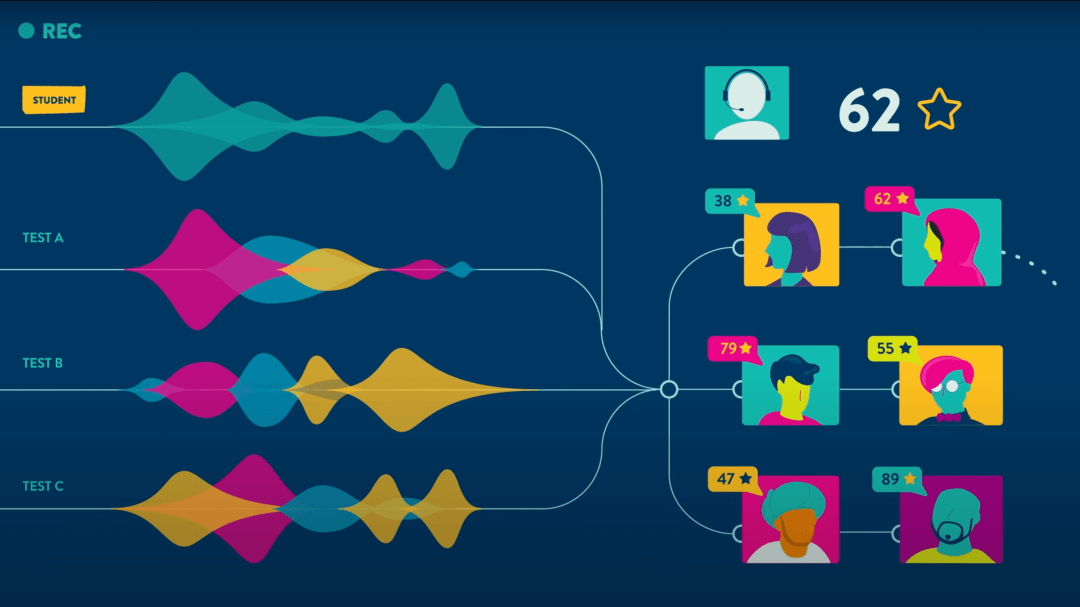
    How do we know automated scoring works

    Are you thinking of taking PTE Academic, or have you recently taken it, but you are wondering how it is that a computer can mark your test?

    Well, firstly the test has been designed by humans, all leading experts in their field. Our human experts design and write the questions, quality assure them, and then score them. At this point, computers are trained to use the patterns of highly trained language experts to attribute scores to questions. When the computer marks correlate highly with the human scores, we then allow the computer to mark test scripts from across the world.

    As a result of our processes and technology, the computer behaves like an expert human examiner – but without any possible bias, lack of concentration, or variation between individual examiners.

    The scoring criteria are exactly the same as human scoring – test takers are marked on their delivery, clarity, relevance, the accuracy of grammar, and appropriateness of vocabulary.

    Want to hear more?

    Take a couple of minutes and listen to one of our leading independent advisors, Dr. Alistair Van Moere, a member of Pearson’s Technical Advisory Group, as he explains how it all works.

  • Image- student at class 800px
    Reviewing Test Performance
    By PTE Author
    Reading time: 2 minutes

    If you have completed PTE Academic, you would know by now that it is scored against the Global Scale of English and that you need to practice many skills for each part of the test: Speaking & Writing, Reading, and Listening.

    After completing PTE Academic you will receive an email notification that your results are available online. Typically within 2 days. Learn how to access your Score Report.

    What does my Score Report mean?

    When you receive your Score Report it will show you your overall score, which is based on your performance across all test items. Your communicative skills that are measured are listening, reading, speaking and writing.

    This is an example of what your Score Report may look like.

    The enabling skills are those skills that are required to fulfill the question types in the test. It’s important to know what each of these skills refers to.

    Grammar

    Correct use of language with respect to word form and word order at the sentence level.

    Oral Fluency

    Smooth, effortless and natural-paced delivery of speech.

    Pronunciation

    Production of speech sounds in a way that is easily understandable to most regular speakers of the language. Regional or national varieties of English pronunciation are considered correct to the degree that they are easily understandable to most regular speakers of the language.

    Spelling

    Writing of words according to the spelling rules of the language. All national variations are considered correct, but one spelling convention should be used consistently in a given response.

    Vocabulary

    Appropriate choice of words used to express meaning, as well as lexical range.

    Written Discourse

    Correct and communicatively efficient production of written language at a textual level. Written discourse skills are represented in the structure of a written text, its internal coherence, logical development, and the range of linguistic resources used to express meaning precisely.

    How do I identify my areas of weakness?

    From the visual graph on your Score Report, you will be able to see areas you need to improve on. You should aim to develop your core (enabling) skills required across all areas of the test.

    The following resources will help you develop your enabling skills:

    How can I improve in each part of the test?

    It’s also worth focusing on particular parts of the test or questions you think you had trouble with. The following articles may help you improve your skills across questions:

    If you don’t already have one, it’s recommended to work with an English teacher to work through areas that may need improvement.

    Good luck!

  • Image- A guy with headphones and laptop
    Listening: Self-Improvement Part 1
    By PTE Author
    Reading time: 3 minutes

    After working through the strategies to improve your English listening skills, you can work on specific areas of the test. In this part, you will need to apply a number of listening and writing skills.

    Below are improvement tips on the question types that combine writing and listening skills.

    Summarize Spoken Text

    In the Summarize Spoken Text questions you will be scored on content, form, grammar, vocabulary, and spelling.

    Content and Form

    Make sure you write a good, clear summary of all the key points in the text and also condense the most important supporting points.

    In this question, you will not be given the context of the recording before it starts. Make sure to listen carefully from the start to help understand the context and the information given.

    Some helpful tips for the content and form, to maximize your score are:

    • Take notes on your Erasable Noteboard Booklet or in the response box on the screen

    • Do not try to write down sentences (you will not have enough time)

    • Use symbols and abbreviations in your notes

    • Write down key points and their relationships with others

    • Start with an overview sentence to introduce your summary

    • Use cohesive devices to link the information as you write

    • Try to write between 50 and 70 words

    Overall, make sure you summarize the text in your own words as this will show that you have understood the purpose of the text. If you do not write in your own words, you will score zero for content.

    If you write less than 40 or more than 100 words, you will score zero.

    Grammar

    It is important that grammar is correct as you will be tested on sentence structure, punctuation and capitalization.

    Try not to be too ambitious with your grammar to avoid making mistakes. Try to use grammatical structures you feel comfortable with.

    In this question type you should:

    • Communicate meaning clearly and concisely

    • Use complex sentences where possible to score more points

    • Write sentences between 18 and 30 words – long sentences are hard to control grammar

    • Check your response for common errors before submitting

    Vocabulary and Spelling

    You will score points if you use the correct and appropriate vocabulary in the Summarize Spoken Text question type. Use words from the recording if you use them appropriately, however, try to use synonyms to replace words already used.

    You will also need to make sure to spell every word correctly to receive maximum points. Try to type as carefully as possible during this question. If you can not remember how to spell a word, guess as it is better to include the word than leave it out, even if it is incorrect.

    Don’t forget to use the space bar to show the end of each word.

    Write from Dictation

    Another question that tests both listening and writing is the Write from Dictation question type.

    In this question type, you will need to write the words in the correct order with the correct spelling in order to score points.

    Before the recording starts, place your cursor in the response box and get ready to type as soon as you hear the recording. Make sure to reproduce what you hear exactly as you heard it as the recording will only be played once.

    Remember to start the sentence with a capital letter and end it with a full stop (period).

    Type as you hear it and when finished, check for any mistakes. Always make sure that to read over your answer before clicking next.

    Continue improving your listening skills by reading our Listening: Self-Improvement Part 2 article.