
Australian student visa application guide

PTE Author
PTE Author
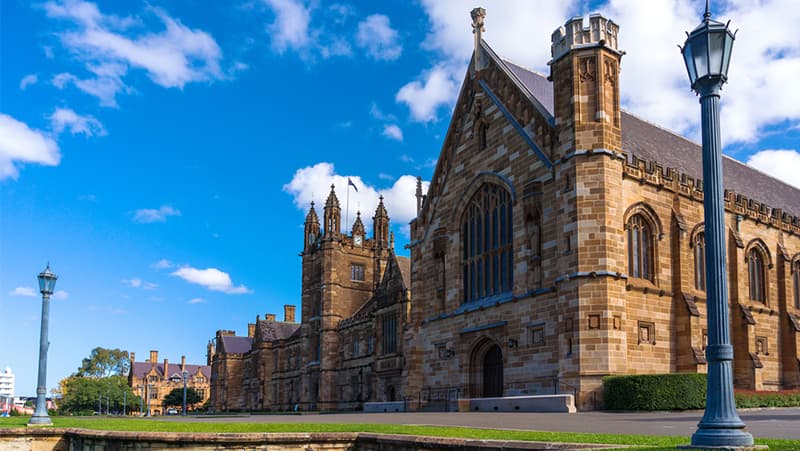
Image- Australian university, 800px x 451px
Reading time: 4 minutes

Australia is known for its beautiful landscapes, quality of life, and excellent standard of education. If you’re interested in studying in Australia, you’ll first need to understand the Australian student visa application process.  This will set the stage for the exciting new chapter in your education. 

However, there can be a lot to remember when it comes to Australian student visa requirements. That’s why we’ve put together this informative guide, which breaks down everything you need to know. Let’s get started!  

Australian student visa requirements 

In order to apply for an Australian student visa – called the Subclass 500 Student visa – you must be enrolled in a course of study at an Australian institution. You’ll need to complete an application form, gather important documents, and prove to the Australian Government that you meet a list of requirements, including:  

  • The Genuine Temporary Entrant (GTE) requirement

  • Financial requirements

  • English proficiency requirements

  • Health and characteristic requirements

You can also use the Document Checklist Tool to which documents need to be attached to the application. 

The Genuine Temporary Entrant (GTE) requirement

To fulfill the GTE requirement, you must prove you’re coming to Australia temporarily to receive a quality education. To do this, you’ll need to provide a personal statement in English, or translated it into English. This should include information and evidence about your:  

  • Previous studies (with academic transcripts)

  • Current employment

  • Ties to your home country 

  • Economic situation  

  • Immigration history

Overall, Australia wants to ensure you’re entering the country to further your education, and not for other motives.

Financial requirements

This is an important part of the Australian student visa application process. Many applicants need to prove they have sufficient funds to pay for life in Australia, including living costs and tuition fees. There are a few options to do this; for example, you can show you’ve received government loans or scholarships. Evidence of 12-months fund or evidence that you meet the annual income requirement will also work.  The requirements range from $29,710 AUD (about $19,000 USD) to $102,500 AUD (about $65,500 USD). For detailed and most updated information, please refer to Department of Home Affairs.  

Learn more about financial requirements.  

English language requirements

Australia is a very diverse country. Approximately 73% of the population in Australia speaks English at home. To meet Australian student visa requirements, applicants who aren’t from an English-speaking country need to show English language proficiency.  And, our computer-based and unbiased English language test at PTE Academic is accepted by the Australian government for every visa category.  

To be eligible for a student visa in Australia, you must achieve:

  • At least 50 for each of the 4 components for PTE Academic 

  • At least 36 for each of the 4 test components of PTE Academic if you undertake an English Language Intensive Course for Overseas Students (ELICOS) course before your main course 

View a full breakdown of Australian study visa PTE requirements

Health & characteristic requirements 

Most visa applicants need to do a medical exam to prove that they are healthy. In addition to the medical exam, the majority of applicants must buy Overseas Student Health Cover (OSHC) from an approved Australian provider. 

To get an Australian student visa, you also need to be of good character. You shouldn’t have a substantial criminal record or be a member of a criminal group, for example. To prove this, you might have to supply a police certificate.  

Fees  

A Subclass 500 Student visa starts at $1,600 AUD ($1,020 USD) unless you are exempt. There are also added charges for each family member who applies for the visa.  For more information on visa costs, check out the Australian government’s visa pricing estimator.  

Processing times 

For an indication of processing times for this visa, use the visa processing time guide tool. This will show the processing times for recently decided applications. It is a guide only and not specific to your application. 

To find out if you’re eligible for an Australian student visa, be sure to review all the requirements on the government website. You can see all the documents you’ll need for your application using the government’s documents checklist tool. 

Learn more about working in Australia on a post-study work visa.

Last updated 20 December 2024.

Related Content

  • Image, student, 800px x 451px
    Australian loans for international students
    By PTE Author
    Reading time: 5 minutes

    It’s not hard to understand why so many international students want to move to Australia. The country has a world-class education system, excellent climate, and high quality of life. But studying in Australia can be expensive – and you need to be financially prepared before you take the leap.  

    In this blog, we’ll help you get started. We’ll explore the student loan options available for international students in Australia, as well as other ways to fund your studies.  

    How much money will I need? 

    Before you begin to research student loans, it’s important to understand how much it costs to live and study in Australia. You can use the Course Search Tool to find out detailed tuition fee for your dream course and the Cost of Living Calculator to estimate the living cost based on the city you want to move to.  

    What student loans in Australia could I be eligible for? 

    Australia’s student loan system is known as the Higher Education Loan Program (HELP).  Unfortunately, HELP can only be accessed by Australian citizens or individuals who hold a humanitarian visa. However, there are still lots of other student loans available for international students in Australia.  

    University loans 

    Universities across Australia provide loans for local and international students. Most institutions offer both short-term and long-term loans; these can help students cover emergencies, as well as pay for bigger expenses.  

    Here are a few examples of what some universities offer:  

    • The University of Melbourne will loan eligible students up to$5,000 AUD ($3,883 USD) if they have an Australian co-signer. They’ll loan students up to $3,000 AUD ($2,330 USD) if their co-signer lives overseas or isn’t an Australian citizen/ permanent resident. 

    • The University of Sydney offers loans up to $2,000 ($1,550 USD), which can be paid back up to two years after graduation.  

    • Students in need of financial assistance at Monash University can take out loans between $750-$3,000 AUD ($544 – $2,330 USD), to be paid back within 6-12 months. 

    Universities across Australia offer similar loans. It’s best to check directly with your institution to see exactly what loans are available to students – and to make sure you’re eligible.  

    International student loan schemes  

    You might be eligible to take out federal student loans in your home country to study in Australia. For example, students from the U.S., Canada, Sweden, Norway, or Denmark who attend the University of Sydney can access government funding from home.  

    Private loans  

    A private loan is one of the simplest forms of international student loans in Australia: you borrow money from a bank or similar lender and repay the loan (with interest) over an agreed-upon period of time. These loans can be secured – which means they’re tied to collateral – or unsecured. But with unsecured loans, interest rates are usually higher. 

    How else can I pay for my studies? 

    Student loans aren’t the only way to pay for your education in Australia. Here are a few other options to consider:  

    Work in Australia  

    Many international students are attracted to Australia because they know they’ll be able to work. Unlike other studies abroad destinations, you can work up to 48 hours every two weeks while studying and unlimited hours during study breaks on an Australian student visa. Even more, the minimum wage in Australia is $24.10 per hour or $915.90 per week – meaning many international students are able to pay for some of the costs associated with living in Australia while they study.   

    Apply for scholarships 

    There are a number of scholarship opportunities for international students in Australia – both funded by the government, and universities. Some, like Australia Awards scholarships, support students with full tuition, living costs, and airfare. Check out the Australian Government’s search tool to find a scholarship that’s right for you.  

    Read more: scholarships for international students in Australia 

    Take out a private loan in your home country

    To apply for a student visa in Australia, you need to prove you have sufficient funds. For this reason, many students decide to take out a private bank loan in their home country before coming to study in Australia.

    As you can see, there are lots of ways to fund your studies in Australia as an international student. But everyone’s financial situation is different, so we recommend doing lots of research to find a loan you feel confident about – and one that will work for you both during, and after university.

    Still, deciding where in the world you want to study? Check out our article types of loans for international students, which explores more loan options in Canada, the U.S., and the U.K.

    We are not immigration agents. For all up-to-date information about visa rules and regulations, see the official guidelines on the Australia Department of Home Affairs website.

    Last updated 20 December 2024.

  • Image- scholarships, 800px x 451px
    Scholarships for international students in the UK
    By PTE Author
    Reading time: 3 minutes

    The UK is home to some of the most prestigious universities in the world. And, being awarded a scholarship to study in the UK can give you access to a top-level education at a more affordable price.  

    So, how do you apply? UK university scholarships are offered by both the UK government and individual universities – and are available for undergraduate, postgraduate, and PhD students alike. In this blog, we’ll highlight some of the top scholarships for international students in the UK:  

    Undergraduate scholarships in the UK

  • Image- Norway -800px
    Consider these 6 destinations to study abroad
    By PTE Author
    Reading time: 5 minutes

    You can still study abroad and stick to a budget. In fact, many of the cheapest countries to attend university are also some of the most beautiful places in the world.

    In this blog, we’ll explore 6 affordable international study destinations. And the great news is PTE Academic – our English language proficiency exam can help you achieve your study abroad dream at these amazing places. Let’s delve in:  

    1. Norway 

    Norway isn’t just picturesque. It’s also one of the cheapest countries to study in for international students. Most universities in Norway are publicly funded and don’t charge tuition fees – even for foreign learners. While some private universities do charge tuition – between €7000-€19,000 – international students aren’t required to pay more than Norwegians.  

    It is important to keep in mind, however, that the living costs in Norway are high. It can cost international students between €800 –€1400 per month to live in the country. But there are some grants and scholarships available to help students fund their time abroad. You can check them out here.  

    Overall, Norway offers world-class education and an excellent standard of living. Medical services are usually free for international students and many courses are taught in English, making it a great place to study abroad. 

    PTE Academic is accepted at top institutions in Norway including University of OsloUiT The Arctic University of NorwayNorwegian University of Science and Technology (NTNU). 

    Find out where else PTE Academic can take you in Norway.

     2. Malaysia 

    With high-ranked universities and the fastest growing regional economy in the world, Malaysia is also an excellent destination to consider. The country boasts more than 100 higher education institutions – including branches of universities like Monash University and the University of Nottingham.  

    A bachelor’s degree for international students (not studying medicine) costs about $10,000-$20,000 USD at a public institution, and significantly more at an international branch campus.  

    However, the thing that makes Malaysia attractive is its low cost of living. Kuala Lumpur, the country’s capital city, is ranked by QS Best Student Cities Rankings as the second most affordable student city in the world. Rent in a shared apartment in Malaysia can cost as little as $50-$250 USD per month.  

    To learn more about how much it costs to live in Malaysia, visit the government’s website here.  

    PTE Academic is accepted at top institutions in Malaysia including Universiti Malaya (UM)Universiti Sains Malaysia (USM), and Universiti Teknologi Malaysia (UTM)Find out where else PTE Academic can take you in Malaysia. 

     3. Spain 

    Spain has a great climate, a relaxed lifestyle, and more than 70 universities to choose from. And yes, it also offers affordable tuition fees. Tuition for EU/EAA students at a public university can range from just €150-€3500.  Keep in mind though, if you’re coming from a country outside the EU/EAA, your tuition fees could be higher.  

    The cost of living for international students in Spain ranges from €700-€1,100 a month. Many courses here are also taught in English, making Spain a good choice if you’re interested in improving both your English and Spanish skills.  

    PTE Academic is accepted at top institutions in Spain including Universidad de GranadaFind out where else PTE Academic can take you in Spain.

     4. France 

    France is a surprisingly affordable place for international students to study. It’s also incredibly popular – more than 350,000 students enroll in the university there each year. France’s public universities charge just €170 per year for a bachelor’s degree for EU/EAA students. But like in Spain, if you’re a non-EU/EAA citizen, fees are likely to cost more.  

    The cost of living is more expensive in larger cities like Paris. But in smaller cities, you can expect to pay around €650 per month.  

    PTE Academic is accepted at top institutions in France including Université Paris 1 Panthéon-Sorbonne. Find out where else PTE Academic can take you in France. 

    5. South Africa

    South Africa is renowned for its natural beauty and rich culture – it has 11 official languages, which is more than any other country in the world. It’s also home to the top-rated university in Africa: University of Cape Town.  

    Tuition for a bachelor’s degree in South Africa is reasonably inexpensive compared to locations and will cost international students between €6000–€7000 per year. Living costs are also only about €550 per month. 

    Find out how PTE Academic can help you to study at University of Cape Town. 

    6. Greece 

    Last but not least, Greece is one of the most affordable study destinations in Europe.  Most students from the EU/EEA can study for free, while all other students could pay up to €2000 per year. 

    Greece also boasts low costs of living. Students can expect to pay between €450-€750 per month – and some students in financial need can live on campus for free. Better yet, between studies, international learners can soak up the sun while spending time on Greece’s beautiful beaches. What’s not to love?  

    Ready to kickstart your dream of studying abroad?

    Many top-rated international institutions offer courses in English and require you to take an English language test.  

    PTE Academic is recognized by universities around the world – find out who accepts PTE Academic.