
Australian student visa application guide

PTE Author
PTE Author
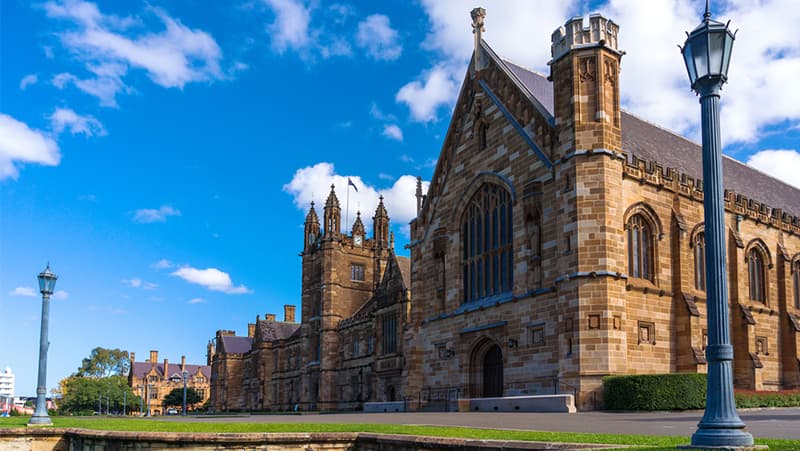
Image- Australian university, 800px x 451px
Reading time: 4 minutes

Australia is known for its beautiful landscapes, quality of life, and excellent standard of education. If you’re interested in studying in Australia, you’ll first need to understand the Australian student visa application process.  This will set the stage for the exciting new chapter in your education. 

However, there can be a lot to remember when it comes to Australian student visa requirements. That’s why we’ve put together this informative guide, which breaks down everything you need to know. Let’s get started!  

Australian student visa requirements 

In order to apply for an Australian student visa – called the Subclass 500 Student visa – you must be enrolled in a course of study at an Australian institution. You’ll need to complete an application form, gather important documents, and prove to the Australian Government that you meet a list of requirements, including:  

  • The Genuine Temporary Entrant (GTE) requirement

  • Financial requirements

  • English proficiency requirements

  • Health and characteristic requirements

You can also use the Document Checklist Tool to which documents need to be attached to the application. 

The Genuine Temporary Entrant (GTE) requirement

To fulfill the GTE requirement, you must prove you’re coming to Australia temporarily to receive a quality education. To do this, you’ll need to provide a personal statement in English, or translated it into English. This should include information and evidence about your:  

  • Previous studies (with academic transcripts)

  • Current employment

  • Ties to your home country 

  • Economic situation  

  • Immigration history

Overall, Australia wants to ensure you’re entering the country to further your education, and not for other motives.

Financial requirements

This is an important part of the Australian student visa application process. Many applicants need to prove they have sufficient funds to pay for life in Australia, including living costs and tuition fees. There are a few options to do this; for example, you can show you’ve received government loans or scholarships. Evidence of 12-months fund or evidence that you meet the annual income requirement will also work.  The requirements range from $29,710 AUD (about $19,000 USD) to $102,500 AUD (about $65,500 USD). For detailed and most updated information, please refer to Department of Home Affairs.  

Learn more about financial requirements.  

English language requirements

Australia is a very diverse country. Approximately 73% of the population in Australia speaks English at home. To meet Australian student visa requirements, applicants who aren’t from an English-speaking country need to show English language proficiency.  And, our computer-based and unbiased English language test at PTE Academic is accepted by the Australian government for every visa category.  

To be eligible for a student visa in Australia, you must achieve:

  • At least 50 for each of the 4 components for PTE Academic 

  • At least 36 for each of the 4 test components of PTE Academic if you undertake an English Language Intensive Course for Overseas Students (ELICOS) course before your main course 

View a full breakdown of Australian study visa PTE requirements

Health & characteristic requirements 

Most visa applicants need to do a medical exam to prove that they are healthy. In addition to the medical exam, the majority of applicants must buy Overseas Student Health Cover (OSHC) from an approved Australian provider. 

To get an Australian student visa, you also need to be of good character. You shouldn’t have a substantial criminal record or be a member of a criminal group, for example. To prove this, you might have to supply a police certificate.  

Fees  

A Subclass 500 Student visa starts at $1,600 AUD ($1,020 USD) unless you are exempt. There are also added charges for each family member who applies for the visa.  For more information on visa costs, check out the Australian government’s visa pricing estimator.  

Processing times 

For an indication of processing times for this visa, use the visa processing time guide tool. This will show the processing times for recently decided applications. It is a guide only and not specific to your application. 

To find out if you’re eligible for an Australian student visa, be sure to review all the requirements on the government website. You can see all the documents you’ll need for your application using the government’s documents checklist tool. 

Learn more about working in Australia on a post-study work visa.

Last updated 20 December 2024.

Related Content

  • Image- A guy on headset and using laptop- 1800px
    Strategies to Improve English Listening Skills
    By PTE Author
    Reading time: 3 minutes

    Part 3: Listening in PTE Academic requires many hours of practice to maximize your score. Whilst practicing other parts of the test you would have learned certain core English skills that are needed in Part 3 that you can further improve.

    To do well in the listening questions set a daily goal of listening regularly to authentic English texts. The more you listen, the better you will do in the test.

    When choosing recordings to listen to, do not choose examples that are too difficult. Start at a level you are comfortable with and build up to a higher level example as you improve.

    If you find the recording too difficult, try to just listen for the content words, such as nouns, adjectives, and verbs so that you can pick up the meaning of the recording.

    Always try to listen as many times as you need to fully understand the content. Try to go back and listen to the same recording a few days later to help you remember the content, vocabulary, and pronunciation.

    Use an Online Tone Generator tool to help slow down recordings and keep the original pitch of the speaker. Try not to slow it down so much that you translate the meaning into your own language as this will not help improve your listening skills.

    Don’t forget to be an active listener and focus on what you are hearing.

    What should I listen to?

    As the speakers in PTE Academic have various accents, we recommend listening to a wide range of speakers from different backgrounds to learn the different pronunciations used.

    Try to listen to speakers from Britain, America, Canada, Australia, and New Zealand, as well as second language speakers from India, China, and Europe.

    Some of the below podcasts will help:

    You can also listen to radio around the world at Live Online Radio.

    When listening keep a listening diary to write down the titles of recordings along with notes. Listen for stressed words in the recordings as these are usually the most important.

    The easiest way to take notes will be to use abbreviations and/or symbols as you will not have enough time in the test to write full words.

    From your notes, you should be able to answer the following questions:

    • What was the topic and main ideas?

    • What accent did the speaker/s use?

    • Was it interesting?

    • What did you learn from it?

    • What vocabulary did you learn?

    • Do you want to listen to more texts from that site?

    • Did you need to slow the text down? If so, what speed?

    • How many times did you listen to the text? Do you want to listen again?

    • Do you feel your listening skills are improving?

    What's next?

    To learn more about how to apply listening skills and improve test results, view our self-improvement strategies:

  • Image- writing 1080px
    Writing: core English skills part 1
    By PTE Author
    Reading time: 4 minutes

    Part 1 of PTE Academic includes a variety of speaking and writing question types. For writing questions, you may need to improve your skills, such as grammar, spelling, and vocabulary.

    To help practice these skills, we’ve put together some tips on how to improve for this part of the test.

    Grammar

    To help improve grammar, get into the habit of reading something in English every day.

    Create a reading plan and a reading goal to improve your grammar. Start by reading for at least 30 minutes a day.

    It’s recommended that you read a range of texts that you find interesting. Also read news articles on English news sites such as:

    It is hard to use correct grammar in long sentences, so try to keep sentences short: about 18 to 30 words. You should also practice with a variety of short and long sentences.

    Always remember to:

    • End sentences with a full stop (period)

    • Use uppercase and lowercase correctly

    Try to avoid run-on sentences. These are sentences which should be cut to make a shorter sentence, or properly joined to make a grammatically correct sentence.

    You can avoid run-on sentences by using compound and complex sentences, which will also help improve your score. Use commas when writing complex sentences. Some examples of the compound and complex sentences can be found through the British Council’s Learn English website.

    To perform well, learn to proofread your writing so that you can complete the question types as correctly as possible.

    If you can identify areas that you often get wrong, you should work on improving these areas. Ask your English teacher for help, or if you don’t have an English teacher, you can look up your common errors on the internet.

    Spelling

    PTE Academic recognizes and accepts US, UK, Australian and Canadian spelling. However, you should be careful with your spelling. Once you have chosen a spelling convention for one question, keep using it within that question. You can change the spelling format in answers to other questions if you like.

    Vocabulary

    To do well in the writing test, you need to have a broad vocabulary. You should have a good dictionary to help you. A good dictionary will have the meaning, related forms of the word, and example sentences.

    Longman Dictionaries are a great resource to help you improve your vocabulary.

    You should expose yourself to new words at least ten times a day to expand your vocabulary. To learn a new word you should read it, write it and listen to it many times over a couple of days so you can understand the word and use the correct pronunciation.

    Another way to expand your vocabulary is to learn the word forms of words you already know.

    For example, climate (noun), acclimatization (noun), climatic (adjective), acclimatize (verb) etc.

    Each of the above word forms mean something slightly different, so try to learn all the meanings of each word.

    In PTE Academic you will score higher points for vocabulary if by using academic words in your writing. Try to learn some of the most frequent academic words used in writing.

    Also, think about using synonyms in your writing to avoid repetition of words. A thesaurus can help you find synonyms for common academic words.

    The other elements of your vocabulary to consider are correct common prefixes and suffixes, which are added to the base words. Prefixes can change the meaning of a word, for example, expensive and inexpensive.

    Adding a suffix, however, can change the part of speech of the word. A common suffix used is ly, which can change an adjective into an adverb (quick/quickly), ment can change a verb into a noun (entertain/entertainment).

    There are also collocations, which help you use the right word combinations, as some English words just don’t work well together. To identify collocations, read the PTE Academic collocation list.

    PTE Academic is not very strict about accepting only academic vocabulary. You will not lose points for the use of personal pronouns. You will, however, score more points by using higher-level academic vocabulary in the correct way.

    You should try to keep a notebook of new words you learn, their meanings, synonyms, and all the parts of vocabulary that may help you in the test.

    The last core skill required for the writing test is written discourse.

    Want more prep ideas?

    Plus, explore Smart Prep, which combines all our practice materials in one place, so it's easier for you to stay on track with your PTE preparation.

    • Smart Prep is a clear path to test day, guiding you through the official paid and free resources available for your test

    • It can be accessed whether you’ve booked a test or not – just create, or sign in to your myPTE account

    • Preparation materials include guided practice tests, introductory videos, video courses and test tips.

    Ready to get started?

  • Image- Two Asian man in a cafe setting- 800px
    How does PTE Academic mark different accents?
    By PTE Author
    Reading time: 2 minutes

    Your accent will not stand in the way of success!

    Everyone has an accent. You might even be a proficient or fluent English speaker, but with an accent, other people find hard to understand.

    So how does your accent affect your score when you take PTE Academic?

    Because PTE Academic is marked by a computer, it can cut out potential obstacles, such as a human examiner being unfamiliar with your particular accent.

    When the automated scoring program was being designed the computer was trained using candidates from over 126 countries, speaking more than 90 different languages, so it recognizes accents from around the globe. As a result, PTE Academic’s automated scoring technology recognizes and marks everyone’s speech equally and with equal accuracy, regardless of where they are from. What the PTE Academic scoring engine looks for is intelligibility and clarity of response (not which accent you are speaking in) – did you answer in a clear and understandable way that any international speaker of English would understand?

    To hear more on this, listen as one of our leading independent advisors, Dr Alistair Van Moere, a member of Pearson’s Technical Advisory Group, explains how it works.