
Which English tests do universities accept for international students?

Reading time: 5 minutes

You are preparing applications and need to confirm which English proficiency evidence universities will accept. This guide explains the main English language proficiency tests commonly recognised by higher-education institutions worldwide and highlights where test variants or immigration rules can change acceptance.

English proficiency tests universities commonly accept

Most universities recognise a small number of established English language qualifications. The most commonly accepted include PTE Academic, IELTS Academic, TOEFL iBT, and Cambridge English qualifications.

  • Pearson Test of English (PTE Academic) is a computer-based English test scored from 10–90. It is accepted by many universities across the UK, USA, Canada, Australia and other study destinations. Results are typically available quickly and are usually valid for two years for university admissions.
  • IELTS Academic: offers both paper and computer delivery with a 0–9 band scale and a face-to-face speaking interview; it is widely accepted globally
  • TOEFL iBT: a fully computer-delivered test with scores from 0–120 and broad acceptance, especially among US institutions.
  • Cambridge English (C1 Advanced, C2 Proficiency): qualifications aligned to CEFR levels and recognised by many universities, particularly in the UK and Europe; these certificates do not expire in the same way as other test results.

Always confirm acceptance with each institution because individual programs may require specific tests, score thresholds, or test variants.

How English requirements differ for admissions and visas

University admission requirements are not always the same as visa or immigration requirements.

Universities decide which English language tests they accept for entry onto a course. However, immigration authorities may have additional rules about which tests or test versions are valid for a student visa.

Before booking a test, it is important to check both:

  • your university’s admissions requirements 
  • the visa or immigration requirements for your destination country

Explore accepted universities and recognition for PTE Academic

How scoring, validity and reporting generally work

Different tests use different scoring scales: PTE Academic 10–90, IELTS Academic 0–9 bands, TOEFL iBT 0–120, and Duolingo English Test 10–160. Cambridge English qualifications are reported as CEFR levels (C1 Advanced, C2 Proficiency).

Most academic tests have a two-year validity period from the test date and report results electronically to institutions, while Cambridge English certificates are typically not time-limited in the same way. Score comparability across tests is not exact, so universities publish accepted tests and minimum scores for each program. Treat the published university requirements as definitive for admissions decisions.

Explore PTE Academic scoring

Where to verify acceptance and requirements

Universities’ official admissions pages are the primary source for accepted tests and minimum scores.

To check whether a specific university or program accepts PTE Academic, you can also use PTE's institution finder, which lists institutions and their accepted PTE products by country and program type:

Find out if your university or institution accepts PTE Academic

Frequently asked questions

Which tests do most universities accept?

Most universities accept at least one of these: PTE Academic, IELTS Academic, TOEFL iBT, Cambridge English C1 Advanced or C2 Proficiency, or the Duolingo English Test. Accepted tests and minimum scores vary by institution and program.

Related Content

  • [Asset] Girl looking out over cityscape background
    Convenience matters: how to pick an English test that works for you
    By PTE Author

    When your schedule is packed and deadlines are approaching, choosing an English test that works around your life can make all the difference. You need a test that fits your timeline without creating extra admin, travel, or waiting around.

    A convenient English test isn’t just “short.” It’s a test you can book quickly, take in a way that suits your life, and get results fast while still meeting the requirements of your university, employer, or visa pathway. PTE is designed around that real-world need: fast, fair, and simple.

    Five practical questions to guide your choice

    Before you book, ask yourself:

    1. Will my score be accepted where I want to apply?

    2. How easy is it to book a test date that works for me?

    3. Can I take the test in a location that fits my life?

    4. Is the test design simple and intuitive?

    5. How long will I wait for results?

    Use these questions to compare your options and choose a test that fits your timeline, not one that forces you to change it.

  • Higher-Education-Students-in-the-UK
    New DHA visa requirements for PTE Academic
    By PTE Author
    Reading time: 5 minutes

    The Australian Department for Home Affairs (DHA) recently updated their score requirements for all accepted tests of language proficiency. The new score requirements take effect from 7 August 2025.

    What are the new score requirements? 

    From 7 August, anyone who takes the test for DHA visa purposes will need to meet updated score requirements.

    The table below shows the old and new score requirements for each score.

    We have also created a more accessible version of this table at the end of this article.

  • PTE changes 2025: everything you need to know
    By PTE Author

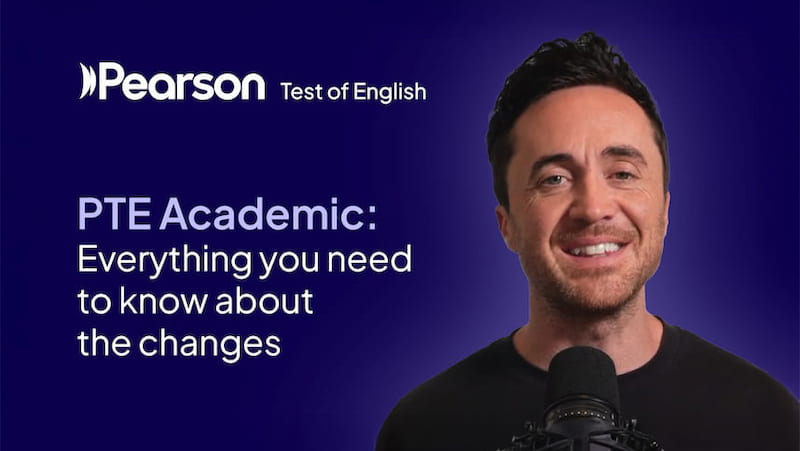
    We’ve made a few updates to the PTE Academic and PTE Academic UKVI tests. To make sure you’ve got the facts, we’ve created a short video that walks you through everything you need to know.

    Hosted by Jarrad, one of our product managers, this video covers what’s being updated, what’s staying the same, and how it all benefits you as a test taker.

    What’s covered in the video? 

    • The original 20 question types are still in the test.

    • We are adding two new speaking question types to give you even more chance to demonstrate your skills.  

    • Tips on how to prepare for the new speaking question types.

    • There are no changes to pricing, ID requirements, or score delivery time.

    • There are no changes to the way the test is taken (including the Speaking section).