

5 famous Canadian authors and where they went to university

PTE Author
PTE Author
Image - reading book 1080px
Reading time: 6 minutes

Are you thinking about moving to Canada to study? Get inspired by these talented Canadian authors and discover the universities they attended. Find out which Canadian universities accept PTE Academic now! 

Canada inspires good writing. The northern country is home to many talented literary figures and authors whose works have been celebrated worldwide for decades. From old classics like Anne of Green Gables to newer works like Women Talking and The English Patient, Canadian literature has really made a mark.  

But who are the masterminds behind these incredible stories? More importantly, where in Canada did they study?  

Here, we take a look at some of Canada’s most talented writers and learn where they earned their university degrees. 

This list includes reputable institutions from the scenic east coast, to the quiet prairies to highly-regarded schools in Ontario. And if you have yet to read these writers’ books, add them to your reading list! 

1. Lucy Maud Montgomery  

Lucy Maud Montgomery published Anne of Green Gables in 1908. It became one of Canada’s most famous books. The story is set in the Canadian province of Prince Edward Island which is where the author was born.  

The fictional story is about a red-haired, impulsive orphan growing up in a small eastern Canadian town. Though it was rejected by many publishers at first, the novel went on to sell more than 50 million copies. It has also been translated into 36 languages.  

More recently, it was developed into a TV series called Anne With An E, which can be streamed on Netflix.  

Education: Dalhousie University 

Lucy Maud Montgomery studied at Dalhousie University in Halifax, Nova Scotia. She started her studies there at age 21 in 1895. At the time, it wasn’t common for women to be seen on campus. During her time at Dalhousie, she argued that more women should seek a university education.  

Feeling inspired to study at Dalhousie University? The good news is that they accept PTE as proof of your English level.  

2. Joseph Boyden  

Joseph Boyden is a Canadian novelist and short-story writer. Boyden is best known for writing about First Nations culture. He is best known for his books Three Day Road, Through The Black Spruce, and The Orenda. In his writing career, Boyden has collected many Canadian literary prizes. These include Canada Reads, the Scotiabank Giller Prize, the Rogers Writers’ Trust Fiction Prize, The Governor General’s Award for fiction, and the Canadian Booksellers Association Fiction Book of the Year. Boyden grew up in North York, Ontario.  

Education: York University  

He studied creative writing at York University where he was admired by a professor for his intensity and determination. He also has honorary degrees from Wilfrid Laurier University, Trent University, Nipissing University, and Algoma University.  

Do you want to follow in Boyden’s footsteps? York University accepts PTE

3. Alice Munro 

Alice Munro is one of the best authors to have ever come out of Canada. In 2013, she won the Nobel Prize in Literature. She is known and praised as being the master of the short story. Her books include Dear Life, Dance of the Happy Shades, The Lives of Girls and Women, Who Do You Think You Are and The Love of a Good Woman. When she won the Nobel Prize, she was quoted saying that she didn’t expect to win.  

Education: Western University  

As for her education, Munro studied English at Western University. She started at the university in 1949. She actually published her first-ever work at the university’s campus literary magazine called Folio. Munro is one of Western University’s most famous alumni.  

If you’ve bookmarked Western University as a place to study, it also accepts PTE.  

4. Miriam Toews 

Miriam Toews is a bestselling author of Women Talking, All My Puny Sorrows, and A Complicated Kindness. Toews has collected many literary awards in Canada. Her major awards are the Governor General’s Award for English-language fiction, Canada Reads, and the Scotiabank Giller Prize. Her novel Women Talking is a fictional story based on a Mennonite colony in Bolivia. It became a bestseller and was shortlisted for the Governor General’s Award. Toews lives in Toronto.  

Education: University of Manitoba 

She earned her first degree at the University of Manitoba where she studied film studies and earned a bachelor of arts degree.  

Check out the University of Manitoba for yourself, the highly regarded institution also accepts PTE. 

5. Michael Ondaatje 

Michael Ondaatje is considered one of Canada’s most important contemporary writers. His novels and poetry are required reading in many Canadian schools and universities. Ondaatje was born in Sri Lanka but moved to Canada in 1962 and stayed. His most famous book is The English Patient. It’s a war-era love story set in Italy. Not only did it win the Man Booker Prize, but it was also turned into an award-winning movie in 1996. Ondaatje also wrote In The Skin Of A Lion, The Cat’s Table, and Anil’s Ghost. In addition to the Booker Prize, Ondaatje has also won Governor General’s Awards and the Giller Prize. He is also a member of the Order of Canada. Before becoming the famous author that he’s known as today,  

Education: Queen’s University 

Ondaatje studied ag Queen’s University in Kingston, Ontario in 1967. He’s one of the university’s most celebrated past students. Currently, he lives in Toronto.  

Queen’s University is a great choice for international students and accepts PTE

Travel to study in Canada 

Thinking of studying in Canada? With so many incredible universities, Canada is an obvious pick for many international students. In order to secure a spot at a Canadian university though, students coming from abroad must prove English proficiency.  

PTE Academic can help make your dreams of studying in Canada come true. The English language test is recognized worldwide. Many top Canadian universities including the ones mentioned above accept PTE scores as part of their application process.  

Check out PTE test centers and view prices in Toronto, Ottawa, Montreal, Edmonton, Calgary, or Burnaby to take the first step towards your Canadian university career.

Related Content

  • Man-looking-at-plane-airport-1026x580
    How to move to the UK with a Skilled Worker visa
    By PTE Author
    Reading time: 5 minutes

    Would you like to live and work in the UK? You’re not alone. The number of people who apply to work in the UK rises year after year. But if you’re planning to move to the UK, you’ll need a visa. There are lots of different types of visas available – and one of the most popular is the Skilled Worker visa.

    Let’s take a look at the details of who can apply, the English language requirements, and the test you have to take in order to show you have the right level of English for the Skilled Worker visa.

    1. What are the latest UK work immigration trends?

    Apart from a pandemic-related dip in 2020, immigration to the UK has been steadily rising for the last decade. In 2021, there were 239,987 work-related visas granted – a 110% increase on the previous year, and a 25% increase on 2019. 

    Of these 239,987 visas, 63% were Skilled Worker visas. This type of visa saw the largest growth from 2019 at an increase of 33%. That means that, of all the people moving to the UK to work, the majority of them (almost two thirds, in fact) apply for the Skilled Worker visa. 

    India, the Philippines, Nigeria, the United States and Pakistan were the top five countries of origin for people who were granted Skilled Worker visas in 2021. 

    2. What is the UK Skilled Worker visa?

    The UK Skilled Worker visa is a visa that allows you to come to the UK and work for an approved company. You can live in the UK for up to five years before you need to renew your visa. You can apply for the visa up to three months from your starting date of work, and you should receive a decision in around three weeks if you’re outside the UK. The visa application fee is between £610 and £1,408, depending on your personal circumstances. 

    If you work in healthcare – for example as a doctor or a nurse – you can apply for the Health and Care Worker visa instead, which is cheaper to apply for, and doesn’t require you to pay an annual immigration health surcharge. 

    3. What kinds of workers can apply?

    An extensive number of careers and professions are covered by the Skilled Worker visa, from architects to bakers, and hairdressers to chefs. You can see if your profession is eligible by checking the full list of occupations

    In order to meet the requirements to be eligible for a Skilled Worker visa, you’ll need to make sure not only that your job is eligible for the visa, but also that your employer has been approved by the Home Office. 

    You also need to ensure that you’ll be paid at least the minimum salary for the type of work you’ll be doing in the UK. You’ll be expected to earn:

    • £25,600 per year

    • £10.10 per hour

    • the ‘going rate’ for the type of work you’ll be doing

    Whichever of these three options is the highest, that’s the information you’ll use for your visa form. 

    However, if your job is on the list of Skilled Worker visa shortage occupations, you will only have to be paid 80% of the job’s usual going rate. 

    4. What are the English requirements for the UK Skilled Worker visa?

    In order to apply for the Skilled Worker visa, you’ll need to show that you have recently passed a secure English language test at the right level to be able to live and work in the UK. There is a list of countries that are exempt, but everyone else will need to show that they speak English to at least a B1 level on the CEFR scale. It’s a key requirement when it comes to a successful visa application! 

    The only exemption is if you have a qualification at degree level in English (either a Bachelors, Masters or PhD); if you have a degree, you don’t need to sit an English test. 

    5. What is PTE Academic UKVI?

    PTE Academic UKVI is an English test which is approved by the UK Home Office for visa applications. It tests you on all four language skills: writing, speaking, reading, and listening. 

    To sit the test, you will attend an official test center, where you will take PTE Academic UKVI on a computer. The entire test is computer-based, and takes around two hours. After sitting the test, you will typically receive your results within 48 hours. 

    6. How can you get the score you need in PTE Academic UKVI?

    In order to meet the requirements of the Skilled Worker visa, you will need to score a minimum of 43 on your PTE Academic UKVI test. The best way to make sure you get the score you need is to prepare as thoroughly as possible for the test: 

    Get to know the test format

    It’s really important to get to know the test format very well before you sit PTE Academic UKVI. The test content is exactly the same as PTE Academic. The test is split into three sections: Speaking and Writing, Reading, and Listening. There are 20 different types of questions across the three different sections. Each question type follows a specific structure. It’s important to learn about the different question types. You will need to use specific techniques for each question to make sure you get the highest possible score.  

    Learn how the questions are scored

    In the test, different questions are scored in different ways. On some questions, you’ll be marked on whether you’ve given a correct answer. But in others, your score will be affected by how closely you followed the instructions (i.e. did you go over the word limit) and the quality of your response, which is affected by things like pronunciation and oral fluency. You can find out how we score each question in our test format guide.

    Study with official preparation materials

    There are lots of different preparation materials for PTE Academic UKVI. You will be able to prepare using Scored Practice Tests which will allow you to sit a mock test and see what score you would receive. This will tell you what questions and skills you need to work on.

    There’s also the Official Guide to PTE Academic, a textbook which offers an in-depth guide to the test and gives you detailed advice on the techniques and strategies you will need to get the right score. The PTE Academic Question Bank has over 300 questions for you to practice with. Explore our preparation materials in our preparation guide.

    Take a preparation course

    Lots of people prepare for PTE Academic UKVI on their own, but others find it helpful to do a preparation course. You could also do the six hour online speaking course run by Pearson partner Macquarie University. Or, look for a preparation course near you.

    With the right preparation, you’ll be sure to get the score you need to apply for your UK Skilled Worker visa and achieve your dream of living and working in the UK!

  • Image- Big Ben
    Olivia’s Chevening dream: a decade in the making
    By PTE Author
    Reading time: 5 minutes

    The Chevening scholarship is a route to studying in the UK for people all over the world. It offers the brightest and best the opportunity to study for a Master’s at a British university. Since 1983, Chevening has helped over 50,000 professionals pursue their studies and become leaders within their communities and sectors.  

    Chevening scholar Olivia Rondonuwu grew up in Jakarta, Indonesia. Her background was in journalism and she dreamed of studying social policy in the UK. But her path to becoming an international Master’s student wasn’t a straightforward one.  

    The importance of determination 

    Olivia knew several successful people working in journalism who’d been awarded Chevening scholarships. As a journalist, she’d interviewed high profile people who were alumni of LSE. Her ambition was to become one of the female leaders in the Indonesian media, focusing on Indonesian social policy.  

    “I had been thinking about the scholarship for ten years,” she says. “My dream was to study social policy at the London School of Economics, but of course, I couldn’t afford it.”  

    Competition for the scholarships is fierce, as Olivia discovered the first time she applied to the Chevening scholarship. She got to the interview stage, but she wasn’t successful. Then she applied again - and this time, she didn’t reach the interview stage.  

    However, Olivia wasn’t deterred from pursuing her dream of studying in the UK - and on her third application for the Chevening scholarship, her persistence paid off. “I couldn’t believe it,” she says. “It didn’t seem real until I got on the plane to London. It had been such a long process - I was so happy to finally be going to study in the UK.”  

    Studying at the London School of Economics  

    So how was Olivia’s first day in London? “It was horrible,” she laughs. “The weather was awful, and my bus got stuck in a traffic jam. In Indonesia, if you’re in a traffic jam, you can just get off the bus and jump on a motorbike taxi – but in London, you can’t do that! And at lunchtime, it seemed like the only option was cold sandwiches – British people love bread!” 

    As Olivia started the MSc in Social Policy and Development, doubts started creeping in. Had moving to London to study been the right choice for her after all?  

    Imposter syndrome affects a lot of students who are studying at top universities. At times, they can feel that they don’t belong there. And Olivia felt that, as an older student, she was at a disadvantage, compared to other students who’d gone straight into the Master’s from their undergraduate degree. “I was thirty six,” she explains, “so I was older than a lot of the other students. I felt that I was too old to be there.”  

    Luckily, it didn’t take Olivia long to shake off these doubts. As the course went on, she was able to recognise the value of her experience as a journalist, and gain in confidence and self-belief.  

    “You have to look inside yourself,” she explains, “and find the confidence to say, I’m a future leader.” And of course, she’d been waiting for so long to study at LSE -  meaning that she really appreciated every moment, and was able to make the most of this amazing opportunity.  

    A personal transformation and a new network 

    Once Olivia got over her imposter syndrome, she found herself gaining more and more confidence, thanks in part to the academic culture at LSE and the focus on critical thinking. “It was quite different from Indonesian academic culture,” Olivia explains.  

    “Here, you are encouraged to think more critically about your opinion on a topic.” She found that building her critical thinking skills helped with her self-belief. “Once you have the confidence in yourself, it helps you to dare to be different,” she says.  

    The other thing that Olivia loved about her Chevening experience was meeting other students from all over the world. “I was amazed by how international the group was - there were students from Latin America, from Afghanistan,” she says. “It was very competitive, but very international.”  

    Studying in the melting pot of a London university was a fantastic way to build a global, professional network. 

    Advice for other international students 

    Before Olivia travelled to London, she was given lots of advice by the UK embassy in Jakarta. “They warned us about the weather,” she says. “They even recommended getting a special lamp in case we suffered from seasonal affective disorder!”  

    But when Olivia is asked what her words of advice were for other international students, her answer is perhaps surprising. “Be brave and embrace it, the bad and the good,” she says. “Enjoy every minute. Yeah, some days the weather will be grey, but enjoy it! It’s all part of the experience of studying in the UK. So enjoy every minute - learning, networking, living in London.”  

    Though she will admit – she still doesn’t like sandwiches for lunch!  

    Learn more 

    In order to study at a UK university and apply for a UK student visa, you’ll need to prove your level of English. PTE Academic is a fast, reliable, computer-based test that is accepted by 99% of UK universities and the UK Home Office as proof of your English language skills. You’ll typically receive your scores in just two days - so you won’t have a long wait for your results, and can get on with the application process!  

    Learn more about how PTE Academic can help you study in the UK.

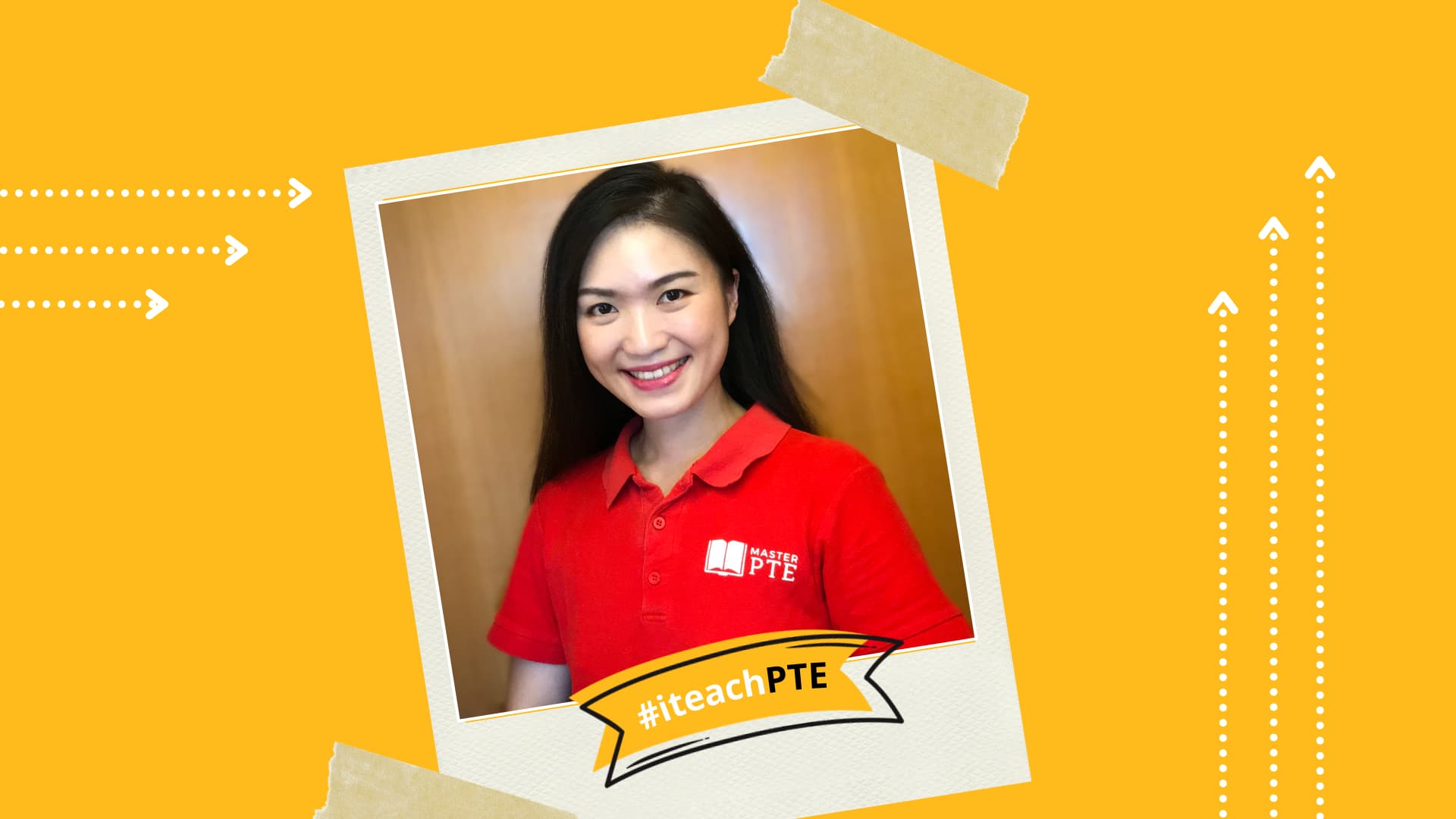
  • Image - Kelly Hoo #iteachPTE
    Teacher profile: Sharing the learning journey with PTE teacher Kelly Hoo
    By PTE Author
    Reading time: 6 minutes

    Kelly Hoo is an English teacher based in Malaysia. She works with people from all over the world, helping them to prepare for PTE. But when Kelly first began learning English, she found it really difficult. She certainly never dreamed that one day she would be teaching English and running her own company!  

    From student to teacher  

    So how did Kelly go from learning English, to teaching other people how to get the score they need in PTE?  

    Kelly’s first language was Mandarin, and she struggled a lot when first learning English. “I started my journey with IELTS,” she explains, “and then I discovered PTE.”  

    Kelly was learning English in order to attend the University of Melbourne, where she studied for a Bachelor of Commerce. “I always thought I’d be an accountant,” she laughs. “But it wasn’t meant to be!”  

    After graduating, Kelly went to work for Unilever, a big multinational corporation. But she found herself giving advice to people learning English, and being able to help people on their language-learning journey was really rewarding.  

    “It started with sharing tips with other people who were learning English,” she says. “I’d been through the journey, so when I saw people struggling, I would always give them recommendations and advice.”  

    Starting her own company 

    From those small beginnings, Kelly went on to become a full-time teacher. The next step was starting her own English teaching company, Master PTE, where she is able to combine her passion for teaching with the expertise she gained in her business degree.   

    But Kelly credits her success to the people around her. “It’s not just my own hard work,” she says. “Our team at Master PTE is amazing. My colleagues work so hard and do such a good job. Without them, I wouldn't be here, sharing my experience.”  

    The company is now four years old, and in that time Kelly and her colleagues have helped lots of students build their English skills, prepare to sit PTE, and get the score they need.  

    Helping students set manageable goals  

    The team at Master PTE teaches students of all ages and levels, from all over the world, in a mix of online and in-person classes.  

    “Thanks to Covid, we’re now doing hybrid classes,” explains Kelly, “a mix of online and face to face. Our clients are mainly working adults or students, so they’re very busy, and they need that flexibility.”  

    At Master PTE, Kelly and her colleagues help students to break the big goal of getting the PTE score they need into smaller, more manageable goals.  

    “We don’t ask them to do ten exam tasks in a day, because it’s impossible,” says Kelly. “We focus on what’s doable - a little bit of preparation each day, to make it easier for our students and give them a feeling of achievement, and the satisfaction that comes from that.”  

    The skill that Kelly’s students struggle with the most is speaking. It’s a cultural problem, Kelly says, as in Malaysia, people are worried about making mistakes. “We want to boost their confidence and tell them to express themselves. I always tell students, Don’t be afraid to make a mistake. Just say what’s on your mind - it’s ok, we don’t judge people at Master PTE!”  

    Speaking to a computer can also be a challenge for some students, but for others, a computer-based exam like PTE helps with their confidence. They prefer to speak to a computer rather than a human examiner.  

    Kelly’s students are her inspiration  

    One of the things Kelly loves about her job is meeting people from all over the world. “We have students from Japan, from Botswana, from India. It's amazing to connect with people and learn about their culture, their stories. The learning is definitely a two-way street in our classes!” she laughs.  

    One of Kelly’s most inspirational students was from India. He was planning to sit PTE in order to move to Australia with his wife and young children. “When I first spoke to him, his English was at a really low level,” she explains. “I thought he would need a lot of preparation.”  

    He started studying with Kelly, preparing for the test, and working hard every evening. “He was really burning the midnight oil,” she says, “as he was working full time too. He put in so much hard work, but he was doing it for his family, for his kids’ future, to give them a better life. I really admired his spirit - and I was so happy in the end when he got the score he needed after just two months of studying!”  

    The importance of perspective 

    Kelly has one piece of advice for other PTE teachers: always try to think from the students perspective.  

    “Teaching English is easy for us,” she says. “We use English everyday. That’s why it’s so important to put yourself in your student’s shoes. Make sure they can absorb and retain the information you are teaching them.”  

    From time to time, Kelly studies a new language like German, or Japanese, just to remind herself what it’s like to learn a new language.  

    “I understand where the students are coming from,” she says. “I’ve been a learner too, and learning English as a second language isn’t easy.”  

    That’s why Kelly is so focused on understanding each student’s situation, and making things a little easier for them by supporting them and creating a community that they are part of.  

    “I always tell them, Don’t give up!” she says. “Learning can be fun and interesting.”  

    Learn more 

    For more insights into PTE preparation, have a look at the PTE blog, where you’ll find inspiration, advice, and lots of useful resources such as free lesson plans and preparation tools. And if you’d like to be featured on our PTE teacher profile series, just fill out this form!