PTE inspiration and advice

Explore our latest articles, guidance and advice to support your test journey

  • Image, teaching, 800px

    How are PTE and IELTS different? Here’s what you need to know

    By PTE Author

    Read Time: 6 minutes

    PTE Academic is a real-world English test. This means it uses authentic source materials and a range of accents to assess natural real-world English proficiency. The test format is clearly structured, but students still need to understand the tasks in each section and know what they have to do to succeed on test day. 

    The good news is that if you’re already used to preparing candidates for IELTS Academic, you’ll easily be able to adapt to help prepare them for their PTE Academic test. 

    Let’s have a look at the similarities and differences between both tests and explore how you can adapt your test preparation classes for success in PTE Academic. 

    The structure of the tests

    The structure of PTE Academic and IELTS Academic is broadly similar. Both tests assess students on all four language skills: speaking, writing, reading and listening. The biggest difference in structure is that for PTE Academic there is just one two-hour computed-based test for all four skills. Whereas with IELTS Academic you need to book a separate face-to-face speaking test. More on that below. The order that skills are tested in, and the way the tasks are timed and organized, is also different:

  • Image- nurse- 800px x 451px

    How to work as a registered nurse in the UK, US and Australia

    By PTE Author
    Reading time: 6 minutes

    Are you interested in working as a nurse overseas? With the right qualifications, your passion for nursing could help you begin a new chapter in Australia, the US, or the UK.

    In this guide, we’ll learn about what you’ll need to do to work as a registered nurse in each country, as well as what employment opportunities waiting for you abroad. Let’s explore:  

    Nursing in Australia: requirements 

  • Image- Singapore, 800px x 451px

    How to study in Singapore

    By PTE Author
    Reading time: 5 minutes

    Asian students have long been drawn to Western universities. In fact, in 2018 and 2019, China sent more students to study in the UK than any other country. But now as Asian countries seek to attract more international students themselves, many learners are choosing to study closer to home instead.  

    After all, studying within the region offers plenty of benefits. Not only do Asian universities provide a world-class education at a more affordable price. But they are also “among the world’s best at enhancing their alumni’s job market prospects,” states the QS Graduate Employability Rankings. This is a big draw, considering a recent report found that 81% of respondents from eight Asian countries wanted to study at a foreign university to improve employment. 

    So, what are some of the top study abroad locations for Asian students? And what do learners need to keep in mind when choosing a destination? In this guide, we’ll focus on Singapore: 

    Singapore at a glance 

    Singapore is modern, sustainable, and multicultural. This makes it an attractive place to study for students from around the region. Malay, Mandarin, Tamil, and English are all recognized as official languages, although English is most commonly spoken. In fact, almost 40% of the population in Singapore speaks English at home.  

    Singapore invests heavily in human capital. For example, it spends more than 20% of its budget on education each year. It comes as no surprise, then, that Singapore’s education system is listed as one of the best in the world by OECD’s Programme for International Student Assessment (PISA). 

    Universities in Singapore 

    There are dozens of universities and colleges in Singapore. The two most popular universities are the National University of Singapore (NUS) and Nanyang Technological University (NTU). Both universities are ranked among the top 20 in the world. According to QS World University Rankings 2021, NUS holds the spot for 11. NTU is ranked number 13. About a quarter of learners at both universities are international students.  

    Even more, according to QS, NUS ranks number 24 for graduate employability.  

    To study at a Singaporean institution, you must apply directly through the admissions office. This is usually done at the beginning of the year. 

    If you’re a second language speaker or haven’t studied full-time at an English institution, you will also need to prove your English proficiency. PTE Academic is a computer-based language test that provides unbiased and secure results and can help you qualify for studying and migrating abroad.  

    Students wanting to attend a college in Singapore – including the Singapore Institute of Management Global Education (SIM GE), the East Asia Institute of Management, and LASALLE College of the Arts – will need a PTE Academic score of 42. In general, universities look for a minimum PTE Academic score between 55 and 62. Here’s a more detailed breakdown of what some popular universities require: 

    • National University of Singapore–62 

    • Nanyang Technological University– 55 

    • Singapore University of Technology and Design (SUTD) – 62 

    However, students are strongly advised to always check with their own university or college to see exactly what PTE Academic score is needed.  

    Getting your visa 

    If you want to study in Singapore, you will need to have a Student Pass. To apply, you must already be accepted as a full-time student at an academic institution. With a Student Pass, you’ll be able to work up to 16 hours a week during the school term. However, you can only do this if you go to an approved institution.  

    Find out exactly how to apply for a Student Pass here.  

    Cost of living 

    Singapore is considered one of the best student cities in the world; it has great weather, a vibrant mix of cultures, and an excellent food scene. However, compared to other Asian countries, it is on the expensive side. International student tuition fees sit at about $18,700 USD a year. To get an idea about how much it costs to live in Singapore, check out the government’s cost of living calculator.  

    Financial aid 

    It’s important to keep in mind that Singapore does offer financial aid for citizens, permanent residents, and international students. The Ministry of Education provides these grants under The Tuition Grant Scheme.  

    The amount of money offered depends on the area of study and the status of each student in Singapore. This table is a good resource, showing what was available to students studying at NTU in 2020. You can see that for international students, the grants start at about $7,700 USD.   

    To accept a Tuition Grant, students who aren’t citizens must sign a Tuition Grant Agreement. This states that they will work in Singapore for a minimum of three years after graduation.  

    For more grant information, visit the Ministry of Education website.  

    Want to study in Singapore?

    With PTE Academic you can achieve your dreams.  

    Our unbiased English tests are trusted as proof of English proficiency by universities in Singapore –  and results are typically ready within 2 days. 

    Find out where you can take PTE Academic now

  • Female-student-reading-and-studying-at-laptop-in-library 800px x 451px

    Listening: Core English skills part 2

    By PTE Author
    Reading time: 4 minutes

    During Part 3: Listening in PTE Academic, you will need to know pronunciation in order to understand what the speakers are saying.

    Pronunciation

    When completing PTE Academic, you will hear a variety of accents from both fluent English speakers and second language speakers, as you would in the real world. Don’t worry, the accents will be clear and regular users of English do not have trouble understanding them. To prepare you should choose texts from around the world and practice listening to a wide range of accents.

    The recordings in PTE Academic use authentic examples of speech, so there will be connected speech present. Connected speech includes: assimilation, elision, twinning, catenation, linking vowel sounds, intrusive sounds, the schwa /ə/, weak forms, and contractions. These words are not used in English when you pronounce each word separately. They are only used in connected speech.

    Assimilation

    In connected speech in English, the sound at the end of a word can change to sound the same as the beginning of the first word.

    Watch these videos from BBC Learning English to better understand assimilation:

    Elision

    Elision occurs when a sound is not pronounced at all by the speaker.

    For example, we say pos card, but we write postcard.

    This Pronunciation: The sound /s/ video shows how it works.

    Twinning

    When you finish a word with the same sound as the start of the next word, it’s called twinning.

    Watch the video below to learn more:

    Catenation

    Catenation is when one word ends in a consonant sound and the next one starts with a vowel and we say the two words as one.

    The below video will help you learn more about catenation:

    Linking vowel sounds

    When we speak, we use the /j/ (the first sound in yellow) and /w/ (the first sound in wet) to link words that end with a vowel to the next word that starts with a vowel.

    For example, we would say he yordered, but we write he ordered and you say go won, but write go on.

    To learn more about linking /j/ and linking /w/ you can view this video:

    Intrusive sounds

    When we speak, we add a /r/ (first sound in the word red) when the first word ends in some vowel sounds and the next word also starts with a vowel sound.

    For example, we say sawrants but we write saw ants.

    This video on intrusive sounds will help you understand better:

    The schwa /ə/

    The most common vowel sound in English is the schwa /ə/. It is used in connected speech and is when you pronounce a vowel, which is not stressed in a word.

    This video will better explain what it means and how it’s used:

    Weak forms

    In addition to the above, the schwa /ə/ is used to pronounce the vowel in weak forms of grammar words in connected speech. It can be a little confusing so we recommend watching all of the below videos to learn more:

    Contractions

    In connected speech, when we are not stressing the subject, verb, or not, we do not use the full form of the subject and verb with verbs be and have. These are contractions.

    Contractions are also used with be, have and do in the negative, as well as some modal verbs in the negative.

    For example:

    • I am =>I’m

    • You are =>you’re

    • We have =>we’ve

    • They have =>they’ve

    • You are not => you aren’t

    • They are not => they aren’t

    • He/she/it is not =>he/she/it isn’t (you can also use he’s/she’s/it’s not)

    We also use I’m not and we’re not and do not => don’t, did not => didn’t, cannot => can’t, will not => won’t, might not => mightn’t. They are used very often in connected spoken English so make sure to listen carefully to pick these up.

    The below video will take you through this type of connected speech:

    All of the above types of connected speech are important in the Fill in the BlanksHighlight Incorrect Words and Write from Dictation question types.

    As part of Part 3: Listening in your test, you will need to review your vocabulary and grammar skills, as well as learn cohesive devices and signal language. You can read more about these core English skills in part 3.

  • Image- Asian student group, 800px x 451px

    Study in Malaysia with PTE Academic

    By PTE Author
    Reading time: 2 minutes

    Do you want to study in Malaysia?

    If you are an international student wanting to study in Malaysia, you may need to take an English test.

    International students are required to meet the English language competency requirements set by the Malaysian Qualifications Agency (MQA).

    Do you need to take an English test?

    If you are an international student who meets all academic qualifications but have not met the English language requirement for admission you may receive a conditional offer.

    You will then need to complete an English language preparation program within 12 months at the respective private college or university and pass the language test requirement. Only then will you will be able to commence your course.

    Who is exempt?

    You do not need to prove your English language skills if you are an international student that:

    • is from an English-speaking country

    • has an academic qualification from an institution that uses English as the medium of instruction

    • has completed their education in Malaysia and has decided to further their studies to a higher level

    Where is PTE Academic accepted?

    Since April 2016, the Malaysian Ministry of Higher Education has accepted PTE Academic as proof of the English language skills for international students wanting to study at a private higher educational institution in Malaysia.

    There are a growing number of Malaysian Universities that now recognize PTE Academic such as:

    • Asia Pacific Institute of Information Technology (APIIT)

    • Asia Pacific University of Technology & Innovation (APU)

    • Asia School of Business

    • Asia e University

    • Berjaya University College

    • Curtin University (Sarawak)

    • Cyberlynx International College

    • Disted College

    • Education Malaysia Global Services

    • Despark College

    • First City University College

    • HELP University College

    • Heriot Watt University Malaysia

    • Inti International College Subang

    • Malaysia University of Science and Technology

    • Monash University Malaysia

    • Multimedia University

    • MAHSA University

    • Pintar College

    • Segi University

    • Sunway College

    • Sunway University

    • Swinburne University of Technology (Sarawak)

    • Taylor’s University

    • The University of Nottingham Malaysia Campus

    • UCSI University

    • University of Reading Malaysia

    • University of Southampton Malaysia Campus

    • Xiamen University (Malaysia Campus)

    We are constantly expanding the number of Malaysian Universities that accept our scores, explore our full list of institutions in Malaysia who accept PTE.

    You can take PTE Academic at test centers around the world and at 6 locations in Malaysia. Ready to take PTE Academic? Book now!

  • A man using a laptop

    Prepare online with E2Language

    By PTE Author
    Reading time: 1 minute

    Are you preparing to take PTE Academic?

    Good news! We have added a new test preparation company to our existing list of providers. This will give you even more options and support in your test preparation.

    Try E2Language with a free trial

    E2Language is a global online tutorial and test preparation provider. They offer good quality practice services and materials for PTE Academic. E2Language offers online tuition through group and 1-1 learning, supported by a range of YouTube videos that share tips and advice. They offer a set of online preparation materials.

    We are always looking to expand and enhance the services we offer our test takers and we believe the addition of E2Language helps us achieve this goal.

    Give yourself the best chance of performing well on the day with E2Language – try for free.

  • Video thumbnail for the video, 'Learn how PTE Academic uses AI to mark tests'

    How do you know PTE Academic’s computer marking works?

    By PTE Author
    Reading time: 2 minutes

    How do we know automated scoring works

    Are you thinking of taking PTE Academic, or have you recently taken it, but you are wondering how it is that a computer can mark your test?

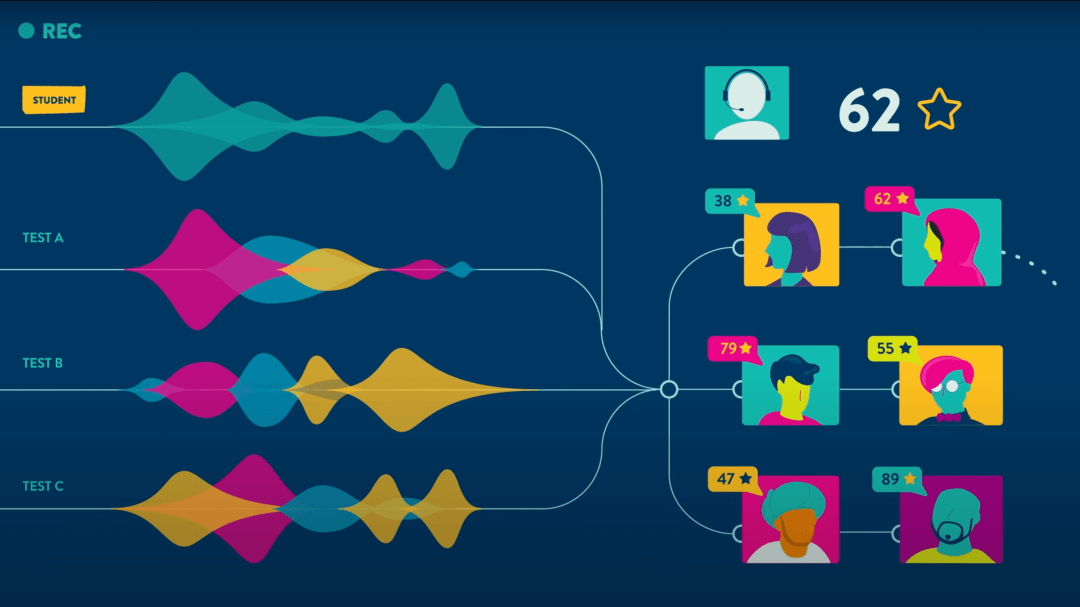
    Well, firstly the test has been designed by humans, all leading experts in their field. Our human experts design and write the questions, quality assure them, and then score them. At this point, computers are trained to use the patterns of highly trained language experts to attribute scores to questions. When the computer marks correlate highly with the human scores, we then allow the computer to mark test scripts from across the world.

    As a result of our processes and technology, the computer behaves like an expert human examiner – but without any possible bias, lack of concentration, or variation between individual examiners.

    The scoring criteria are exactly the same as human scoring – test takers are marked on their delivery, clarity, relevance, the accuracy of grammar, and appropriateness of vocabulary.

    Want to hear more?

    Take a couple of minutes and listen to one of our leading independent advisors, Dr. Alistair Van Moere, a member of Pearson’s Technical Advisory Group, as he explains how it all works.

  • Image- student at class 800px

    Reviewing Test Performance

    By PTE Author
    Reading time: 2 minutes

    If you have completed PTE Academic, you would know by now that it is scored against the Global Scale of English and that you need to practice many skills for each part of the test: Speaking & Writing, Reading, and Listening.

    After completing PTE Academic you will receive an email notification that your results are available online. Typically within 2 days. Learn how to access your Score Report.

    What does my Score Report mean?

    When you receive your Score Report it will show you your overall score, which is based on your performance across all test items. Your communicative skills that are measured are listening, reading, speaking and writing.

    This is an example of what your Score Report may look like.

    The enabling skills are those skills that are required to fulfill the question types in the test. It’s important to know what each of these skills refers to.

    Grammar

    Correct use of language with respect to word form and word order at the sentence level.

    Oral Fluency

    Smooth, effortless and natural-paced delivery of speech.

    Pronunciation

    Production of speech sounds in a way that is easily understandable to most regular speakers of the language. Regional or national varieties of English pronunciation are considered correct to the degree that they are easily understandable to most regular speakers of the language.

    Spelling

    Writing of words according to the spelling rules of the language. All national variations are considered correct, but one spelling convention should be used consistently in a given response.

    Vocabulary

    Appropriate choice of words used to express meaning, as well as lexical range.

    Written Discourse

    Correct and communicatively efficient production of written language at a textual level. Written discourse skills are represented in the structure of a written text, its internal coherence, logical development, and the range of linguistic resources used to express meaning precisely.

    How do I identify my areas of weakness?

    From the visual graph on your Score Report, you will be able to see areas you need to improve on. You should aim to develop your core (enabling) skills required across all areas of the test.

    The following resources will help you develop your enabling skills:

    How can I improve in each part of the test?

    It’s also worth focusing on particular parts of the test or questions you think you had trouble with. The following articles may help you improve your skills across questions:

    If you don’t already have one, it’s recommended to work with an English teacher to work through areas that may need improvement.

    Good luck!

  • Image- A guy with headphone 1080px

    Listening: Core English Skills Part 1

    By PTE Author
    Reading time: 3 minutes

    The last part of PTE Academic, Part 3: Listening, requires a large combination of core skills.

    The very first skill you will need to develop involves how you listen (listening methods).

    Below, is information on different types of listening and where you may need to use them during PTE Academic.

    Listening Methods

    Predicting

    One of the listening methods you will need to develop is predicting. Before listening, most people will have some idea about what they are going to listen to and prepare themselves for it. They predict.

    It helps to think about the recordings before you hear it spoken, it helps you listen more effectively.

    This listening method will help during Select Missing Word questions as the topic of the text you listen to is given in the instructions. It will also help in the Re-tell Lecture questions as the image will give you an idea of the general context of the listening text.

    Listening for Gist

    Listening for ‘gist’ will allow you to understand the general meaning of a text quickly. When someone is talking, listen in a general way and think about what the speaker is trying to communicate and how they might feel about the topic based on their tone of voice.

    When practicing, try to listen for the gist before listening for a second time more intensively for specific information.

    This reading method will help in the Multiple-choice, Choose Multiple Answer and Multiple-choice, Choose Single Answer questions. Remember in PTE Academic you can not replay the listening track.

    Listen for Specific Information

    You will also need to be able to listen effectively to find specific information. This is more detailed listening and is often used when you need to answer comprehension questions. You first need to understand what information you are looking for in the text.

    When practicing, if you listen to a text that does not have questions write some yourself. Questions that may help could be:

    • What happened?

    • When did it happen?

    • Where did it happen?

    • Why did it happen? Or, why did it happen in this way, and not another way?

    While listening for specific information, you should listen for synonyms and paraphrasing to match the meaning of the text with the meaning of the questions.  This is because you will not hear the exact words in the question.

    Listening to Infer Meaning

    At times you can understand what the speakers are saying by inferring meaning, as the information is not always stated by the speakers.

    To infer meaning, you need to listen for clues in the text or use general knowledge to guess the meaning of what the speakers are saying. Do this by working out the relationship between the speakers, the tone of voice or the words they use.

    You may need to use this listening method in the Multiple-choice, Choose Multiple Answer and Multiple-choice, Choose Single Answer questions.

    In addition to listening methods, you will also need to understand how words are pronounced on their own and together in a sentence. Read more about pronunciation in Part 2 of Core English Skills.

    Want more prep ideas?

    Explore Smart Prep, which combines all our practice materials in one place, so it's easier for you to stay on track with your PTE preparation.

    • Smart Prep is a clear path to test day, guiding you through the official paid and free resources available for your test

    • It can be accessed whether you’ve booked a test or not – just create, or sign in to your myPTE account

    • Preparation materials include guided practice tests, introductory videos, video courses and test tips.

    Ready to get started?

Looking for news or press releases?