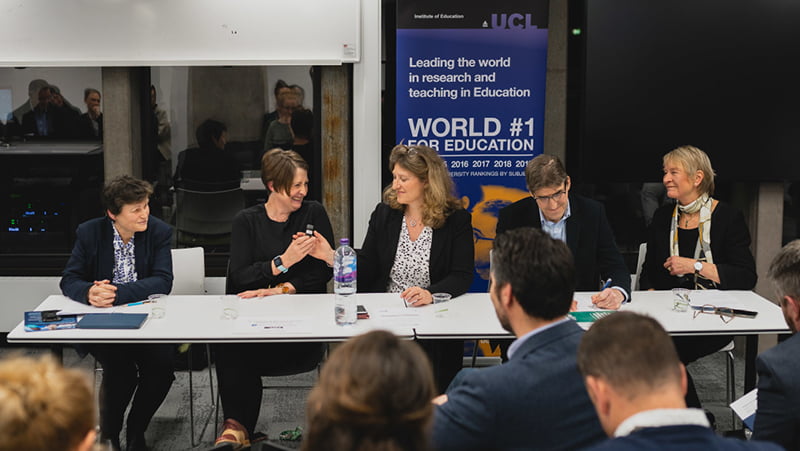

Key highlights from the role of AI in English assessment discussion panel

PTE Author
PTE Author
News-  The Role of AI in English Assessment Discussion Panel 800px x 451px
Reading time: 3 minutes

Earlier this week Pearson and UCL Institute of Education hosted an event to launch their three-year research partnership looking at the role of AI in English Language assessment. The event was held at UCL and was kicked off by a lively debate on the opportunities that AI offers to the field of educational assessment – as well as some of the challenges. I was joined by leading experts in the field of assessment who all gave their own unique take on this topic. To summarise:

Dr. Mary Richardson from UCL, who will be co-leading the research collaboration, emphasized the central values of truth, equity, and trust in the assessment. These values have been a continual challenge in traditional paper-based testing, so we must also ensure that in the emerging world of Automated and AI assessments. We establish public awareness, understanding, and trust that test takers are treated fairly, irrespective of their gender, race or location.

Dr. Bryan Maddox from the University of East Anglia continued with the theme of establishing validity in a new age of assessment. Bryan is an expert in the use of micro analytics to explore and analyze student interaction with assessments, which can then be fed back for test evaluation purposes. The considerable amount of process data that automated assessment offers rich research opportunities to use Micro-analytic methods (video ethnography, eye tracking, retrospective think-aloud). All well suited to demonstrate the validity and fairness of assessments in heterogeneous global AI test-taking populations.

I described how machine learning works, particularly in the skills of speaking and writing. I emphasized the importance of ensuring that assessment is not only reliable and accurate but just as important that they represent the full knowledge and skills of a subject. AI can do this, and therefore it opens up the opportunities for authentic, fair and fast assessment- globally.

Professor Patricia Broadfoot

Professor Patricia Broadfoot

Professor Patricia Broadfoot CBE then closed the debate with a clarion call to update the current 19th assessment practices in terms of the way high and low stakes assessments are delivered and utilized by all educational stakeholders. Patricia has been a leading advocate of both the fairness of assessments and also the promotion of the use of Technology-enhanced assessments (TEA). She said that while we must guard against poor quality, we must promote and use high-quality TEA to drive highly reliable, valid and secure summative assessments. Also, offer personalized learning and feedback, address teacher workload. It is indeed time for TEA, and AI in language assessment is leading the way.

Dr Rose Clesham and Dr Mary Richardson

Dr. Rose Clesham and Dr. Mary Richardson

The event was a great success with a lively Q&A session at the end.  Many thanks to all the speakers, attendees, and organizers. There will be further dissemination pieces throughout the research period. If you are interested in learning more than please drop me a line.

Dr. Rose Clesham, Director of Research, Academic Standards and Measurement, Pearson

Related Content

  • Image - Asian man reading a book 800px
    PTE Academic launches free Online course to help test takers
    By PTE Author
    Reading time: 2 minutes

    PTE Academic has launched a brand new Massive Open Online Course (MOOC); ‘Introduction to PTE Academic’, which is available free of charge to all users.

    The course is designed to familiarise candidates with the test structure and question types for PTE Academic through video guidance and online practice.

    The course was developed in partnership with E2Language, a global online test preparation and tuition provider for PTE Academic and other English language assessments.

    Dan Doyle, PTE Academic Vice President Product Management and Delivery, explains, “This course suits anyone who is unfamiliar with PTE Academic and needs to understand the essentials about what it is they are likely to face in the test in just a few short hours.”

    Jarrad Merlo ( Jay), Co-founder of E2Language, further states “Candidates often don’t know which test to take. This MOOC will give candidates a very quick overview of PTE Academic and the information they need to make the right choice for them.”

    The course is equally useful for any teachers or Higher Education Institutions who are considering preparing their students for PTE Academic.

    Throughout the course, Jay briefly offers guidance on how they should respond to the example questions presented. The course simulates each of the questions types in PTE Academic allowing users to try out their own techniques for attempting the questions before receiving guidance.

    After completing the course users are encouraged to undertake further preparation in order to maximize their chances of achieving their desired score on the test. Candidates can choose from a wide range of quality PTE Academic self-study resources including books, a mobile phone app for practice on the go and our unique fully Scored Practice Test – which gives an indicator of how they may perform on the test.

    For alternative preparation resources and tutor-lead support, PTE Academic has a range of preparation partners including E2Language to help provided targeted preparation based on where help is needed.

  • Image- Pakistan - 750 x 495px
    PTE Academic test center opens in Pakistan
    By PTE Author
    Reading time: 1 minute

    Test takers can now take PTE Academic in Pakistan after the official opening of a new center in Islamabad this week.

    Pearson has partnered with JNS Education to open the PTE Testing Center in Islamabad.