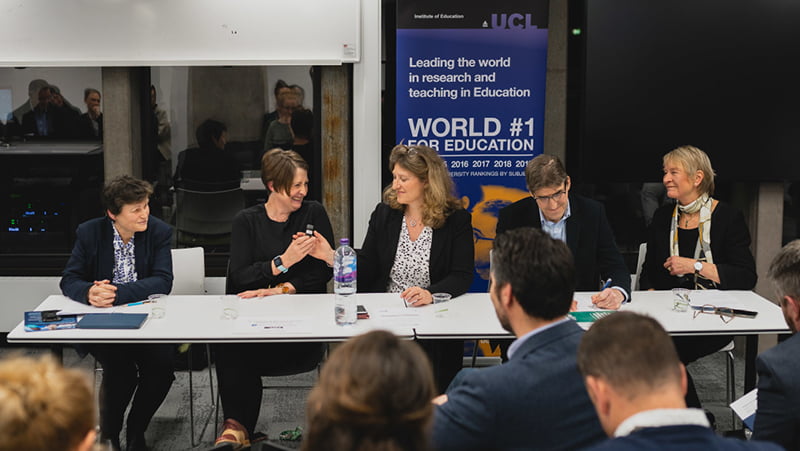

Key highlights from the role of AI in English assessment discussion panel

PTE Author
PTE Author
News-  The Role of AI in English Assessment Discussion Panel 800px x 451px
Reading time: 3 minutes

Earlier this week Pearson and UCL Institute of Education hosted an event to launch their three-year research partnership looking at the role of AI in English Language assessment. The event was held at UCL and was kicked off by a lively debate on the opportunities that AI offers to the field of educational assessment – as well as some of the challenges. I was joined by leading experts in the field of assessment who all gave their own unique take on this topic. To summarise:

Dr. Mary Richardson from UCL, who will be co-leading the research collaboration, emphasized the central values of truth, equity, and trust in the assessment. These values have been a continual challenge in traditional paper-based testing, so we must also ensure that in the emerging world of Automated and AI assessments. We establish public awareness, understanding, and trust that test takers are treated fairly, irrespective of their gender, race or location.

Dr. Bryan Maddox from the University of East Anglia continued with the theme of establishing validity in a new age of assessment. Bryan is an expert in the use of micro analytics to explore and analyze student interaction with assessments, which can then be fed back for test evaluation purposes. The considerable amount of process data that automated assessment offers rich research opportunities to use Micro-analytic methods (video ethnography, eye tracking, retrospective think-aloud). All well suited to demonstrate the validity and fairness of assessments in heterogeneous global AI test-taking populations.

I described how machine learning works, particularly in the skills of speaking and writing. I emphasized the importance of ensuring that assessment is not only reliable and accurate but just as important that they represent the full knowledge and skills of a subject. AI can do this, and therefore it opens up the opportunities for authentic, fair and fast assessment- globally.

Professor Patricia Broadfoot

Professor Patricia Broadfoot

Professor Patricia Broadfoot CBE then closed the debate with a clarion call to update the current 19th assessment practices in terms of the way high and low stakes assessments are delivered and utilized by all educational stakeholders. Patricia has been a leading advocate of both the fairness of assessments and also the promotion of the use of Technology-enhanced assessments (TEA). She said that while we must guard against poor quality, we must promote and use high-quality TEA to drive highly reliable, valid and secure summative assessments. Also, offer personalized learning and feedback, address teacher workload. It is indeed time for TEA, and AI in language assessment is leading the way.

Dr Rose Clesham and Dr Mary Richardson

Dr. Rose Clesham and Dr. Mary Richardson

The event was a great success with a lively Q&A session at the end.  Many thanks to all the speakers, attendees, and organizers. There will be further dissemination pieces throughout the research period. If you are interested in learning more than please drop me a line.

Dr. Rose Clesham, Director of Research, Academic Standards and Measurement, Pearson

Related Content

  • Image- reading 800px x 451px
    How PTE Academic supports its test outcomes
    By PTE Author
    Reading time: 1 minute

    Pearson recently published an Efficacy report looking at PTE Academic.

    The purpose of Pearson’s Efficacy Reporting is to be as open and transparent as possible about how it designs, develops, and evaluates the impact of its products on learners.

    Sarah Hughes, Research & Analysis Manager, helped pull the PTE Academic report together. Below she sets out its key findings:

    “The PTE Academic Assessment Efficacy Report explains how our research relates to three key indicators of assessment quality: validity, reliability, and fairness.

    • Validity evidence demonstrates that test scores can be used and interpreted for the defined purpose of the test. For PTE Academic, it is important that the test scores provide a meaningful reflection of a test taker’s language proficiency that can be understood around the world and used to help them make the next step in their journey.

    • Reliability is a measurement concept, which means that scoring is consistent over time, across multiple test forms, and/or over multiple administrations. Any time a candidate takes the test, they should be presented with the same opportunity for consistent measurement.

    • Fairness in assessment means that the test is not systematically biased and that scores can be interpreted in the same way for all test takers. PTE Academic’s research into fairness and automated scoring ensure that test-takers are given the same opportunity to demonstrate their language proficiency regardless of gender, race/ethnicity, for instance.”

    Read the PTE Academic Assessment Efficacy Report (PDF 940KB).

    View the full range of research conducted on PTE Academic.

  • Group studying and working together 1000px W
    New centers open and new universities sign up as PTE Academic demand grows
    By PTE Author
    Reading time: 1 minute

    With 34% global growth this year, more test takers than ever are selecting PTE Academic as their first choice English language exam for studying and working abroad.

    To meet this demand, we have opened 14 brand new state of the art Pearson VUE test centers across the globe so far in 2018 to give test takers even greater flexibility when choosing the venue and date for their PTE Academic exam.

    For example, five centers have opened in major cities across Australia including Adelaide, Perth, and Sydney. Likewise in India, a further nine Pearson VUE test centers have recently opened across the country, in cities such as Delhi, Surat, and Ahmedabad, to give test takers a greater choice of venue.

    In addition, we have opened a further 21 new third-party test centers this year.

    Alongside this, increasing numbers of universities worldwide are accepting PTE Academic as the test by which prospective students can prove their English skills. Recent additions include:

    • University College of Northern Denmark (UCN)

    • UNITAR International University, Malaysia

    • Inland Norway University of Applied Sciences, Norway

    • East Asia Institute of Management, Singapore

    • EAE Business School, Spain

    • Norwich University of the Arts, UK

    • Illinois State University, USA

    • University College of Northern Denmark (UCN)

    Search the full list of universities which recognize PTE Academic.

    Take the next step

  • Image- European students, 800px x 451px
    New PTE Academic test center opens in Italy
    By PTE Author
    Reading time: 2 minutes

    From April Italian based test takers will be able to take PTE Academic to study or work abroad

    Starting earlier this month, candidates can now take PTE Academic every Wednesday at the Pearson Italia Test Center in Milan, scheduling up to 24 hours in advance and getting results typically within 5 business days – often much quicker with over 85% of results returned within 2 days in 2018.

    PTE Academic is recognized by thousands of programs in the USA, 100% of Australian, New Zealand, and Irish Universities, over 98% of UK universities, and 90% of Canadian. It is also one of the few language qualifications accepted for Visa purposes by the Australian and New Zealand governments.

    Freya Thomas Monk, Senior Vice President English Assessment, Pearson said:

    “I’m delighted that we are opening a PTE Academic Test Center in Milan and that Italian students can now experience what PTE Academic has to offer – an unbiased, secure, fast and accurate test of their English language ability skills.”

    “PTE Academic is a high-stakes test that we at Pearson are very proud of. It is one of the few tests accepted by thousands of academic programs around the world as well as for Australian and New Zealand visa applications. It provides unbiased proof of a candidate’s English skills and scores are returned quickly – more than 85% within 2 days in 2018 – all achieved through our use of leading AI technology.”

    The PTE Academic Center in Milan is located via Arconati 1 (Porta Vittoria Station, bus 92, tram 12). Pearson provides plenty of preparation to get ready for the exam, such as:

    Explore all PTE Academic preparation resources or book your test today.