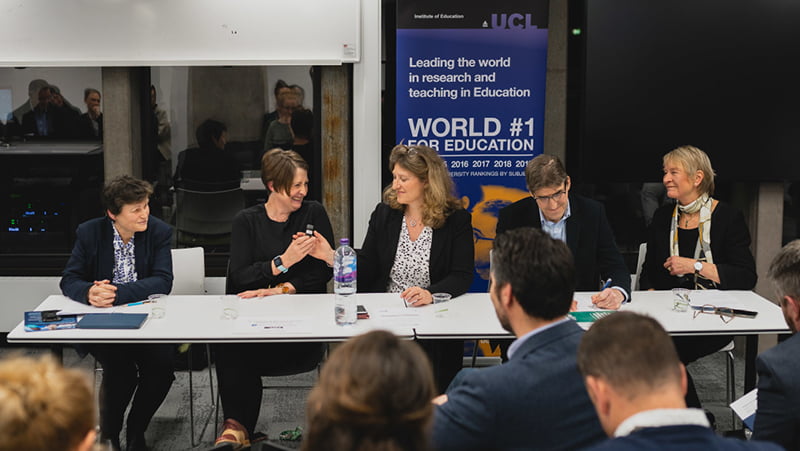
Earlier this week Pearson and UCL Institute of Education hosted an event to launch their three-year research partnership looking at the role of AI in English Language assessment. The event was held at UCL and was kicked off by a lively debate on the opportunities that AI offers to the field of educational assessment – as well as some of the challenges. I was joined by leading experts in the field of assessment who all gave their own unique take on this topic. To summarise:
Dr. Mary Richardson from UCL, who will be co-leading the research collaboration, emphasized the central values of truth, equity, and trust in the assessment. These values have been a continual challenge in traditional paper-based testing, so we must also ensure that in the emerging world of Automated and AI assessments. We establish public awareness, understanding, and trust that test takers are treated fairly, irrespective of their gender, race or location.
Dr. Bryan Maddox from the University of East Anglia continued with the theme of establishing validity in a new age of assessment. Bryan is an expert in the use of micro analytics to explore and analyze student interaction with assessments, which can then be fed back for test evaluation purposes. The considerable amount of process data that automated assessment offers rich research opportunities to use Micro-analytic methods (video ethnography, eye tracking, retrospective think-aloud). All well suited to demonstrate the validity and fairness of assessments in heterogeneous global AI test-taking populations.
I described how machine learning works, particularly in the skills of speaking and writing. I emphasized the importance of ensuring that assessment is not only reliable and accurate but just as important that they represent the full knowledge and skills of a subject. AI can do this, and therefore it opens up the opportunities for authentic, fair and fast assessment- globally.