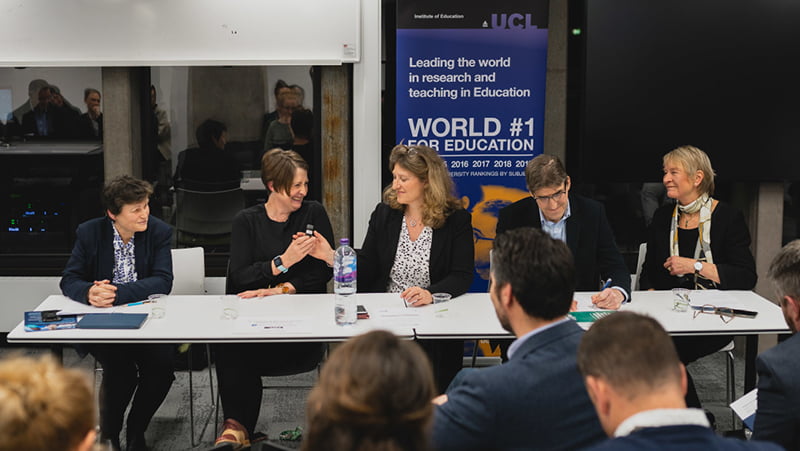
Key highlights from the role of AI in English assessment discussion panel

PTE Author
PTE Author
News-  The Role of AI in English Assessment Discussion Panel 800px x 451px
Reading time: 3 minutes

Earlier this week Pearson and UCL Institute of Education hosted an event to launch their three-year research partnership looking at the role of AI in English Language assessment. The event was held at UCL and was kicked off by a lively debate on the opportunities that AI offers to the field of educational assessment – as well as some of the challenges. I was joined by leading experts in the field of assessment who all gave their own unique take on this topic. To summarise:

Dr. Mary Richardson from UCL, who will be co-leading the research collaboration, emphasized the central values of truth, equity, and trust in the assessment. These values have been a continual challenge in traditional paper-based testing, so we must also ensure that in the emerging world of Automated and AI assessments. We establish public awareness, understanding, and trust that test takers are treated fairly, irrespective of their gender, race or location.

Dr. Bryan Maddox from the University of East Anglia continued with the theme of establishing validity in a new age of assessment. Bryan is an expert in the use of micro analytics to explore and analyze student interaction with assessments, which can then be fed back for test evaluation purposes. The considerable amount of process data that automated assessment offers rich research opportunities to use Micro-analytic methods (video ethnography, eye tracking, retrospective think-aloud). All well suited to demonstrate the validity and fairness of assessments in heterogeneous global AI test-taking populations.

I described how machine learning works, particularly in the skills of speaking and writing. I emphasized the importance of ensuring that assessment is not only reliable and accurate but just as important that they represent the full knowledge and skills of a subject. AI can do this, and therefore it opens up the opportunities for authentic, fair and fast assessment- globally.

Professor Patricia Broadfoot

Professor Patricia Broadfoot

Professor Patricia Broadfoot CBE then closed the debate with a clarion call to update the current 19th assessment practices in terms of the way high and low stakes assessments are delivered and utilized by all educational stakeholders. Patricia has been a leading advocate of both the fairness of assessments and also the promotion of the use of Technology-enhanced assessments (TEA). She said that while we must guard against poor quality, we must promote and use high-quality TEA to drive highly reliable, valid and secure summative assessments. Also, offer personalized learning and feedback, address teacher workload. It is indeed time for TEA, and AI in language assessment is leading the way.

Dr Rose Clesham and Dr Mary Richardson

Dr. Rose Clesham and Dr. Mary Richardson

The event was a great success with a lively Q&A session at the end.  Many thanks to all the speakers, attendees, and organizers. There will be further dissemination pieces throughout the research period. If you are interested in learning more than please drop me a line.

Dr. Rose Clesham, Director of Research, Academic Standards and Measurement, Pearson

Related Content

  • Image- Asian student, 1080px
    PTE now available in all the Association of Southeast Asian Nations (ASEAN) member countries
    By PTE Author
    Reading time: 3 minutes

    Editor’s note (November 2025): As of November 2025, PTE tests are no longer available in Myanmar due to changes affecting payment processing and test delivery.

    Pearson now delivers Secure English Language Test (SELT) exams for UK visas in all Association of South East Asian Nations (ASEAN) countries. 

    PTE Academic, PTE Academic UKVI, and PTE Home tests are available at 29 locations in total across the 10 ASEAN countries of Brunei, Cambodia, Indonesia, Laos, Malaysia, the Philippines, Singapore, Thailand, and Vietnam as of December 2024.

    English is the working language of the 10 member ASEAN bloc, which is home to more than 650 million people and as many as 1,000 languages. 

    The ASEAN PTE centers are located at:

    • Brunei Darussalam: Bandar Seri Begawan 

    • Cambodia: Phnom Penh 

    • Indonesia: Jakarta, Surabaya, Pontianak 

    • Japan: Chiyoda-ku, Osaka shi, Shinjuku 

    • Korea, South: Busan, Seoul 

    • Lao People’s Democratic Republic: Vientiane 

    • Malaysia: Johor Bahru, Kuala Lumpur, Penang, Sabah, Selangor 

    • Philippines: Baguio City, Cebu, Davao, Makati, Makati City, Manila 

    • Singapore: Singapore 

    • Thailand: Bangkok, Chiang Mai, Chon Buri, Pathumthani 

    • Vietnam: Hanoi, Ho Chi Minh City 

    Book a PTE test today or view prices and your nearest test center.

    Last updated 05 November 2025.

  • Image- UCL,640px
    Pearson and UCL launch AI research partnership
    By PTE Author
    Reading time: 3 minute

    London, February 4, 2020: Pearson, the world’s learning company, and the UCL Institute of Education today launched a new three-year project collaboration looking at the role of AI in English Language assessment.

    The research will focus on test-takers end to end experience of taking PTE (Pearson’s leading high stakes test of English) for either study or migration purposes. This fully digital test is delivered through Pearson VUE, the computer-based testing business of Pearson. The latest AI technology is used for scoring; biometric data collection provides enhanced security measures and voice recognition software is applied for the speaking element of the test. These cutting-edge technologies ensure the provision of an impartial and highly accurate test of people’s English language proficiency.

    The purpose of the research will be to ensure that global test-taker responses are fed back into the ongoing development and use of AI in assessment and to ensure the fairness, accuracy, and validity of these tests.

    Commissioned by the PTE research team, the project will be led by UCL Associate Professors Dr. Mary Richardson and Dr. Sandra Leaton-Gray.

    Dr. Mary Richardson said: “If you take an English oral exam, for example, you want a system that gives you the marks you deserve, whether you learned English originating from America, Australia, Canada, India, Ireland, Malta, or Hong Kong. All those different, slightly subtle local variations in vocabulary and sentence structure need to be built into the assessment model, so you get a fair mark. This is where artificial intelligence can really help us.”

    Her views are echoed by Dr. Rose Clesham, Director of Academic Standards, Measurement, and Research for PTE: “Pearson has been working in the area of Artificial Intelligence in assessment for some time. There is a real potential to revolutionize the way people take low and high stakes tests, the way we mark them, and how we provide results and feedback. This new collaboration between PTE and the UCL Institute of Education will put our test takers right at the heart of the assessment process.”

    PTE Academic is one of the fastest-growing products in Pearson and is a strategic growth priority for the company, posting 17% growth in test volumes last year. The test is accepted by the UK, Australian, and New Zealand Governments for all visa applications. It is also accepted by 100% of Australian, New Zealand, and Irish Universities, 98% of UK universities, and more than 2,000 academic programs in the USA.

    Alongside this, we have recently launched PTE Home, a two-skills language test accepted by the UK Government for family, settlement, or citizenship applications. It tests speaking and listening skills.