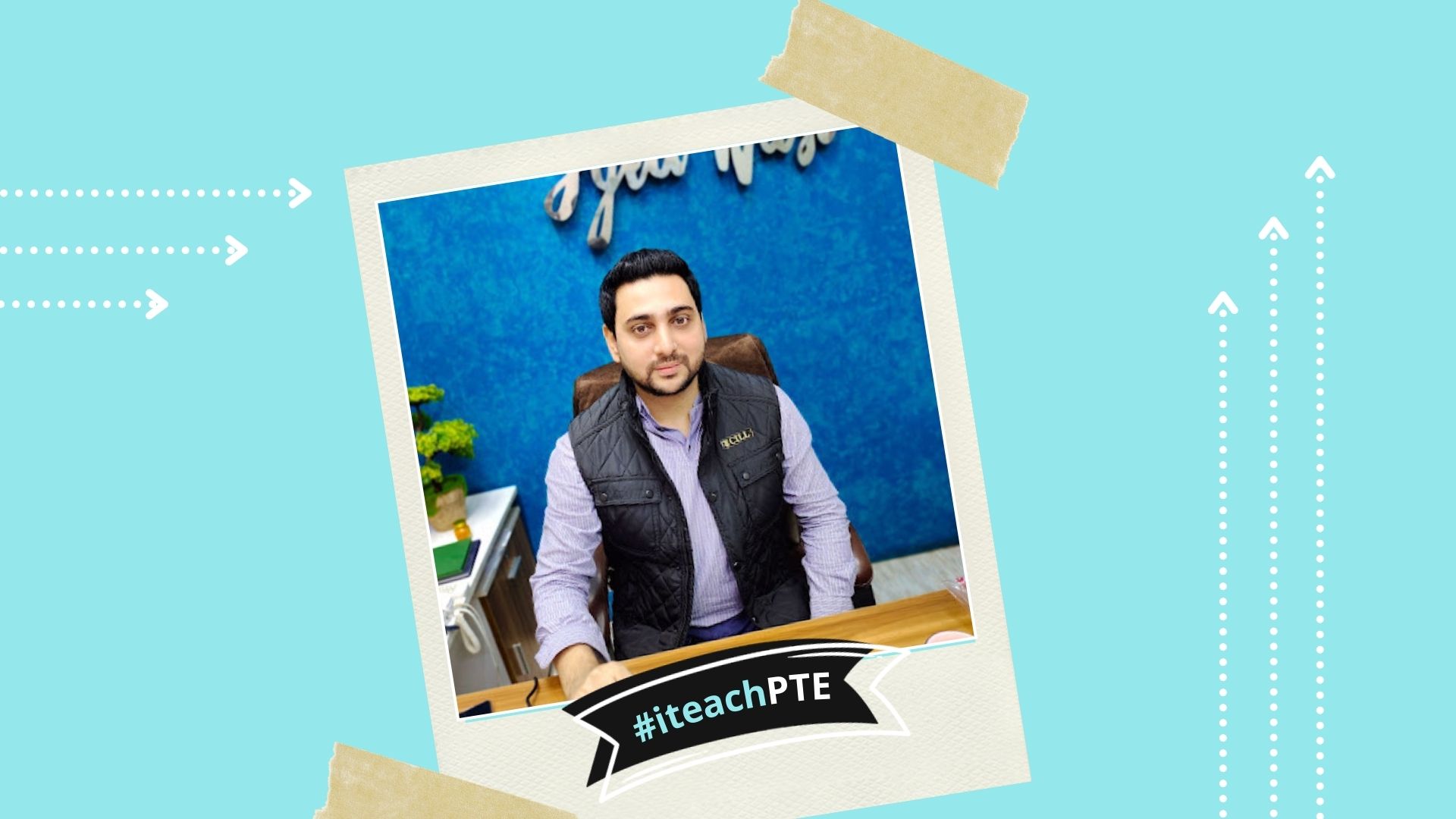

Teacher profile: Building a learning community in Dhaka

PTE Author
PTE Author
Image - iteachPTE Syed Wasi
Reading time: 5 minutes

Syed Wasi is a pioneer in many ways. He was the first PTE trainer in Bangladesh, and the first Bangladeshi to score 90 in PTE – no mean feat in a country of 166 million people! Syed is the founder of the Center for Innovative Language Learning (CILL) where students come for his help in preparing for PTE. The center is renowned for its high student success rate.  

So, how does Syed help his students to get the scores they need in PTE? Let’s find out.  

How Syed teaches PTE  

When a student arrives at CILL, their first step towards PTE success starts with a language assessment. “If we find that their language skills aren’t particularly strong,” says Syed, “the first thing we do is create a course which includes general language classes. We go step by step through the levels, helping them to improve their language skills – and once they are ready for PTE, they join a PTE preparation class.”  

Once Syed’s students are part of a preparation class, they follow a carefully designed curriculum. Each language skill tested in PTE (speaking, writing, reading and listening) is covered in a module of three classes. The first class introduces the type of exam questions that students can expect. The second class gives students the practical tools and techniques that they’ll need to answer the exam questions, and the third class is a practice session. But the secret to Syed’s success? He doesn’t let the students sit PTE before they’re ready:  

"The final step in PTE preparation is the mock test. We don’t let them take the test until they’re ready for the test, which is why we have a very high success rate.”  

Flexibility is also important. The PTE preparation courses at CILL are blended courses; some students attend the center in person, and others join online. When the pandemic began, there was a massive shift to teaching online, and many schools had to adapt quickly. But Syed’s language school was ahead of the curve when it came to blended learning. “I did my masters in online teaching back in 2012,” says Syed. “We’ve been teaching with a blended learning model since 2016, so it was easy for us to adapt. Now, students are returning to the classroom, but we still offer the blended learning option.”  

Building a community of learners  

An important part of the school culture at CILL is the accessibility of the teachers. Learning isn’t confined to the classroom – the teachers are available to answer questions outside of class times. “We create WhatsApp groups for different classes, and it’s like a virtual hub,” Syed explains. What’s more, the teachers follow up with students after class. This dedicated service has helped Syed to build a loyal community of learners around the world. “Many of our students have moved to Australia, to the UK, or to other countries,” he says. “And wherever they go, if they meet anyone interested in PTE preparation, they refer them to our school. They’ll say, there’s a person in Bangladesh who can give you the support you’ll need to pass the test.”  

Syed’s advice for PTE teachers 

“If you’re new to PTE teaching, the most important thing is to make sure you have the expertise you need to prepare students for the test,” Syed says. After all, there’s a lot on the line when it comes to PTE. Students often need a certain score for a university application or a visa. So if you don’t prepare students thoroughly, it could have an impact not only on their score but on their careers. Syed recommends taking the test yourself in order to gain real insight into PTE.  

And for more experienced teachers, Syed believes that honesty is the best policy when it comes to test preparation. “Tell your students exactly what they’ll need to do in order to get the score they need. Be honest with them, and that way they know what they have to do.”  

PTE is a high stakes test. When you’re helping students to prepare for the exam, you’re helping them to change their lives, to do something new. “It’s not just a business,” says Syed. “We are helping students to reach their goals. It’s my passion, and my vocation.”  

Learn more

Each month, we feature the profile of a teacher from our PTE community. If you have advice and insights to share with other PTE preparation teachers, we’d like to hear from you! Fill out this form and we’ll be in touch shortly.  

In previous months, we featured Jurine Ruperto, who teaches in Cebu in the Philippines, and Ramesh Thapa, a PTE teacher in Kathmandu. You can read all about them on our blog, where you’ll also find lots of resources for PTE preparation classes. And don’t forget to sign up to our monthly newsletter.

Related Content

  • Image- Cornell university 800px
    Which English test should I take to migrate to Australia or New Zealand?
    By PTE Author
    Reading time: 3 minutes

    PTE Academic can help you get there

    If you want to migrate to Australia or New Zealand you may be required to sit an English test as part of your visa application. Or you may need to sit a test as part of a  skills assessment or for professional registration.

    The question is “which test should I take?”

    There are a range of language tests you can choose from. However, the Pearson Test of English Academic (PTE Academic) is the market leader in computer-based English language testing. PTE Academic is delivered entirely on a computer and then scored by a computer, using Pearson’s automated scoring technology.

    The PTE Academic English test is accepted by Australia’s Department of Home Affairs (DHA) and Immigration New Zealand (INZ) for all visa applications. This includes Permanent Residency, Employer- Sponsored/Work Visas, and Student Visas.

    Further, PTE Academic is accepted by most Australian skills assessment authorities and professional registration bodies including:

    • Australian Health Practitioner Regulation Agency (AHPRA)

    • Australian Nursing and Midwifery Council (ANMAC)

    • Certified Practicing Accountants Australia (CPA Australia)

    • Chartered Accountants Australia and New Zealand

    • Australian Computer Society (ACS)

    • Engineers Australia

    How does PTE Academic’s technology help me?

    You will sit PTE Academic on a computer in one of Pearson’s secure test centers. Pearson then uses its automated scoring technology to ensure that your English skills are assessed with complete fairness. Your responses are scored objectively and consistently, no matter where in the world the test is taken, so it doesn’t matter where a test taker comes from or what they look like.

    The use of the automated scoring technology also allows PTE Academic to deliver test results typically within2 days, in comparison to other English languages tests which take 2-3 weeks.

    Where can I take the test?

    Booking PTE Academic is a simple online process. Simply choose one of our 240+ test centers in 400+ test centers in 117 countries, then select a convenient test time and date. We test 365 days of the year around the world.

    Plus you can also schedule your test up to 24 hours in advance where seats are available.

    Interested in studying abroad?

    When studying abroad in a course taught in English, you will often need to prove how your English language skills. With PTE Academic you can apply to thousands of universities and colleges around the world including:

    • All universities in Australia, Ireland, and New Zealand, including all New Zealand Institutes of Technology and Polytechnics.

    • All TAFE and Institutes of Technology and Polytechnics in Australia and New Zealand.

    • Prestigious institutions such as Stanford University, Harvard University, and Imperial College London accept PTE Academic scores.

    • In the USA, Canada, UK, Singapore, and Europe, PTE Academic is continuing to grow.

    You can view a complete list of institutions that accept PTE Academic on the website.

    Learn more

    You should always check with government bodies and institutions for the latest score requirements and tests accepted.


  • UK city
    UK student loans for international students
    By PTE Author
    Reading time: 5 minutes

    The United Kingdom is a cornucopia of leading education facilities and employment opportunities – but such world-class education comes at a cost. With university courses quite easily exceeding £20,000 (US$24,830), studying in the UK is known to be costly (and that’s not even taking into account rent and other costs of living!).

    It’s understandable then that many students in the UK require some financial help to see them to the end of their education. Working while studying can be an option – but what about UK education loans for international students? 

    Can international students get loans in the UK? 

    The answer to this question is quite simple, and it lies in your citizenship. It is also set to change once the UK leaves the EU.  

    EU citizens/Student loans UK

    If you’re a student from a European Union country – such as Italy, Germany, France, Spain or Sweden – your education costs will be capped as though you were a UK student. This means that you won’t pay more than £9,250 a year for your university degree. 

    You will also be eligible for a government student loan. This will cover your tuition fees, as well as your living costs if you’re studying an undergraduate course. This UK education loan for international students is not paid directly to you; instead, it will be paid to your university, and you will be required to pay it off in increments once you graduate. 

    A wide number of degree types will allow you to access student financial assistance. These include (according to gov.uk): 

    • A first degree, for example BA, BSc or BEd

    • A Foundation Degree

    • A Certificate of Higher Education

    • A Diploma of Higher Education (DipHE)

    • A Higher National Certificate (HNC)

    • A Higher National Diploma (HND)

    • An Initial Teacher Training course

    • An integrated master’s degree

    • A pre-registration postgraduate healthcare course.

    Interestingly, if you are an EU student and plan to study in Scotland, you might not pay any tuition fees. The costs are covered by the Student Awards Agency for Scotland (SAAS) for first degrees and PGDE courses. 

    International student loans UK 

    We wish that there was good news on this front – but unfortunately, UK education loans for international students (excluding students from the EU) are not available. Additionally, the cost of your tuition fees can potentially be far more than home students, with laboratory-based degrees set to cost up to £30,000. 

    If you plan to study in the UK as an international student, it’s also worth remembering that you’ll need to prove that you have £1,015 in your international student bank for each month of study up to nine months in order to be eligible for your visa. This number increases to £1,265 if you’re studying within London. This means that you’ll need to have saved between £9,135 and £11,385 in your bank account (depending on your university’s location) before you can obtain your student visa. 

    So, what can international students do to support themselves while studying in the UK? 

    Working while studying in the UK 

    While it can be difficult to balance work and study – especially if you’re studying in a country that is not your home – it is one of the best ways to ensure a steady income if you cannot apply for an international student loan. Your visa may restrict you to a set number of hours, but that doesn’t mean you can’t work to get a little extra cash into your bank account. 

    An international student visa (Student route visa, formerly known as Tier 4), will allow you to work up to 20 hours per week during the term. A number of casual jobs will grant short shifts that do not exceed this limit, including: 

    • Retail worker

    • Receptionist

    • Waiter/barista/bartender

    • Shelf packer

    • Mystery shopper.

    When UK vacation periods come into effect, however, you are able to work full-time hours. This means you could potentially undertake higher-paying jobs such as: 

    • Private tutor

    • Sales representative

    • Event assistant

    • Call center operator

    • Amusement park staff member.

    Students should check out IndeedReed, or Monster to apply for part-time work.

    Apply for an international student loan 

    Depending on your country of origin, you can still apply for a loan to study abroad. The USA and Australia have such loans in place, but these may be restricted to particular countries, courses and universities. This is likely the closest equivalent to an international student loan in the UK. 

    Consider an exchange program 

    Although these may not be as extensive as full-time study in the UK, it can be a chance to test out the experience for up to a year. You will have to check that your university in your home country has an exchange program set up with a university in the UK, but it could be an excellent experience if you can partake in it. 

    Apply for a scholarship 

    This is likely your best chance for getting a foot in the door if you’re an international student looking for a loan to study in the UK. There are many scholarships open to international students, with varying levels of criteria to meet. They also tend to differ depending on the country in which you live. Some examples of these include: 

    If you have your heart set on studying in the UK, it’s best to explore every avenue available to you to ensure you end up studying in the country and university you love.

    Learn more about PTE Academic if you need to undertake an English language proficiency test before you depart.

  • Image- Asian student writing
    How long will I wait for my PTE Academic results?
    By PTE Author
    Reading time: 3 minutes

    Most test scores are now returned within just 2 days

    During 2018 students, migrants, and professionals that sat PTE Academic received their scores in even less time than ever before. In fact, during 2018, 85.7% of PTE Academic test takers received their results within just 2 days.