
PTE changes 2025: everything you need to know

PTE Author
PTE Author

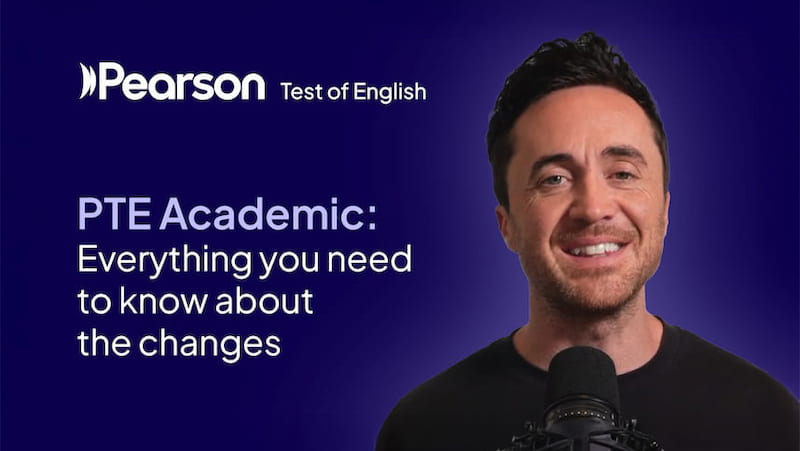
We’ve made a few updates to the PTE Academic and PTE Academic UKVI tests. To make sure you’ve got the facts, we’ve created a short video that walks you through everything you need to know.

Hosted by Jarrad, one of our product managers, this video covers what’s being updated, what’s staying the same, and how it all benefits you as a test taker.

What’s covered in the video? 

  • The original 20 question types are still in the test.

  • We are adding two new speaking question types to give you even more chance to demonstrate your skills.  

  • Tips on how to prepare for the new speaking question types.

  • There are no changes to pricing, ID requirements, or score delivery time.

  • There are no changes to the way the test is taken (including the Speaking section).

Play
Privacy and cookies
By watching, you agree Pearson can share your viewership data for marketing and analytics for one year, revocable upon changing cookie preferences. Disabling cookies may affect video functionality. More info...

For more information on the test enhancements, explore our test updates page.

Key takeaways

Here are some key questions and answers which are also covered in the video:

What are the PTE Academic changes? 

The updated PTE Academic test is almost exactly the same:

  • It still has the original 20 questions that you're familiar with. 

  • The format of the questions has not changed.

There are, however, two new speaking question types, and there are some minor scoring enhancements. 

Why is PTE Academic changing? 

Well, first of all, tests should change from time to time. It means they're evolving, are staying up to date with technology and society, and our understanding of how language is used. So these latest test updates will allow you to show off your English skills better than ever. 

Is PTE Academic becoming more difficult?

No, the changes are designed for test takers to showcase a broader range of English skills. But this doesn't mean the test is more difficult. It simply means that with a broader range of question types, you have even more opportunity to showcase your English skills.

Will I still get my PTE Academic score within two days? 

We know how important fast results are for you. You'll still get your scores back within two days in almost all cases. In rare instances it may take slightly longer, but we'll keep you updated every step of the way. 

Is PTE Academic still being accepted by the same institutions? 

Yes. There are no changes here. The same institutions still accept PTE. To find an up-to-date list, visit our Who accepts PTE? page.

Is the price of PTE Academic changing? 

No. The price stays the same. We do occasionally change our test prices, so for up-to-date prices by country, please visit our test centers and fees page.

Which PTE tests are impacted by the recent changes? 

The changes only affect PTE Academic and PTE Academic UKVI. PTE Core and PTE Home are not affected. 

Will institutions change their PTE Academic score requirements? 

Institutions do review their score requirements from time to time, so we recommend checking with your chosen institution before taking the test.

Do the ID requirements for PTE Academic stay the same? 

Yes, there are no changes whatsoever to the ID requirements that you'll need. And if you need to apply for an ID exception, please visit our ID policy page

Will retake limits on PTE Academic still remain the same? 

Yes, the retake limits stay the same. Please visit our retake policy page for full information. 

Has the PTE Academic booking process changed?

No, the booking process for PTE tests hasn't changed. You can still book a test online or by contacting our customer support team over the phone

Are the existing PTE Academic question types changing?

The original 20 question types – that is, the tasks themselves, the format, the timings, and the types of responses expected – are exactly the same. 

What are the two new PTE Academic question types? 

There are two new question types:

  • Respond to a Situation, and

  • Summarize Group Discussion

They're both speaking tasks, and you can find out more information about them on our updates page.

Will PTE Academic now be longer?

The average test duration will still be around two hours. While we have added two new questions and have increased the number of some existing tasks, it's typical for many test takers to take less than two hours to complete their test.

How should I prepare for PTE Academic?

You can still prepare for PTE Academic in the same way that you've always prepared, but we recommend that you pay close attention to the two new speaking question types and prepare specifically for how to answer these questions. Visit our PTE Academic preparation page for more information on the preparation resources we offer.  

Do you have any tips for the two new PTE Academic question types?

We have created two full length videos on the two new question types:

There is also a test tip document which will help you to prepare properly for the two new question types. 

Is the PTE Academic Score Report changing? 

No, the PTE Academic Score Report will still show your Overall , Reading, Listening, Speaking and Writing scores on a scale of 10-90.

Why are you introducing more human marking in PTE Academic? 

By using the best of AI combined with the best of human expertise, you get the most accurate score. As long as you continue to provide genuine responses to all the questions, you won't notice a difference. 

Is human marking being introduced to all PTE Academic question types?  

No. Double marking – that is, human and AI scoring for content – is used for seven of the 22 PTE Academic question types. 

That question types which use double marking are:

  • Describe Image

  • Retell Lecture

  • Summarize Written Text

  • Write Essay

  • Summarize Spoken Text

  • Summarize Group Discussion

  • Respond to a Situation

Is PTE Academic still a fair test? 

Yes, absolutely. PTE Academic is still a primarily AI-scored test taken at a computer in a test center. 

A human marker will never mark your pronunciation or fluency, as these aspects continue to be marked by a machine. For these reasons, you can be sure that your accent or appearance will not be judged. 

What PTE Academic rating scales will humans use to mark my content scores? 

The human experts always use the exact same rating scales as the AI. These rating scales are published in the Score Guide.

What information can a human expert see? 

The human expert will only see your response. They will not see your photograph, and they will not know your name or where you're from or anything about you. In fact, your test is likely to be marked by multiple human experts because all the responses that require human input get distributed to different markers. It's only your English language skills that are being judged, nothing else. 

Who are these human experts? 

All PTE Academic human scoring is done by highly qualified expert raters who are managed by Pearson. 

The PTE Academic responses that require human double marking are distributed anonymously and scored at response level, so your test is likely to be marked by multiple people. 

For any response where a machine and a human score differ, a second human makes a final judgement. 

Will my accent now be judged by a person? 

No, the human expert will never score your pronunciation or oral fluency. These traits will continue to be scored only by the AI.  You can rest assured that your accent will not affect your score. 

I thought PTE Academic was an AI-powered test? It doesn't seem that way anymore. 

PTE Academic still uses an AI-first approach to scoring. Every response gets an AI score. The AI understands different accents and doesn't see what you look like. 

The human review is a small part of the process and is only used to validate the AI score on some aspects. 

If the human score differs from the AI score, a second human expert will make the final score decision to ensure the fairest, most accurate result.

What happens to my existing PTE Academic booking? 

Your existing booking remains unchanged, so if you want to change the date of your test, you can reschedule it. For more information, you can read our reschedule and cancellation policy.

How do the PTE Academic changes benefit me, the test taker? 

The PTE Academic changes are designed to assess a broader range of real-world academic skills for study and in the workplace, making the test more relevant and authentic. 

The test continues to be trusted by governments and institutions worldwide, so you can continue to use it to reach your goals.

Related Content

  • Image - Australian city hall- 800px
    How to find work in Australia
    By PTE Author
    Reading time: 3 minutes

    Have you ever dreamt of migrating to Australia for work or study? As one of the world’s most attractive places to both work and live, you’re not alone, however, there are a number of things to keep in mind before you start planning to apply for jobs in Australia.

    Let’s explore some of the major things that you need to keep in mind when looking to find work in Australia.

    Organizing your visa

    In order to legally apply for work in Australia, you’re going to need a visa that gives you permission to enter the country with a view to seeking employment.

    It’s important to remember that the appropriate visa depends on your career type and industry that you’re applying to. To understand what visa applies to your specific skills, use the visa finder on the government’s Home Affairs site.

    Learn the culture

    The workplace culture in Australia is unique for many reasons. Whilst Australian’s are known to be laid-back, this isn’t to be confused with their approach to hard work. Australian’s work hard though also have strict workplace laws that protect the health and wellbeing of all employees.

    Australian’s like to keep things casual in the workplace and it is common that everyone is encouraged to speak up during meetings. This can cause culture shock for those that migrate from countries where the workplace hierarchy dictates your ability to speak up.

    In-demand skills

    As with all countries, certain professions are in demand in Australia. It’s important to remember that seasonality can impact the demand for certain jobs at different times of the year so it’s important to do your own research to understand job availability in your specific area of expertise.

    To learn more about careers in demand in Australia, visit the government’s Job Outlook site.

    Choosing where to work in Australia

    If you’re looking to migrate to Australia for work, you’ve probably done some research on where you’d like to live. The major capital cities in Australia are:

    • Adelaide, South Australia

    • Brisbane, Queensland

    • Canberra, Australian Capital Territory

    • Darwin, Northern Territory

    • Hobart, Tasmania

    • Melbourne, Victoria

    • Perth, Western Australia

    • Sydney, New South Wales

    Whilst Sydney is best known for tourism, each capital city has a unique look and feel and all have unique attributes. The major Australian universities are largely spread across Adelaide, Sydney and Melbourne and the two most dominant cities for professional careers are Sydney and Melbourne.

    Writing a resume and cover letter

    It’s a common misconception that applying for a job in a new country requires a unique resume and cover letter style. Whilst there isn’t a specific formula when applying for a job in Australia, it’s important to consider that an employer in Australia may not have any context around the businesses that you’ve worked with in your home country. As a result, it’s a good idea to ensure that this context is shared in your cover letter to ensure that key skills aren’t overlooked.

    Applying for jobs in Australia

    As is the case in virtually all major job markets, applying for jobs in Australia is largely an online experience. The Australian market has a number of major job listing sites and it’s on these sites that you’ll also be required to file job applications. In addition to the major job listing sites, LinkedIn is commonly used in Australia for connecting with recruiters and applying for jobs too, however, this can vary depending on your job category and what you’re hoping to apply for.

    The most appropriate site to apply for jobs really depends on what industry you’re applying for, so it’s best to do your own research to find what job site best suits your needs.

  • Image- Study group - 800px
    Speaking: Core English Skills
    By PTE Author
    Reading time: 3 minutes

    In Part 1 of the PTE Academic test, you require certain skills to answer the questions within the test to the best of your ability.

    We’ve put together some tips and advice on how to practice and improve your core skills.

    Oral Fluency

    Oral fluency applies to the Read Aloud, Repeat SentenceDescribe Image and Re-tell Lecture question types.

    To improve your oral fluency before your test, we recommend that you speak English as often as you can. If you don’t have anyone you can speak English with, join an English-speaking club or take a short course.

    As soon as you’ve booked the test, we suggest that you try to read, listen and write in English as much as you can.

    If you’re having trouble with speaking too slow or too fast, record yourself and listen back to identify where you need to improve.

    You can also use Tiny Texts to help improve your speaking. Read the text silently to yourself, then listen to a recording while you read and have a try afterward to read at a similar pace.

    Pronunciation

    Pronunciation skills are required for the Read Aloud, Repeat SentenceDescribe Image and Re-tell Lecture question types.

    In PTE Academic you do not have to speak like a fluent speaker of English to do well. However, you do need to use a pronunciation that can be understood by a regular speaker of English.

    This means you need to make sure your vowel and consonant sounds are pronounced in a fluent-like way with the correct words. You also need to use the correct sentence stress to convey meaning.

    Luckily, there are many online tools that can help with your pronunciation, such as:

    Vocabulary

    The only question type in the speaking section that will require strong vocabulary skills is Answer Short Question.

    The easiest way to improve your vocabulary is to keep a vocabulary notebook to use as your own personal dictionary. When you hear or see new words, add them along with the meaning and put them in a sentence.

    Want more prep ideas?

    Explore Smart Prep, which combines all our practice materials in one place, so it's easier for you to stay on track with your PTE preparation.

    • Smart Prep is a clear path to test day, guiding you through the official paid and free resources available for your test

    • It can be accessed whether you’ve booked a test or not – just create, or sign in to your myPTE account

    • Preparation materials include guided practice tests, introductory videos, video courses and test tips.

    Ready to get started?

  • Image- Students at library- 800px
    Part 3: Listening Test Introduction
    By PTE Author
    Reading time: 4 minutes

    Part 3 of PTE Academic will take 45-57 minutes to test your listening skills.

    This section is designed to test your ability to listen, read and write. PTE Academic is an integrated skills test, therefore, this test contains multiple question types that test up to 2 skills each.

    There are eight question types in the listening section. A breakdown of these question types is as below.

    Summarize Spoken Text

    The first question type you will need to complete is Summarize Spoken Text, which will tests listening and writing skills.

    To complete the task, a recording between 60-90 seconds long will be played for you to listen to. As you listen, try to use the Erasable Noteboard Booklet to take notes of key points to help you understand the context.

    After the recording, you will have 10 minutes to write a summary of what you heard.

    To answer this question type, you must write a minimum of 50 words but no more than 70 words.

    You can receive a maximum of 2 points for content, 2 for form, 2 for grammar, 2 for vocabulary and 2 for spelling.

    Multiple-choice, multiple answer

    The second question type, Multiple-Choice, Multiple Answer will test listening skills.

    First, you will be given information to help answer the question. You only have 7 seconds to read this. A recording will then play that is between 40-90 seconds long.

    Select all the response options that you think are correct.

    In this question type, you can receive 1 point for each correct option, but will lose -1 point for each incorrect option. You cannot score below 0.

    Fill in the blanks

    In the third question type, Fill in the Blanks, listening and writing skills will be tested.

    Similar to the previous task, you will be given 7 seconds to read some information before hearing the recording.

    A recording between 30-60 seconds will play. As you listen, type each word in the blank spaces as you hear them so that you do not miss any.

    Do not leave any spaces blank, you can review them at the end.

    You receive 1 point for each correct word which is spelled correctly.

    Highlight correct summary

    The fourth question type, Highlight Correct Summary, will test listening and reading skills.

    You will be given 10 seconds before the recording starts to read the options. A recording will be played that is between 30-90 seconds long.

    To complete the task, select only one correct response. If unsure, choose the one you think is correct as you cannot lose points in this question.

    Your response will either be marked as correct or incorrect.

    Multiple-choice, single answer

    The fifth question type, Multiple-Choice, Single Answer will test listening skills.

    To complete this task, you will be given information to read for context, you will then need to listen to a recording between 30-60 seconds long.

    Choose the option that best suits.

    Your response to this question type will be marked as correct or incorrect.

    Select missing word

    In the sixth question type, Select Missing Word, will test your listening skills.

    A recording between 20-70 seconds long will be played and you will need to predict the last word or words of the text to complete the task.

    You will be marked on this question type as either correct or incorrect.

    Highlight incorrect words

    In the seventh question type, Highlight Incorrect Words, your listening and reading skills will be tested.

    In this question type, you will be shown information and have 10 seconds to read it before a recording starts.

    A recording between 15-50 seconds will play and you will need to select the words that are incorrect and do not match the recording.

    You can receive 1 point for each correct word and lose -1 point for each incorrect word. You cannot score below 0.

    Write from dictation

    The eighth and final question type, Write from Dictation, tests listening and writing skills.

    You will have 7 seconds to read the instructions before the recording starts. The recording is between 3-5 seconds long and once it starts, listen and type the sentence in the response box.

    You can receive 1 point for each correct word you write. Write the words in the right order and spell them correctly in order to receive 1 point. Points are not lost for incorrect words.

    What's next?

    We recommend reviewing the core listening skills required for PTE Academic.

    Want more prep ideas?

    Plus, explore Smart Prep, which combines all our practice materials in one place, so it's easier for you to stay on track with your PTE preparation.

    • Smart Prep is a clear path to test day, guiding you through the official paid and free resources available for your test

    • It can be accessed whether you’ve booked a test or not – just create, or sign in to your myPTE account

    • Preparation materials include guided practice tests, introductory videos, video courses and test tips.

    Ready to get started?