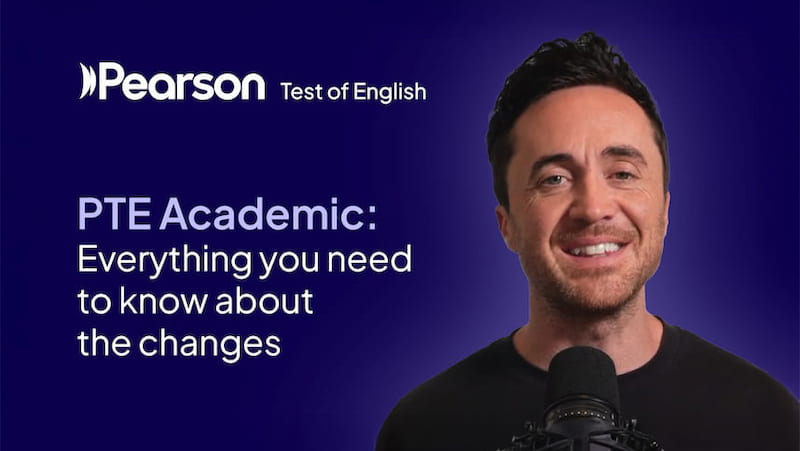

PTE changes 2025: everything you need to know

PTE Author
PTE Author

We’ve made a few updates to the PTE Academic and PTE Academic UKVI tests. To make sure you’ve got the facts, we’ve created a short video that walks you through everything you need to know.

Hosted by Jarrad, one of our product managers, this video covers what’s being updated, what’s staying the same, and how it all benefits you as a test taker.

What’s covered in the video? 

  • The original 20 question types are still in the test.

  • We are adding two new speaking question types to give you even more chance to demonstrate your skills.  

  • Tips on how to prepare for the new speaking question types.

  • There are no changes to pricing, ID requirements, or score delivery time.

  • There are no changes to the way the test is taken (including the Speaking section).

Play
Privacy and cookies
By watching, you agree Pearson can share your viewership data for marketing and analytics for one year, revocable upon changing cookie preferences. Disabling cookies may affect video functionality. More info...

For more information on the test enhancements, explore our test updates page.

Key takeaways

Here are some key questions and answers which are also covered in the video:

What are the PTE Academic changes? 

The updated PTE Academic test is almost exactly the same:

  • It still has the original 20 questions that you're familiar with. 

  • The format of the questions has not changed.

There are, however, two new speaking question types, and there are some minor scoring enhancements. 

Why is PTE Academic changing? 

Well, first of all, tests should change from time to time. It means they're evolving, are staying up to date with technology and society, and our understanding of how language is used. So these latest test updates will allow you to show off your English skills better than ever. 

Is PTE Academic becoming more difficult?

No, the changes are designed for test takers to showcase a broader range of English skills. But this doesn't mean the test is more difficult. It simply means that with a broader range of question types, you have even more opportunity to showcase your English skills.

Will I still get my PTE Academic score within two days? 

We know how important fast results are for you. You'll still get your scores back within two days in almost all cases. In rare instances it may take slightly longer, but we'll keep you updated every step of the way. 

Is PTE Academic still being accepted by the same institutions? 

Yes. There are no changes here. The same institutions still accept PTE. To find an up-to-date list, visit our Who accepts PTE? page.

Is the price of PTE Academic changing? 

No. The price stays the same. We do occasionally change our test prices, so for up-to-date prices by country, please visit our test centers and fees page.

Which PTE tests are impacted by the recent changes? 

The changes only affect PTE Academic and PTE Academic UKVI. PTE Core and PTE Home are not affected. 

Will institutions change their PTE Academic score requirements? 

Institutions do review their score requirements from time to time, so we recommend checking with your chosen institution before taking the test.

Do the ID requirements for PTE Academic stay the same? 

Yes, there are no changes whatsoever to the ID requirements that you'll need. And if you need to apply for an ID exception, please visit our ID policy page

Will retake limits on PTE Academic still remain the same? 

Yes, the retake limits stay the same. Please visit our retake policy page for full information. 

Has the PTE Academic booking process changed?

No, the booking process for PTE tests hasn't changed. You can still book a test online or by contacting our customer support team over the phone

Are the existing PTE Academic question types changing?

The original 20 question types – that is, the tasks themselves, the format, the timings, and the types of responses expected – are exactly the same. 

What are the two new PTE Academic question types? 

There are two new question types:

  • Respond to a Situation, and

  • Summarize Group Discussion

They're both speaking tasks, and you can find out more information about them on our updates page.

Will PTE Academic now be longer?

The average test duration will still be around two hours. While we have added two new questions and have increased the number of some existing tasks, it's typical for many test takers to take less than two hours to complete their test.

How should I prepare for PTE Academic?

You can still prepare for PTE Academic in the same way that you've always prepared, but we recommend that you pay close attention to the two new speaking question types and prepare specifically for how to answer these questions. Visit our PTE Academic preparation page for more information on the preparation resources we offer.  

Do you have any tips for the two new PTE Academic question types?

We have created two full length videos on the two new question types:

There is also a test tip document which will help you to prepare properly for the two new question types. 

Is the PTE Academic Score Report changing? 

No, the PTE Academic Score Report will still show your Overall , Reading, Listening, Speaking and Writing scores on a scale of 10-90.

Why are you introducing more human marking in PTE Academic? 

By using the best of AI combined with the best of human expertise, you get the most accurate score. As long as you continue to provide genuine responses to all the questions, you won't notice a difference. 

Is human marking being introduced to all PTE Academic question types?  

No. Double marking – that is, human and AI scoring for content – is used for seven of the 22 PTE Academic question types. 

That question types which use double marking are:

  • Describe Image

  • Retell Lecture

  • Summarize Written Text

  • Write Essay

  • Summarize Spoken Text

  • Summarize Group Discussion

  • Respond to a Situation

Is PTE Academic still a fair test? 

Yes, absolutely. PTE Academic is still a primarily AI-scored test taken at a computer in a test center. 

A human marker will never mark your pronunciation or fluency, as these aspects continue to be marked by a machine. For these reasons, you can be sure that your accent or appearance will not be judged. 

What PTE Academic rating scales will humans use to mark my content scores? 

The human experts always use the exact same rating scales as the AI. These rating scales are published in the Score Guide.

What information can a human expert see? 

The human expert will only see your response. They will not see your photograph, and they will not know your name or where you're from or anything about you. In fact, your test is likely to be marked by multiple human experts because all the responses that require human input get distributed to different markers. It's only your English language skills that are being judged, nothing else. 

Who are these human experts? 

All PTE Academic human scoring is done by highly qualified expert raters who are managed by Pearson. 

The PTE Academic responses that require human double marking are distributed anonymously and scored at response level, so your test is likely to be marked by multiple people. 

For any response where a machine and a human score differ, a second human makes a final judgement. 

Will my accent now be judged by a person? 

No, the human expert will never score your pronunciation or oral fluency. These traits will continue to be scored only by the AI.  You can rest assured that your accent will not affect your score. 

I thought PTE Academic was an AI-powered test? It doesn't seem that way anymore. 

PTE Academic still uses an AI-first approach to scoring. Every response gets an AI score. The AI understands different accents and doesn't see what you look like. 

The human review is a small part of the process and is only used to validate the AI score on some aspects. 

If the human score differs from the AI score, a second human expert will make the final score decision to ensure the fairest, most accurate result.

What happens to my existing PTE Academic booking? 

Your existing booking remains unchanged, so if you want to change the date of your test, you can reschedule it. For more information, you can read our reschedule and cancellation policy.

How do the PTE Academic changes benefit me, the test taker? 

The PTE Academic changes are designed to assess a broader range of real-world academic skills for study and in the workplace, making the test more relevant and authentic. 

The test continues to be trusted by governments and institutions worldwide, so you can continue to use it to reach your goals.

Related Content

  • Image- Visa, 1080px
    How to apply for permanent residence in the UK
    By PTE Author
    Reading time: 4 minutes

    Do you want to settle in the UK? With great healthcare, world-class education, and lots of art, history, and culture, it’s an excellent place to call home.

    In this guide, we’ll explore how to take up permanent residence in the UK. We’ll delve into who can apply, and the online resources you’ll need to start your application.  

    Why Live in the UK 

    The UK is very multicultural. In fact, about 14% of the population in the UK was born abroad, according to the Migration Observatory at the University of Oxford.  About 35% of the immigrant population lives in London.  

    The UK has an excellent healthcare system, too. The National Health Service (NHS) is free for residents and has been ranked among the best in the world for its affordability, safety, and efficiency. UK countries also boast world-class research facilities, universities, and a strong education system in general. 

    How to apply for permanent residence in the UK  

    Permanent residence in the UK is also known as Indefinite Leave To Remain (ILR). With this, you can live and work in the UK permanently. You may also be able to apply for British citizenship after 12 months.

    There are different ways to apply to live permanently in the UK, depending on your situation. For example, you might be able to apply for ILR if: 

    You’ve lived in the UK for 5 years or more 

    If you have lived in the UK for 5 or more years, you should be able to apply for permanent residence in the UK. There are exceptions, though. For example, you won’t be able to apply for ILR if you’ve lived in the UK on a Tier 2 ICT work visa – given to people who’ve transferred to a UK company branch from abroad to work on a specific project.  

    You’re a family member of a UK citizen or permanent resident  

    If you’re the spouse, parent, or dependent relative to a UK citizen or permanent resident, you might also be eligible for ILR. Depending on the type of visa you’ve been living in the UK on, you might be able to apply for permanent residence as soon as 2 years.

    Check if you can get indefinite leave to remain and learn about the financial requirements needed to apply.   

    You have a work visa  

    You can apply for ILR if you’ve had a Tier 2 (General) work visa for five years. Your employer will need to sponsor you. You’ll also likely have to prove you earn at least £25,600 per year unless you work in healthcare or in a profession that’s in short supply in the UK.  

    Learn more about how to apply through ILR through your work visa

    Fees and processing times 

    According to UK Visas and Immigration, ILR takes about 6 months to process. The application for ILR costs £2,389. But keep in mind that many categories have financial requirements, which can make applying much for expensive. 

    English requirements 

    To apply for ILR, you might have to demonstrate your English skills are at least a B1 level. And, our PTE Academic UKVI secure English language test is recognized by the UK Home Office for all UK visas. The test is computer-based to reduce human bias, fast, and convenient – you get your results within 48 hours.  

    Discover how PTE Academic UKVI can help 

    The EU Settlement Scheme  

    If you’re an EU citizen – and don’t have IRL – you can apply for the EU Settlement Scheme.  

    Applying for the scheme is free, and with it, you’re granted either “settled” or “pre-settled status.” With settled status, you can stay in the UK indefinitely. With pre-settled status, you can stay for another 5 years – but can always apply for settled status later.  

    With both, you’ll get the right to work and study in the UK, access NHS, access public benefits and pensions, leave the UK to travel – and apply for British citizenship after 12 months.  

    Read our article about applying for the EU Settlement Scheme

    Ready to apply for permanent residence? 

    At PTE Academic, we’re here to help make your dream come true.

    Prepare for – and book – your approved English language test for permanent residence in the UK today.

  • Image- student, 1080px
    Scholarships for international students in Australia
    By PTE Author
    Reading time: 4 minutes

    Dreaming of studying in Australia? It’s never too early to start planning financially. Tuition fees for international undergraduate students typically range from AUD 35,000 to AUD 55,000 per year, depending on the university, course of study, and location. For example, STEM and medical programs are generally more expensive than humanities or social sciences​. However, there are lots of scholarships available to help pay for your studies. 

    In this article, we’ll look at what funding is available for international students in Australia. By the end, you’ll have a list of resources to explore to find the scholarship that’s right for you.  

    Are you eligible for a scholarship? 

    Australia offers grants, bursaries, and scholarships to people from around the world – including undergraduate, postgraduate, PhD, and vocational students. They’re funded by the government, universities, and private entities.  

    The Australian Government has an excellent scholarship search tool on its website. With it, you can search for funding opportunities based on a whole range of factors – like what country you come from, what university you’re attending, and your area and level of study. You’ll see how much each scholarship is worth, who it’s made for, and of course, whether you might be eligible.  

    Australian scholarship opportunities  

    Now, let’s cover a few scholarship opportunities for international students in Australia. 

    Australia Awards Scholarships 

    Australia Awards scholarships are offered to global student leaders from developing countries. They’re awarded by the Department of Foreign Affairs and Trade (DFAT), and support students with full tuition, airfare, living costs, and more. In 2021, 818 Australia Awards were given to students from 20 countries worldwide.  

    Destination Australia Awards  

    The Australian government introduced the Destination Australia program to provide both local and international students with the opportunity to study in more regional and remote areas of Australia – towns such as Ballarat (Victoria), Gatton (Queensland), and Lismore (New South Wales). The scholarships are given out through Australian universities and provide students with up to $15,000 AUD each year.  

    University-specific scholarships 

    In addition to government-provided scholarships, universities also offer their own scholarships to qualifying international students. There’s the James Rice Postgraduate Award at The Australian National University (ANU); International Stand Out Scholarship at Bond University, and the Adelaide Refugee & Humanitarian Postgraduate Coursework Scholarship at University of Adelaide.

    The point is, universities offer lots of scholarships for international students based on a long list of eligibility factors – like home country, area of study, and academic merit. 

    To search for funding opportunities at your own institution, use the search tool on the Australian Government website.

    A case study: Monash University scholarships 

    To get an idea of all the different scholarships that can be offered by Australian universities, we’ll take a closer look at one popular institution for international students: Monash University.  

    Monash University is recognized for its research and teaching, and offer more than 80 scholarships to international students, including:   

    Universities throughout Australia offer similar scholarships.  

    To apply for any scholarship or funding opportunity, you’ll need to contact the scholarship provider.  

    Other ways to fund your studies 

    As an international student, there are other options to pay for your studies in Australia.   

    One of the biggest perks of studying in Australia is that international students can work up to 48 hours every two weeks while studying and unlimited hours during study breaks on an Australian student visa. The minimum wage is $24.10 per hour or $915.90 per week,  meaning you’ll be able to put some money aside to help fund your education.

     Depending on where you are from, you might also be able to get a student loan or scholarship from your own country to study overseas.  

    Last updated 20 December 2024.

    PTE Academic can support you on your journey abroad. Our computer-based, bias-free English language proficiency test is accepted by all universities in Australia – as well as by the Department of Home Affairs for all visa categories. 

    Learn more about PTE Academic in Australia.

  • Image- calculator-800px x451px
    Living expenses in the UK for international students
    By PTE Author
    Reading time: 3 minutes

    Studying abroad in the UK can be expensive. International students need to budget for flights, tuition, textbooks, accommodation, and don’t forget the visa application.

    Of course, living costs in the UK for international students can vary depending on your lifestyle and where you live. So, in this blog, we’ll look at how much students in the UK spend on average each month – and explore how much it cost to live in a large city, compared to a smaller city.  

    Average student living expenses in the UK