
PTE changes 2025: everything you need to know

PTE Author
PTE Author

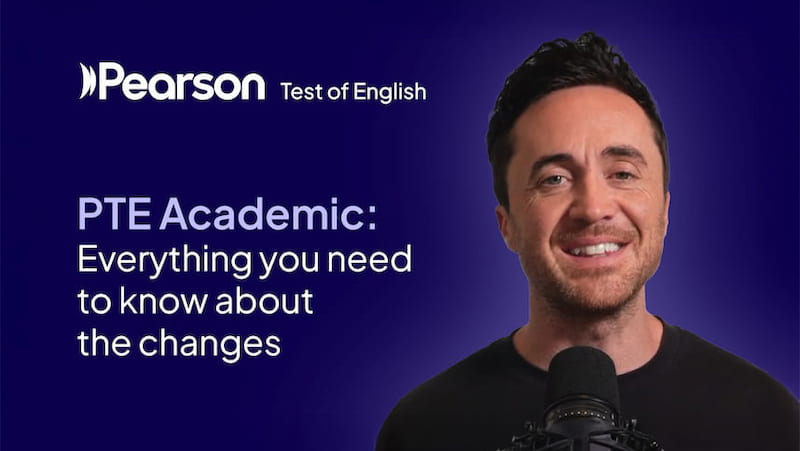
We’ve made a few updates to the PTE Academic and PTE Academic UKVI tests. To make sure you’ve got the facts, we’ve created a short video that walks you through everything you need to know.

Hosted by Jarrad, one of our product managers, this video covers what’s being updated, what’s staying the same, and how it all benefits you as a test taker.

What’s covered in the video? 

  • The original 20 question types are still in the test.

  • We are adding two new speaking question types to give you even more chance to demonstrate your skills.  

  • Tips on how to prepare for the new speaking question types.

  • There are no changes to pricing, ID requirements, or score delivery time.

  • There are no changes to the way the test is taken (including the Speaking section).

Play
Privacy and cookies
By watching, you agree Pearson can share your viewership data for marketing and analytics for one year, revocable upon changing cookie preferences. Disabling cookies may affect video functionality. More info...

For more information on the test enhancements, explore our test updates page.

Key takeaways

Here are some key questions and answers which are also covered in the video:

What are the PTE Academic changes? 

The updated PTE Academic test is almost exactly the same:

  • It still has the original 20 questions that you're familiar with. 

  • The format of the questions has not changed.

There are, however, two new speaking question types, and there are some minor scoring enhancements. 

Why is PTE Academic changing? 

Well, first of all, tests should change from time to time. It means they're evolving, are staying up to date with technology and society, and our understanding of how language is used. So these latest test updates will allow you to show off your English skills better than ever. 

Is PTE Academic becoming more difficult?

No, the changes are designed for test takers to showcase a broader range of English skills. But this doesn't mean the test is more difficult. It simply means that with a broader range of question types, you have even more opportunity to showcase your English skills.

Will I still get my PTE Academic score within two days? 

We know how important fast results are for you. You'll still get your scores back within two days in almost all cases. In rare instances it may take slightly longer, but we'll keep you updated every step of the way. 

Is PTE Academic still being accepted by the same institutions? 

Yes. There are no changes here. The same institutions still accept PTE. To find an up-to-date list, visit our Who accepts PTE? page.

Is the price of PTE Academic changing? 

No. The price stays the same. We do occasionally change our test prices, so for up-to-date prices by country, please visit our test centers and fees page.

Which PTE tests are impacted by the recent changes? 

The changes only affect PTE Academic and PTE Academic UKVI. PTE Core and PTE Home are not affected. 

Will institutions change their PTE Academic score requirements? 

Institutions do review their score requirements from time to time, so we recommend checking with your chosen institution before taking the test.

Do the ID requirements for PTE Academic stay the same? 

Yes, there are no changes whatsoever to the ID requirements that you'll need. And if you need to apply for an ID exception, please visit our ID policy page

Will retake limits on PTE Academic still remain the same? 

Yes, the retake limits stay the same. Please visit our retake policy page for full information. 

Has the PTE Academic booking process changed?

No, the booking process for PTE tests hasn't changed. You can still book a test online or by contacting our customer support team over the phone

Are the existing PTE Academic question types changing?

The original 20 question types – that is, the tasks themselves, the format, the timings, and the types of responses expected – are exactly the same. 

What are the two new PTE Academic question types? 

There are two new question types:

  • Respond to a Situation, and

  • Summarize Group Discussion

They're both speaking tasks, and you can find out more information about them on our updates page.

Will PTE Academic now be longer?

The average test duration will still be around two hours. While we have added two new questions and have increased the number of some existing tasks, it's typical for many test takers to take less than two hours to complete their test.

How should I prepare for PTE Academic?

You can still prepare for PTE Academic in the same way that you've always prepared, but we recommend that you pay close attention to the two new speaking question types and prepare specifically for how to answer these questions. Visit our PTE Academic preparation page for more information on the preparation resources we offer.  

Do you have any tips for the two new PTE Academic question types?

We have created two full length videos on the two new question types:

There is also a test tip document which will help you to prepare properly for the two new question types. 

Is the PTE Academic Score Report changing? 

No, the PTE Academic Score Report will still show your Overall , Reading, Listening, Speaking and Writing scores on a scale of 10-90.

Why are you introducing more human marking in PTE Academic? 

By using the best of AI combined with the best of human expertise, you get the most accurate score. As long as you continue to provide genuine responses to all the questions, you won't notice a difference. 

Is human marking being introduced to all PTE Academic question types?  

No. Double marking – that is, human and AI scoring for content – is used for seven of the 22 PTE Academic question types. 

That question types which use double marking are:

  • Describe Image

  • Retell Lecture

  • Summarize Written Text

  • Write Essay

  • Summarize Spoken Text

  • Summarize Group Discussion

  • Respond to a Situation

Is PTE Academic still a fair test? 

Yes, absolutely. PTE Academic is still a primarily AI-scored test taken at a computer in a test center. 

A human marker will never mark your pronunciation or fluency, as these aspects continue to be marked by a machine. For these reasons, you can be sure that your accent or appearance will not be judged. 

What PTE Academic rating scales will humans use to mark my content scores? 

The human experts always use the exact same rating scales as the AI. These rating scales are published in the Score Guide.

What information can a human expert see? 

The human expert will only see your response. They will not see your photograph, and they will not know your name or where you're from or anything about you. In fact, your test is likely to be marked by multiple human experts because all the responses that require human input get distributed to different markers. It's only your English language skills that are being judged, nothing else. 

Who are these human experts? 

All PTE Academic human scoring is done by highly qualified expert raters who are managed by Pearson. 

The PTE Academic responses that require human double marking are distributed anonymously and scored at response level, so your test is likely to be marked by multiple people. 

For any response where a machine and a human score differ, a second human makes a final judgement. 

Will my accent now be judged by a person? 

No, the human expert will never score your pronunciation or oral fluency. These traits will continue to be scored only by the AI.  You can rest assured that your accent will not affect your score. 

I thought PTE Academic was an AI-powered test? It doesn't seem that way anymore. 

PTE Academic still uses an AI-first approach to scoring. Every response gets an AI score. The AI understands different accents and doesn't see what you look like. 

The human review is a small part of the process and is only used to validate the AI score on some aspects. 

If the human score differs from the AI score, a second human expert will make the final score decision to ensure the fairest, most accurate result.

What happens to my existing PTE Academic booking? 

Your existing booking remains unchanged, so if you want to change the date of your test, you can reschedule it. For more information, you can read our reschedule and cancellation policy.

How do the PTE Academic changes benefit me, the test taker? 

The PTE Academic changes are designed to assess a broader range of real-world academic skills for study and in the workplace, making the test more relevant and authentic. 

The test continues to be trusted by governments and institutions worldwide, so you can continue to use it to reach your goals.

Related Content

  • Image- A woman in front of Big Ben- 800px
    Job opportunities for international students in the UK
    By PTE Author
    Reading time: 4 minutes

    Studying abroad is rarely cheap. Even if you’ve got a scholarship, a job on the side can help you live a little more comfortably during your degree. Luckily, there are lots of jobs for international students in the UK. You just need to know where to find them.  

    Once you arrive, you’ll be able to do the traditional resumé drop-offs and ask about opportunities in the store. But you don’t have to wait until then to start your hunt. Jumping online and applying in advance is the best method for getting a job in the UK for international students. It’s also nice to know that you’ve got a casual or part-time position waiting for you.  

    This quick guide discusses a variety of jobs in the UK for international applicants including: 

    • Part-time jobs in the UK for international students

    • Summer jobs in the UK for international students 

    • Graduate jobs for international students in the UK


    Part-time jobs in the UK for international students

    If you’ve got strong time-management and organization skills, working a part-time job while you study can be an effective way to earn an income. On an international student visa (Student route visa), you’re able to work up to 20 hours per week during the term. 

    Common part-time jobs for international students in the UK include: 

    • Receptionist

    • Retail worker

    • Mystery shopper

    • Shelf packer 

    • Waiter/barista/bar tender

    • Student ambassador

    • Library assistant

    Would you prefer a part-time job that is more academic in nature will intellectually challenge you as much as your actual course? You might consider becoming a research assistant at your university.

    If you’re studying a postgraduate degree or PhD, you could even apply for part-time teaching jobs in the UK for international students. Sharing your experience with undergraduates in tutorials is a great way to solidify your own knowledge while earning some money.

    The UK’s largest job databases are a good place to start your hunt:

    If you’ve got a specific job in mind, try searching for a niche jobs website (e.g. C+D Jobs is a great place to find pharmacy jobs in the UK for international students).

    Most UK universities have support services that can help you find a part-time job (as well as a job after you graduate). As an example, the career center at University College London helps UCL students with all types of career-related activities – including finding part-time jobs in London for international students. Similarly, the University of Edinburgh runs a careers service where international students can get advice about part-time jobs in Scotland. Visit your chosen university’s website to see what kind of career services they provide.

    Summer jobs in the UK for international students 

    Prefer to focus all your time and energy on your studies? That’s alright – a casual job during semester breaks might be a good alternative for you. A student visa allows you to work full-time during vacation periods.

    Most of the part-time jobs listed above are also great options for working during your time off. You may also find an opportunity over summer to work as a:

    • Sales representative

    • Event assistant

    • Call center operator

    • Private tutor

    The resources previously mentioned for part-time jobs are also relevant for international students finding a summer job in the UK. You should also consider talking to your university’s career support staff about any summer internships that might be available – these can provide a great experience and give you a foot in the door.

    Graduate Jobs in the UK for International Students

    As your final exam and graduation approach, you’ll naturally start thinking about your first job after university. The UK’s immigration program will allow you to transition from a student visa to a working visa if you secure a position that meets the relevant salary and time criteria.

    This is where your university’s career center will really come in handy, so make sure you’ve made appointments with them well ahead of your last class. They can help you find and apply for UK jobs for international graduates.

    Many jobsites allow you to filter your search to jobs that are marked as suitable for new graduates. Check that you’re searching in the right area/with the right filter.  

    Whether you’re looking for a part-time role while you study or a full-time job to extend your stay in the UK, you’ll find a wide range of opportunities available to you.


  • Image- Woman reading - 800px
    Reading: Self-Improvement
    By PTE Author
    Reading time: 3 minutes

    There are many ways you can improve your chances of gaining points in Part 2: Reading during PTE Academic.

    To improve your reading skills, practice increasing your reading speed and comprehension at the same time. In turn, you will improve your writing, grammar and vocabulary skills.

    To do well in this part of the test, you need to be able to read quickly, using effective reading strategies, as there is a limited time to answer all questions.

    Speed reading tasks will help improve your reading speed. Practice speed reading every day and:

    • Aim to be reading at least 220 words per minute

    • Reading short articles of around 300 words

    • Read often for short periods of time

    You can also try this as a challenge with your friends to help keep motivated. Once you are happy with your comprehension and speed, focus on chunks (groups of words) rather than individual words.

    When your reading skills reach a level you are happy with, you will feel more confident to answer the questions.

    Multiple-choice, choose single answer

    In the Multiple-Choice, Single Answer question type, some test takers make the mistake of scan reading and matching the words in the text to the words in the answer. Generally, the words in the text are not used in the correct answer, therefore it is important to learn how to use synonyms and paraphrasing as it will be used in the test.

    Learn how to improve your grammar in our Reading: Core Skills part 1 article.

    Multiple-choice, choose multiple answers

    In this question type, you will need more time than in the Multiple-Choice, Choose Single Answer question typeas you need to intensively read the stem (the part before the options) as well as the options, then scan read the text on the screen until you find the part of the text that contains information that was in the stem.

    Read the options very carefully and match the meaning of the option with the text. Do not match the words – this is something test takers may make errors with.

    You should also make sure not to choose all the options since you lose one point for each incorrect choice. However, you cannot score below zero.

    Re-order paragraphs

    To do well in the Re-order Paragraphs questions, you will need to have a strong understanding of cohesive devices and how they work. You will also need to understand how articles work, as well as the logical and chronological order of information.

    In this question type, skim-read the text to get the ideas of the topic of the text. From there, you should read all the sentences carefully.

    Fill in the blanks and reading & writing: fill in the blanks

    For both Fill in the Blanks and Reading & Writing: Fill in the Blanks question types, you will need to understand a range of vocabulary, collocations, grammar, pronouns, and cohesive devices, as well as being able to identify when plural nouns are needed.

    You will also need to be able to skim read to get an idea of the meaning of the text, then read intensively before and after each blank. If unsure, you should guess based on the context.

    Make sure you do not leave any spaces blank. You do not need to correctly fill in all spaces to get points.

    To go back and review the question types within the reading test, we suggest learning more about the reading questions.

    Want more prep ideas?

    Explore Smart Prep, which combines all our practice materials in one place, so it's easier for you to stay on track with your PTE preparation.

    • Smart Prep is a clear path to test day, guiding you through the official paid and free resources available for your test

    • It can be accessed whether you’ve booked a test or not – just create, or sign in to your myPTE account

    • Preparation materials include guided practice tests, introductory videos, video courses and test tips.

    Ready to get started?