
Writing: Self-improvement

PTE Author
PTE Author
Image- Writing journal 1080px
Reading time: 4 minutes

As part of the PTE Academic, you must demonstrate a certain set of core English skills to maximize your score.

To help you do your best in Part 1: Writing we’ve put together some tips.

Summarize Written Text

In the Summarize Written Text question type, you will be scored based on the content, formal requirements, grammar, and vocabulary.

When completing this question type you should first quickly scan read the text prompt given to make sure you understand what it is about. If you are unsure what it is about, make a guess based on the context.

You should try to take notes on the Erasable Noteboard Booklet or on the screen as you read. If you do use the screen, remember to delete your notes before clicking ‘next’ or time runs out.

Some quick ways to pick up points include:

  • Stick to the topic or purpose of the text. Key points in the text will usually be repeated, developed, and highlighted – try to include these in your writing. If you do not summarize the meaning or purpose you will score zero points.

  • Do not include examples or supporting evidence in your summary.

  • Use words from the text but try to use synonyms where possible.

  • Use noun phrases where possible to show that you can use certain features of academic vocabulary in your writing.

When completing the question type, make sure you write only one sentence. If you write more, points will be lost.

A good sentence for this question type is 20-35 words long. If you write a short sentence, it will not capture all the meaning. Remember to check the word count in the box below your answer.

As you write the sentence, try to think about:

  • Have I summarized the key points?

  • Does my sentence start with a capital letter and end with a full stop? If you spell everything in capital letters or all of the words are in lower case, you will score zero.

  • Did I use run-on sentences? If you have, change them to a compound or complex sentence.

Make sure to use grammatical structures that you feel you can write correctly. Usually, a complex structure is required for summarizing text.

Don’t forget, always take time to check your grammar and vocabulary before clicking “next” or the 10 minutes is up.

When checking your answer, look for articles, especially ‘the’, prepositions, tenses, plurals, and subject-verb agreement as well as your own common errors. Check that you have not written a run-on sentence. If so, turn it into a compound or complex sentence.

Write Essay

The second part of the Writing section contains the Write Essay question type.

This question type will test grammar, spelling, vocabulary, and written discourse skills. It is important to manage time, as you will need enough time to plan, write and proofread the essay, all within 20 minutes.

You will be scored on the content and formal requirements of the question, as well as your grammar, general linguistic range, vocabulary range, and spelling.

Overall your essay should:

  • Address the prompt. If not, you will score zero.

  • Be well-planned and organized.

  • Demonstrate critical thinking to show a logical approach to the essay topic.

  • Include 4 paragraphs: an introduction, 2 body paragraphs each developing an idea, and a short conclusion summarizing your ideas.

  • Include examples, explanations, and facts to support the point of view you are expressing.

  • Be between 200-300 words long. Try to write just over 200 words and use the time to check the quality of your writing. If you write less than 200 or more than 380 words, you will score zero.

Use the same method of taking notes as the Summarize Written Text question type.

Your introduction can be linked to the body paragraphs with an overview. Then, the first body paragraph can be linked to the second body paragraph with a cohesive device.

More information on cohesive devices can be found at the below links:

Then for a conclusion, link it by writing In conclusion, To conclude.. etc.

In your writing, try to use complex sentences as you will score more points. Make sure to vary language by using synonyms, antonyms, and academic vocabulary.

The use of appropriate idiomatic expressions or colloquialisms will help you score well, but do not use too many as your writing will not be entirely academic.

Lastly, when it comes to spelling, make sure to spell each word correctly. Making more than 1 spelling mistake will mean you will score zero for this question.

Always remember to proofread your writing to make sure there are no errors before clicking next.

Want more prep ideas?

Explore Smart Prep, which combines all our practice materials in one place, so it's easier for you to stay on track with your PTE preparation.

  • Smart Prep is a clear path to test day, guiding you through the official paid and free resources available for your test

  • It can be accessed whether you’ve booked a test or not – just create, or sign in to your myPTE account

  • Preparation materials include guided practice tests, introductory videos, video courses and test tips.

Ready to get started?

Related Content

  • Image- letter of acceptance, 800px
    Types of loans for international students
    By PTE Author
    Reading time: 6 minutes

    No matter where in the world you choose to study, it’s important to take into account the financial cost of living abroad. Tuition, rent, textbooks, and transport can all be big expenses. But because of visa restrictions, not all students are able to work enough hours to support themselves while studying. 

    In this, many international students might need to take out private student loans.  So, let’s explore what loan options are available for students – including in popular study destinations like Canada, Australia, the U.S., and the U.K.  

    Where can I find a private student loan? 

    Many countries have student loan systems in place to help learners fund their education. However international students are usually not eligible for these loans – only citizens, permanent residents, and those with protected status in a country can apply.  

    On the other hand, there are lots of private loans for international students. Your eligibility will depend on what country you’re studying in. For example, in some countries, you’ll need a co-signer. In other countries, you’ll need to show you have a regular source of income.  

    Loans for students studying abroad are available from various sources, including:  

    • Local banks 

    • Non-bank lenders and private student loan programs (popular in the U.S.) 

    • Universities  

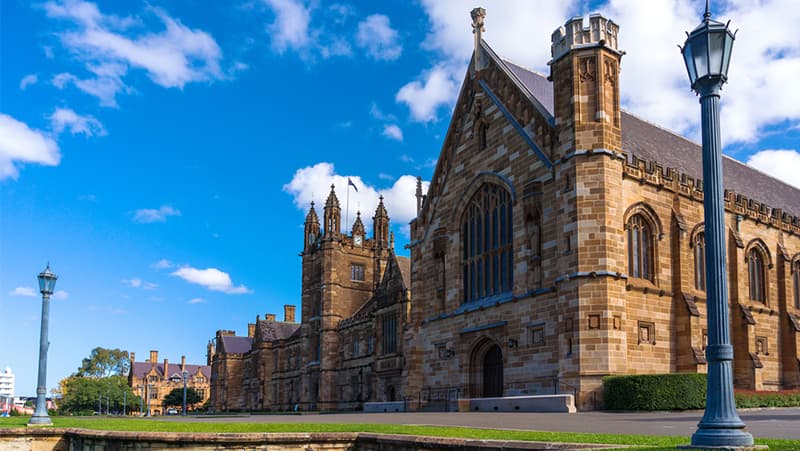
    While searching for student loans, we always recommend checking with your university first, as these loans usually come with better terms. For example, the University of Sydney in Australia offers loans of up to $1000 AUD ($777 USD) that are interest-free and payable within 12 months, as well as $2000 ($1550 USD) loans that can be paid back up to two years after graduation.  

    Private student loans by country 

    Private student loans differ by country. So, let’s take a look at what’s available for international students in these four popular study destinations. 

    Australia 

    It can be expensive to study abroad in Australia. According to the Australian Government, tuition for international students perusing a bachelor’s degree can cost between $25,000 – $45,000 AUD ($19,425-$34,966 USD) a year. Likewise, the cost of living can be about $21,000 AUD ($16,317 USD) for 12 months. Of course, these costs can vary depending on your institution and where you study in the country.  

    But, the good news is that on an Australian student visa, you can work up to 40 hours every two weeks

    As an international student, you won’t be able to access Australia’s Higher Education Loan Program (HELP). But you can explore the following to help further fund your studies:  

    • Short-term and long-term loans from a university. Dozens of universities offer loans to international students, just like the ones from the  we mentioned above. For example,  offers students loans up to $5,000 AUD ($3,883 USD). The even gives out student loans of $200 AUD ($155 USD) in case of emergencies, like if you’ve lost your wallet or are short on cash. 

    • A secured personal loan with a private bank, in which you offer an asset as collateral. 

    • An unsecured personal loan. With these, you don’t have to offer an asset as collateral, but interest rates are generally higher. Banks across Australia offer these types of loans. One example is Westpac.  

    Read more: Australian student loans for international students 

    The U.K.  

    On average, students in the U.K. spend about £795 ($1,100 USD) a month on living expenses, and for international students, tuition for a Master’s Degree can be between £5,000-17,000 ($6,983-$23,743 USD) a year. With Brexit, EU/EAA citizens will now considered international students.  

    So, what loan options do foreign students have? 

    • A foreign-enrolled loan. Students can apply to these to fund their education abroad – but it depends on what countries you come from the U.S. and what university you’ll attend. Students from, for example, can be eligible. 

    • Bank loans for students studying abroad from your home country.

    • Private student loans for foreign learners in the UK. Future Finance, for example, offers 

      flexible loans to international students. 

    Read more: UK student loans for international students  

    The U.S.  

    The U.S. is one of the most expensive places to study as an international student. The cost of living can range between $1,000 – 3,000 USD per month, depending on where in the country you settle. Tuition for a four-year bachelor’s degree can cost roughly $40,000 USD at a public university and can reach past $50,000 USD at a private university.  

    However, there are lots of student loan options available. These loans can be quite a long-term, and students might be able to repay them over the course of up to 25 years.  

    • Banks and online lenders. Loans from these sources often require a U.S. co-signer with good credit history. Organizations like Assent and Discover provide loans to international students. 

    • An online lender that doesn’t require a U.S. co-signer. MPOWER Financing, for example, offers loans for international students without a co-signer.

    Canada 

    Tuition fees at Canadian universities and colleges can vary – international students can expect to pay between $1000-30,000 CAD ($794-$23,830 USD) a year for a bachelor’s degree. Living costs depend on what city you study in but can range between $800-$2000 CAD ($635-$1588 USD)  a month.  

    International students in Canada have a few loan options: 

    • A bank loan from your home country. Like many countries, Canada requires students applying for a visa to show they have enough money to cover their expenses

       – making getting a loan from home a good first option.

    • A student line of credit from a Canadian bank. With these, you have a set limit (just like on a credit card) and only have to pay back the money you actually use. Learn more about the student line of credits on the Government of Canada website.   

    • Private companies. For example, MPOWER Financing also offers loans to international students in Canada without a co-signer.  

    This isn’t an exhaustive list. But we hope this article provides you with a good starting point and helps you understand where to begin looking for student loans to fund your education. Remember, it’s important to shop around for the loan that works best for you – there are lots of options out there. 

    Preparing to study abroad?

    PTE Academic can help you get one step closer. Our computer-based, unbiased language test is accepted by governments and higher education institutions around the world as proof of English proficiency. 

    Find out more about the test or book your PTE Academic test today.

  • Image - student, 800px x 451px
    How to write a personal statement for your UCAS application
    By PTE Author
    Reading time: 6 minutes

    Applying to university and college is an exciting experience. However, it can also be nerve-wracking. After all, the UK’s Universities and Colleges Admissions Service (UCAS) manages three million applications each year.  

    So, how can you make your application stand out? Writing an interesting, enthusiastic and genuine UCAS personal statement is one of the best ways to catch an institution’s attention.  

    But if you’re still not sure what to write about, there’s no need to panic. In this blog, we’ll explore how to write a UCAS personal statement that will open doors – including how to brainstorm ideas and some UCAS personal statement examples.   

    What is a UCAS personal statement for? 

    UCAS personal statement is all about you, and it’s your time to shine.  

    In it, you’ll talk about why you’re interested in what you’re applying for. You’ll also talk about your skills, and how they’ll help you succeed in your studies. It’s a good idea to use concrete examples, and talk about how you have already used these skills in your life.   

    Institutions want to see why you’ll make an excellent student. So, don’t be shy – you’ve got to sell yourself! 

    How to brainstorm ideas 

    We know it can be hard to write about yourself. That’s why we always recommend brainstorming ideas before you begin. This will make your writing process a lot more efficient, and let you communicate your thoughts better. Here are some things that can help:  

    Write a list 

    Make a list of all the topics you may include in your personal statement. Separate the list into three parts: why you’re applying, what you’re interested in, and what skills you want to highlight.  

    Write down everything that comes to mind. With all your thoughts on the page, it will be easier to narrow down the most important ideas.  

    On their blog, UCAS also shares a great tip. “Every course you can apply for is listed in our search tool, together with entry requirements and a description of what it covers. Find the courses you’re interested in and try to match up your strengths and experiences to the course requirements,” they write.   

    Think about what makes you unique

    What makes you special? Perhaps you’ve overcome a big challenge, or have an interesting hobby. Write about whatever comes naturally to you. This will ensure your statement is genuine. It’ll also make your personality shine through. If you’re an international student, don’t forget to talk about why you want to study in the UK.  

    Talk to your teachers or mentors

    If you’re still stuck for ideas, ask your teachers or mentors to help. What do they think makes you a unique student? You never know: they might even point out some transferable skills you didn’t realize you had.  

    Use the tools designed by UCAS

    Don’t forget to check out what resources are on the UCAS website. The UCAS personal statement brainstorming worksheet is a very helpful tool, for example.  

    We also recommend taking a look at the UCAS personal statement builder. This will help you think of topics to write about, and understand how to put your statement together.  

    How to structure your statement 

    There is no right or wrong way to structure your UCAS statement. It all depends on what information you decide to include – and sometimes, even what institution you are applying to.  

    This video by UCAS explores one way to structure your statement. It suggests including: 

    • A catchy introduction that talks about why you’re so excited about the course.

    • A middle paragraph that talks about why you’re so interested in the course – which includes concrete evidence and the skills that’ll help you succeed.

    • And a final paragraph that talks about why you’re so unique.

    Many universities and colleges also have tips on how to structure a UCAS personal statement. So, you should always see what advice the institutions you are applying to have to offer. The University of Sussex, for example, recommends applicants focus 80% on why they want to study the course and just 20% on their skills.  

    And Amy Smith, who works in admissions at Nottingham Trent University, recommends focusing on your skills first. “Put your notes in order according to what the course you’re interested in is looking for. If you have any skills and experience relevant to the entry requirements, make sure you say so at the start of your personal statement,” she said in a popular UCAS blog.  

    As you can see, there is lots of different advice out there. So, just do your research and focus on what works best for you.  

    But don’t forget: you must stick to the word count. So just how long is a UCAS personal statement? It can only be up to 4000 characters or 47 lines – including spaces. 

    Personal statement examples  

    Many institutions provide personal statement examples. These are great for inspiration – especially if you are struggling with how to start or how to end a UCAS personal statement. 

    We especially like the list of examples the University of Essex has put together. They provide examples of personal statements for more than 2 dozen areas of study. None of the statements are perfect – each has their own set of strengths and weaknesses. But with this, students get an excellent idea of what institutions are looking for.  

    You can take a look at their examples here

    Dos and Don’ts  

    We’ve covered a lot of information in this blog. So now, let’s quickly take a look at some dos and don’ts for writing a UCAS personal statement.  

    Don’t

    • Don’t mention any institutions by name. Your application will be sent to all the universities and colleges you are applying to

    • Don’t plagiarize. UCAS uses software to detect this

    • Don’t include jokes or informal hyperboles. This is meant to be a formal document. Still, do make sure you write in plain English 

    Do  

    • Do start your application early and have others read it over. The UCAS has a great timeline to help you plan, which you can check out here  

    • Do be honest and genuine. You’re great – so just put your best foot forward!

    • Do be enthusiastic. Let admissions staff know how excited you are to be applying for the course; they want to offer a place to students with great attitudes

    Ready to apply to study in the UK? 

    At PTE Academic, we want to help you get there. Our secure English language test is accepted by 99% of universities across the UK – and you can check out our minimum score requirements for UK universities here.

  • Image- Australia, 609px
    The benefits of studying in Australia
    By PTE Author
    Reading time: 3 minutes

    Do you dream of studying in Australia? In 2020, more than 878,000 international students enrolled in courses in Australia – with 45% of students coming from China and India alone.

    The country offers a range of benefits for international students, including prestigious universities, multicultural cities, beautiful landscapes to explore, and more.

    Let’s delve into everything that makes Australia a great study abroad destination:

    Quality education

    Did you know that Australia has one of the best education systems in the world? Australian universities and educational institutions have a great reputation, and are looked upon favorably by international students and employers alike. In fact, according to the QS World University Rankings 2025, a number of Australian universities are ranked among the best in the world, including: 

    • The University of Melbourne ranked at 13 

    • The University of Sydney ranked at 18 

    • The University of New South Wales (UNSW Sydney) ranked at 19 

    • And the Australian National University at 30 

    The global university rankings take into account things like quality of education, fees, faculty and employer reputation – all important things to consider when deciding on a place to study.

    Cost of living

    Compared to other study abroad destinations, like the UK or the US, the cost of living in Australia is relatively affordable. The Australian Dollar is the currency in Australia. Keep in mind that $1 AUD is equivalent to about $0.64 USD, so your money is likely to go further here. 

    The cost of living varies depending on the city you live and the lifestyle you pursue. You can use the Course Search Tool to find out detailed tuition fee for your dream course and the Cost of Living Calculator to estimate the living cost.  

    Use of English

    If you’re looking to master English, Australia is a great place to put your language skills to the test. About 73% of the population in Australia only speak English at home.

    Australian slang – which many people consider part of their national identity – can be difficult for international students to grasp. But, learning the slang is all part of studying in Australia, mate.

    A multicultural lifestyle

    Australia is diverse and multicultural, which makes studying here a truly unique experience. Roughly 30% of the population is made up of immigrants; in 2019, people from every single country in the world lived in Australia! You can learn more about immigration trends in the country.

    Beautiful landscapes

    Australia boasts stunning cities, beautiful beaches and arid deserts. Students who study here have the opportunity to places like the Great Barrier Reef, the 12 Apostles, the famous Sydney Opera House – and so much more. What’s not to love?

    Job opportunities before and after graduation

    Most student visas in Australia allow you to work up to 48 hours every two weeks while studying and unlimited hours during study breaks on an Australian student visa. Better yet, the minimum wage is $24.10 per hour or $915.90 per week. This is a huge plus for people studying in Australia. 

    For students that want to work in Australia full time after graduation, the Australian government also offers temporary graduate visas. These allow students to remain in Australia to live and work temporarily – as well as bring their families with them. 

    Don’t forget to read our Australian student visa application guide.

    Feeling excited?

    PTE Academic can help you achieve your Australian study dreams. Our English language tests are fast, flexible, secure, and accepted by all universities in Australia. 

    Learn more about PTE Academic in Australia or book your test today.

    Last updated 20 December 2024.