

8 things to consider before moving abroad

PTE Author
PTE Author
image- new world 1080px
Reading time: 6 minutes

There’s a lot to think about when moving overseas. Will you need health insurance? What identity documents will you need to apply for? And of course, where will you live and work?

We’ve been there, and we get it! That’s why we’ve put together this list of 8 things to consider before moving abroad. Let’s take a look:  

1. Understand visa requirements

If you plan to move abroad for more than six months, you might need a visa to live, work or study. So before making any travel plans, you should visit your destination country’s immigration website to ensure you’re eligible for a visa – and understand all the requirements. Many governments, for example, require applicants to take an approved English language proficiency test like PTE Academic to study or work in the country.

If you’re looking for visa support, you may also decide to hire a registered migration agent. These are immigration professionals and can complete your visa application for you, help prepare documents, and provide advice throughout the application process.

You can more about specific visa requirements on these government websites:

You might be interested in reading our article: Should you hire a migration agent to move to Australia?  

2. Find out if you’re eligible to work 

Just because you’ve been granted a visa to live in a country, doesn’t mean you have the right to work full-time.

Many student visas put a cap on how many hours people can work. For example, in Australia students are allowed to work up to 40 hours every two weeks during the school term. In the UK, students are able to work 20 hours per week during the semester. And in Malaysia, students can also work up to 20 hours a week, but only during school breaks longer than eight days.

If you’re not on a student visa, it is likely you’ll have permission to work full-time. However, many countries require you to apply for a social insurance number – or something similar – before you can.

In Canada, for example, permanent and temporary residents need to apply for a social insurance number after they land in the country, and it can take about 20 days to arrive.

3. Create a budget

Before moving to a new country, you should have some savings. In some cases, depending on your visa type and the country you’re moving to, you might be required to show proof of savings with your visa application.

Day-to-day living costs may also be more expensive abroad, and it could take you longer than anticipated to find a job – so it’s important to have money put away to help you settle in.

If you’re a student planning to move to Canada or the UK, we’ve put together some detailed guides that outline the living costs in each country: 

Many governments offer cost of living calculators online, which can be a great resource for new immigrants. Take a look at New Zealand’s cost of living tool, for example.

When you arrive, you’ll also need to open a bank account. This can often be done online. Some banks even have accounts specifically designed for newcomers and offer credit cards to help build credit history. 

4. Search for housing 

Looking for accommodation can be one of the most exciting parts of moving abroad. Once you find a place to call home, you’re able to really imagine what your new life will be like – you get to explore Google Maps from afar, check out neighborhood restaurants online, and plan where you might socialize with friends.

If you’re moving with a work visa, your new workplace might be able to help you find temporary accommodation. Likewise, if you’re moving abroad to study, your institution should offer housing options for international students – such as on-campus apartments or other homestay partnerships. It’s also a great idea to join local housing Facebook groups, where people post their apartments or houses for temporary or long-term rentals.

You might be interested in: How to choose international student accommodation in the UK.

5. Discover transportation options

Once you know where you’ll live, you can figure out how you’ll get around. Is your apartment close to public transportation? Or have you opted to live outside a city center, and will need to get around by car?

You could be able to drive with an international driver’s license right after landing abroad. But after a few months, lots of countries will require you to apply for a local driver’s license instead. If you’re moving to a country where it snows, it might also be a good idea to invest in driving lessons to learn how to drive safely on icy roads.

6. Apply for healthcare or insurance

You might not be automatically eligible for health coverage in your destination country, even if it offers universal healthcare to citizens.

In Canada, for example, each province administers its own publicly-funded healthcare. That means, if you’re a student, your eligibility for healthcare will depend on where you study. If you’re not eligible, your university should offer you insurance.

On the other hand, if you’re on a work visa or permanent resident visa, you may be able to apply for publicly-funded healthcare. But, there might be a waiting period before you’re able to have access – so it’s important to buy insurance to make sure you’re covered beforehand.

Always check with the local government in your destination country to see what your rights are regarding healthcare. It’s also important to research the mental health services that may be available once you arrive. If you’re a student, your university may offer counseling services on campus.  

7. Keep up to date with travel regulations

Travel regulations change quickly, so it’s essential to keep up to date on what you’ll need to do before – and after – arriving at your destination country.

Always consult the health authorities in the country you’re traveling to ensure you follow public health guidelines – and you’ll be allowed to enter the country. 

8. Don’t forget about the little things 

When moving abroad, we tend to focus on the big things – like housing, work, and healthcare. But there are lots of little things to think about, too! Remember to:

  • Close your utility accounts – like internet and hydro – before leaving home (and do it before the cut-off date, so you don’t get charged extra)

  • Unlock your mobile phone so you’ll be able to use a local SIM card, and get a power plug adapter for your charger if you need one.

  • Bring a few things that remind you of home and that you won’t be able to buy abroad. Something as simple as packing your favorite face wash or snack food can make a big difference when just starting to settle in.

Overall, getting a head-start on your travel preparations will help you to reduce stress and hit the ground running when you arrive.

Related Content

  • Image- Big Ben
    Olivia’s Chevening dream: a decade in the making
    By PTE Author
    Reading time: 5 minutes

    The Chevening scholarship is a route to studying in the UK for people all over the world. It offers the brightest and best the opportunity to study for a Master’s at a British university. Since 1983, Chevening has helped over 50,000 professionals pursue their studies and become leaders within their communities and sectors.  

    Chevening scholar Olivia Rondonuwu grew up in Jakarta, Indonesia. Her background was in journalism and she dreamed of studying social policy in the UK. But her path to becoming an international Master’s student wasn’t a straightforward one.  

    The importance of determination 

    Olivia knew several successful people working in journalism who’d been awarded Chevening scholarships. As a journalist, she’d interviewed high profile people who were alumni of LSE. Her ambition was to become one of the female leaders in the Indonesian media, focusing on Indonesian social policy.  

    “I had been thinking about the scholarship for ten years,” she says. “My dream was to study social policy at the London School of Economics, but of course, I couldn’t afford it.”  

    Competition for the scholarships is fierce, as Olivia discovered the first time she applied to the Chevening scholarship. She got to the interview stage, but she wasn’t successful. Then she applied again - and this time, she didn’t reach the interview stage.  

    However, Olivia wasn’t deterred from pursuing her dream of studying in the UK - and on her third application for the Chevening scholarship, her persistence paid off. “I couldn’t believe it,” she says. “It didn’t seem real until I got on the plane to London. It had been such a long process - I was so happy to finally be going to study in the UK.”  

    Studying at the London School of Economics  

    So how was Olivia’s first day in London? “It was horrible,” she laughs. “The weather was awful, and my bus got stuck in a traffic jam. In Indonesia, if you’re in a traffic jam, you can just get off the bus and jump on a motorbike taxi – but in London, you can’t do that! And at lunchtime, it seemed like the only option was cold sandwiches – British people love bread!” 

    As Olivia started the MSc in Social Policy and Development, doubts started creeping in. Had moving to London to study been the right choice for her after all?  

    Imposter syndrome affects a lot of students who are studying at top universities. At times, they can feel that they don’t belong there. And Olivia felt that, as an older student, she was at a disadvantage, compared to other students who’d gone straight into the Master’s from their undergraduate degree. “I was thirty six,” she explains, “so I was older than a lot of the other students. I felt that I was too old to be there.”  

    Luckily, it didn’t take Olivia long to shake off these doubts. As the course went on, she was able to recognise the value of her experience as a journalist, and gain in confidence and self-belief.  

    “You have to look inside yourself,” she explains, “and find the confidence to say, I’m a future leader.” And of course, she’d been waiting for so long to study at LSE -  meaning that she really appreciated every moment, and was able to make the most of this amazing opportunity.  

    A personal transformation and a new network 

    Once Olivia got over her imposter syndrome, she found herself gaining more and more confidence, thanks in part to the academic culture at LSE and the focus on critical thinking. “It was quite different from Indonesian academic culture,” Olivia explains.  

    “Here, you are encouraged to think more critically about your opinion on a topic.” She found that building her critical thinking skills helped with her self-belief. “Once you have the confidence in yourself, it helps you to dare to be different,” she says.  

    The other thing that Olivia loved about her Chevening experience was meeting other students from all over the world. “I was amazed by how international the group was - there were students from Latin America, from Afghanistan,” she says. “It was very competitive, but very international.”  

    Studying in the melting pot of a London university was a fantastic way to build a global, professional network. 

    Advice for other international students 

    Before Olivia travelled to London, she was given lots of advice by the UK embassy in Jakarta. “They warned us about the weather,” she says. “They even recommended getting a special lamp in case we suffered from seasonal affective disorder!”  

    But when Olivia is asked what her words of advice were for other international students, her answer is perhaps surprising. “Be brave and embrace it, the bad and the good,” she says. “Enjoy every minute. Yeah, some days the weather will be grey, but enjoy it! It’s all part of the experience of studying in the UK. So enjoy every minute - learning, networking, living in London.”  

    Though she will admit – she still doesn’t like sandwiches for lunch!  

    Learn more 

    In order to study at a UK university and apply for a UK student visa, you’ll need to prove your level of English. PTE Academic is a fast, reliable, computer-based test that is accepted by 99% of UK universities and the UK Home Office as proof of your English language skills. You’ll typically receive your scores in just two days - so you won’t have a long wait for your results, and can get on with the application process!  

    Learn more about how PTE Academic can help you study in the UK.
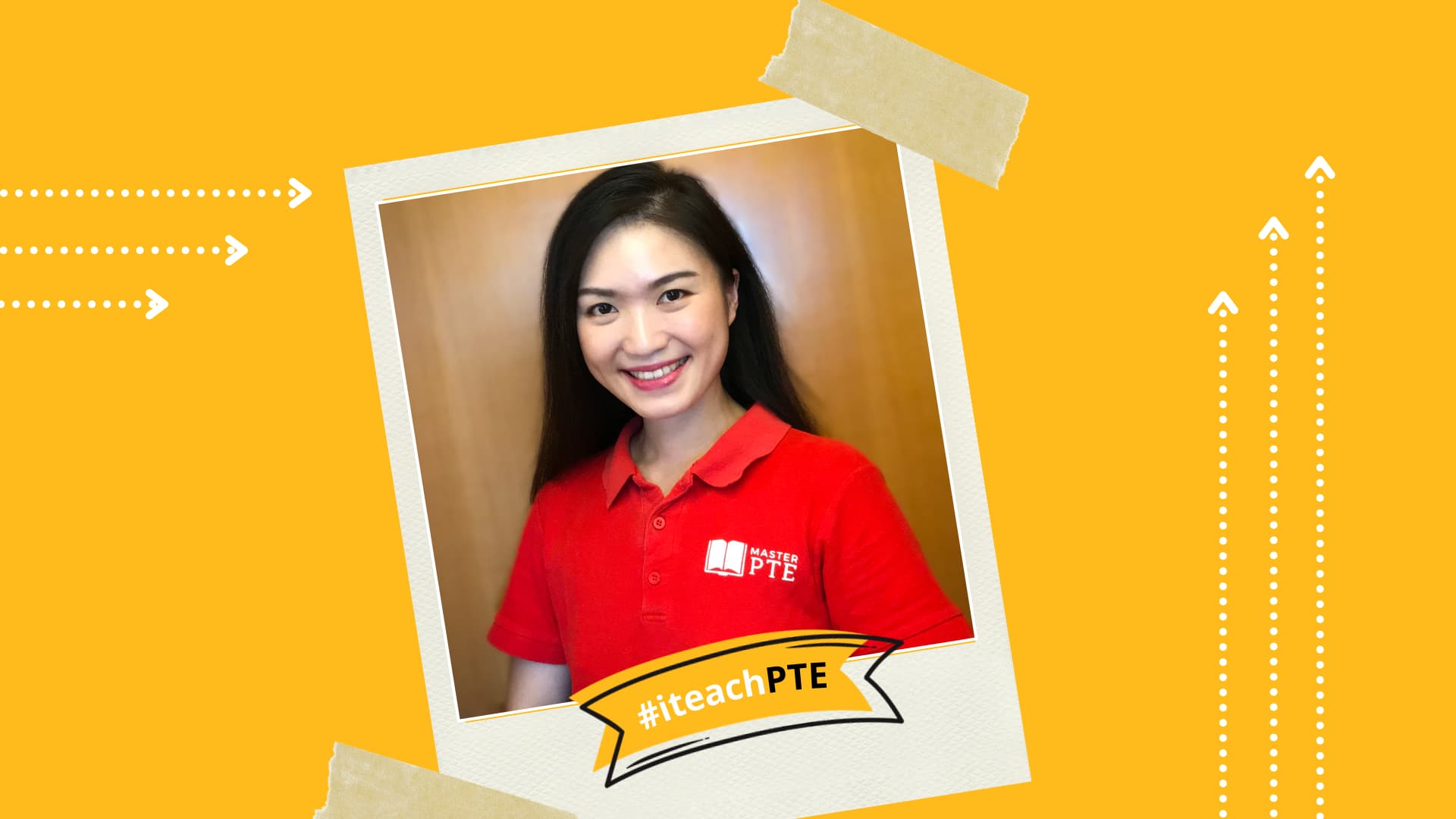
  • Image - Kelly Hoo #iteachPTE
    Teacher profile: Sharing the learning journey with PTE teacher Kelly Hoo
    By PTE Author
    Reading time: 6 minutes

    Kelly Hoo is an English teacher based in Malaysia. She works with people from all over the world, helping them to prepare for PTE. But when Kelly first began learning English, she found it really difficult. She certainly never dreamed that one day she would be teaching English and running her own company!  

    From student to teacher  

    So how did Kelly go from learning English, to teaching other people how to get the score they need in PTE?  

    Kelly’s first language was Mandarin, and she struggled a lot when first learning English. “I started my journey with IELTS,” she explains, “and then I discovered PTE.”  

    Kelly was learning English in order to attend the University of Melbourne, where she studied for a Bachelor of Commerce. “I always thought I’d be an accountant,” she laughs. “But it wasn’t meant to be!”  

    After graduating, Kelly went to work for Unilever, a big multinational corporation. But she found herself giving advice to people learning English, and being able to help people on their language-learning journey was really rewarding.  

    “It started with sharing tips with other people who were learning English,” she says. “I’d been through the journey, so when I saw people struggling, I would always give them recommendations and advice.”  

    Starting her own company 

    From those small beginnings, Kelly went on to become a full-time teacher. The next step was starting her own English teaching company, Master PTE, where she is able to combine her passion for teaching with the expertise she gained in her business degree.   

    But Kelly credits her success to the people around her. “It’s not just my own hard work,” she says. “Our team at Master PTE is amazing. My colleagues work so hard and do such a good job. Without them, I wouldn't be here, sharing my experience.”  

    The company is now four years old, and in that time Kelly and her colleagues have helped lots of students build their English skills, prepare to sit PTE, and get the score they need.  

    Helping students set manageable goals  

    The team at Master PTE teaches students of all ages and levels, from all over the world, in a mix of online and in-person classes.  

    “Thanks to Covid, we’re now doing hybrid classes,” explains Kelly, “a mix of online and face to face. Our clients are mainly working adults or students, so they’re very busy, and they need that flexibility.”  

    At Master PTE, Kelly and her colleagues help students to break the big goal of getting the PTE score they need into smaller, more manageable goals.  

    “We don’t ask them to do ten exam tasks in a day, because it’s impossible,” says Kelly. “We focus on what’s doable - a little bit of preparation each day, to make it easier for our students and give them a feeling of achievement, and the satisfaction that comes from that.”  

    The skill that Kelly’s students struggle with the most is speaking. It’s a cultural problem, Kelly says, as in Malaysia, people are worried about making mistakes. “We want to boost their confidence and tell them to express themselves. I always tell students, Don’t be afraid to make a mistake. Just say what’s on your mind - it’s ok, we don’t judge people at Master PTE!”  

    Speaking to a computer can also be a challenge for some students, but for others, a computer-based exam like PTE helps with their confidence. They prefer to speak to a computer rather than a human examiner.  

    Kelly’s students are her inspiration  

    One of the things Kelly loves about her job is meeting people from all over the world. “We have students from Japan, from Botswana, from India. It's amazing to connect with people and learn about their culture, their stories. The learning is definitely a two-way street in our classes!” she laughs.  

    One of Kelly’s most inspirational students was from India. He was planning to sit PTE in order to move to Australia with his wife and young children. “When I first spoke to him, his English was at a really low level,” she explains. “I thought he would need a lot of preparation.”  

    He started studying with Kelly, preparing for the test, and working hard every evening. “He was really burning the midnight oil,” she says, “as he was working full time too. He put in so much hard work, but he was doing it for his family, for his kids’ future, to give them a better life. I really admired his spirit - and I was so happy in the end when he got the score he needed after just two months of studying!”  

    The importance of perspective 

    Kelly has one piece of advice for other PTE teachers: always try to think from the students perspective.  

    “Teaching English is easy for us,” she says. “We use English everyday. That’s why it’s so important to put yourself in your student’s shoes. Make sure they can absorb and retain the information you are teaching them.”  

    From time to time, Kelly studies a new language like German, or Japanese, just to remind herself what it’s like to learn a new language.  

    “I understand where the students are coming from,” she says. “I’ve been a learner too, and learning English as a second language isn’t easy.”  

    That’s why Kelly is so focused on understanding each student’s situation, and making things a little easier for them by supporting them and creating a community that they are part of.  

    “I always tell them, Don’t give up!” she says. “Learning can be fun and interesting.”  

    Learn more 

    For more insights into PTE preparation, have a look at the PTE blog, where you’ll find inspiration, advice, and lots of useful resources such as free lesson plans and preparation tools. And if you’d like to be featured on our PTE teacher profile series, just fill out this form!

  • Image study buddy 1080px
    Everything you need to know about the new PTE Score Report and Skills Profile
    By PTE Author
    Reading time: 4 minutes

    When it comes to PTE Academic test preparation, it’s important that teachers know everything about the test-taking process so you can guide your learners each step of the way. From the type of questions and exam timings, to how the test is scored, both you and your students need to stay up to date with changes. That way, you can make sure there are no surprises on exam day and test takers can understand and even learn from their PTE results.  

    After sitting PTE, each test taker receives a Score Report, typically within 48 hours. In November, the format of the Score Report changed to make the scoring clearer for everyone.  

    Let's take a look at what students can now expect after sitting PTE Academic.  

    How has the PTE Score Report changed?  

    When a test taker completes their PTE Academic test, they receive a Score Report and now, a new Skills Profile, which are both available on myPTE. The report and profile tell students their test score and language skill level and show them where they can make improvements.  

    Here are some changes that have been made: 

    1. No more enabling skills  

    The PTE Academic Score Report offers test takers an overview of how well they performed during their test. It consists of an overall score of between 10 and 90, which grades their English ability against the Global Scale of English (GSE). They will also see individual scores for the four communicative skills: speaking, listening, reading and writing. These scores are based on their responses to all the exam tasks.  

    Test takers can share their score report with an unlimited number of institutions by providing their Score Report Code or assigning results directly via MyPTE. 

    Before November 2021, the Score Report also showed an Enabling Skills section. This has been replaced by a new personalized Skills Profile which uses the candidates’ test performance to provide specific feedback. The aim of this is to help guide test takers’ future English language learning. It can also be useful for teachers, especially if test takers don’t reach their required score the first time around and are looking to retake the test.